
Skilled Immigration
State Territory
Employer Based Immigration
Some countries offer permanent residency anyone who has a parent,brother,sister,uncle,aunt or first cousin overseas
Investment Migration



hungary job market
hungary job opportunities
jobs in hungary
hungary job vacancy
hungary jobs for indian
hungary job vacancy for indian
Explore Hungary’s job market with 75,000+ vacancies, top hiring sectors, salaries, and opportunities for skilled professionals and foreign workers.
Hungary Job Market in 2026-30
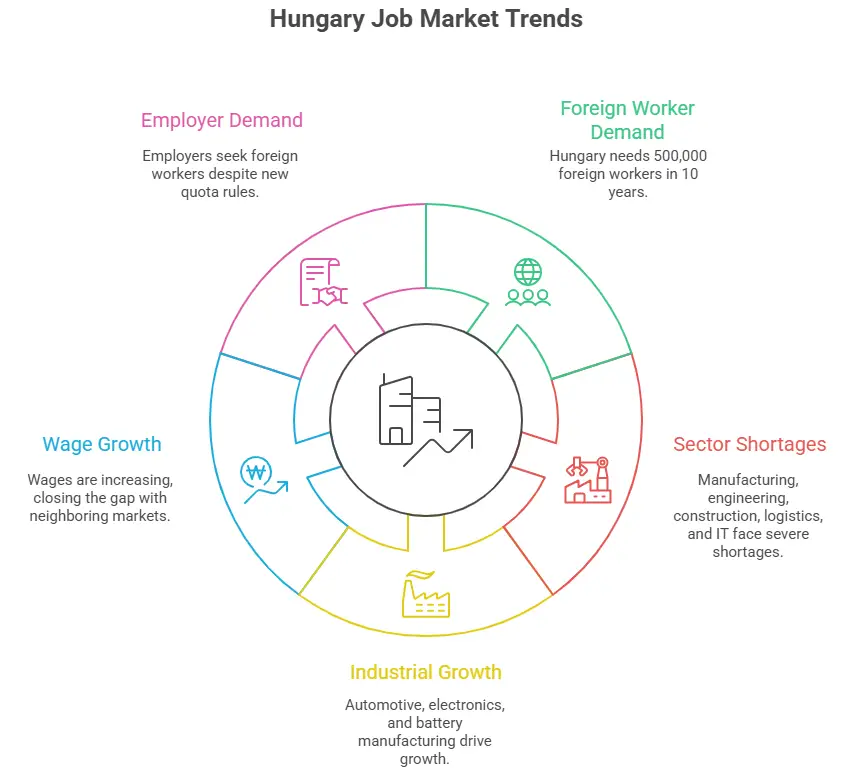
- Requires 500,000 foreign workers in the next 10 years
- Severe shortages in manufacturing, engineering, construction, logistics & select IT roles
- High industrial growth driven by automotive, electronics & battery manufacturing investments
- Steady wage growth narrowing the gap with neighbouring Central/Eastern European markets
- Employer demand for foreign workers continues despite new quota rules for non-EU nationals
Job Outlook in Hungary
Understanding Hungary’s job outlook is essential for international professionals exploring career opportunities in Central Europe. Hungary is witnessing steady economic growth, strong industrial expansion, and a continuous demand for skilled workers across multiple sectors. The country recorded around 78,000 job vacancies among medium and large employers, with persistent labour shortages impacting high-demand industries.
Several regions and cities, including Budapest, Győr, Debrecen, Szeged, and Miskolc, offer growing employment opportunities, especially in sectors such as manufacturing, engineering, logistics, IT, and electronics.
Hungary continues to attract international talent as major investments flow into automotive, battery manufacturing, and electronics, sectors that drive the country's economic development. With rising wages, improving work conditions, and an increasing need for skilled labour, Hungary is becoming an appealing destination for professionals seeking stable, long-term employment.
Relocating to Hungary offers several advantages: career growth, a lower cost of living than many EU countries, high safety standards, and a growing international workforce, making it a promising destination for individuals aiming to build a successful career abroad.
General Employment Trends for the Year
Employment opportunities in Hungary continue to reflect the country’s growing need for skilled professionals across key sectors. Staying updated on the specific skills in demand is essential, as employers increasingly seek workers in manufacturing, engineering, logistics, construction, and select IT fields. Hungary’s overall economic performance, driven by strong industrial expansion and foreign investment, directly shapes these employment trends.
Demographic changes, including an aging workforce and a shrinking working-age population, are influencing labour shortages across the country. As a result, industries such as automotive production, electronics, battery manufacturing, and healthcare are experiencing increased hiring needs. Government initiatives and large-scale industrial projects are also boosting demand for skilled workers, further strengthening Hungary’s job market outlook.
Factors Influencing Job Creation or Reduction in Hungary
- Overall economic performance drives hiring, especially in fast-growing industrial and export-focused sectors.
- Foreign investment in automotive, battery manufacturing, electronics, and logistics boosts large-scale job creation.
- Shortage of skilled labour increases demand for international professionals in key technical and engineering roles.
- Advancements in automation and digital technologies reshape job requirements and reduce certain manual positions.
- Government policies and work permit regulations influence recruitment, especially for non-EU workers under quota systems.
- Demographic challenges, including an aging population and a shrinking workforce, create ongoing labour shortages.
- EU and global market trends affect export-driven industries, impacting hiring levels in manufacturing and supply chains.
- Geopolitical developments and international trade conditions can create fluctuations in job availability.
*Want to work in Hungary? Get in touch with experts at Y-Axis to guide you with the process.
In-Demand Industries and Occupations in Hungary
The most in-demand occupations in Hungary along with their average annual salaries are given below:
|
Occupations |
Average Salaries per year (EUR) |
|
Engineering |
€ 65,000 |
|
IT & Software |
€ 70,000 |
|
Healthcare |
€ 68,000 |
|
Marketing & Sales |
€ 58,000 |
|
Banking & Finance |
€ 58,000 |
|
Nursing |
€ 50,000 |
|
Education |
€ 50,000 |
|
Hospitality |
€ 48,000 |
|
Skilled Trades |
€ 49,000 |
Read more…
Highest Paying Jobs in Hungary for Indians
Workforce Demands in Different Regions of Hungary
Details of the workforce demands and employment opportunities across major regions of Hungary are given below:
Examination of Job Market Differences across Hungarian Regions
Hungary continues to attract international professionals due to its growing economy, strong industrial base, and consistent need for skilled workers. The country offers diverse job opportunities across manufacturing, automotive, logistics, electronics, engineering, IT, construction, and shared services (BPO/SSC).
Regions such as Central Hungary (Budapest), Western Transdanubia, Central Transdanubia, Northern Hungary, and the Southern Great Plain provide strong employment prospects across various high-demand industries.
Areas with Notable Job Opportunities in Hungary
Hungary has a growing demand for skilled workers across multiple regions, especially in industrial and technology-focused areas.
Below is an overview of job opportunities across major Hungarian regions:
|
Region |
Approx. Job Vacancies |
Average Annual Salary (HUF) |
|
Central Hungary (Budapest) |
~32,000 vacancies |
HUF 6,500,000 – 7,800,000 |
|
Western Transdanubia (Győr, Sopron) |
~14,000 vacancies |
HUF 5,800,000 – 7,200,000 |
|
Central Transdanubia (Székesfehérvár, Veszprém) |
~10,500 vacancies |
HUF 5,500,000 – 6,800,000 |
|
Southern Great Plain (Szeged, Kecskemét) |
~8,500 vacancies |
HUF 5,000,000 – 6,500,000 |
|
Northern Hungary (Miskolc, Eger) |
~7,800 vacancies |
HUF 4,800,000 – 6,200,000 |
|
Northern Great Plain (Debrecen, Nyíregyháza) |
~9,400 vacancies |
HUF 4,900,000 – 6,400,000 |
|
Southern Transdanubia (Pécs, Kaposvár) |
~6,200 vacancies |
HUF 4,700,000 – 6,000,000 |
Also, read...
What are the most in-demand jobs in Hungary for the next 10 years?
Impact of Technology and Automation in Hungary
Hungary’s job market has been steadily evolving with advancements in technology, automation, and digital transformation. These developments are reshaping industries, increasing efficiency, and creating new demands for skilled professionals across the country.
Technological advancements and automation shaping the job market
Hungary has experienced significant changes in recent years as automation, robotics, and digital solutions become more embedded in manufacturing, automotive production, electronics, logistics, and business services. The rise of Industry 4.0 technologies — including AI-driven systems, automated production lines, and advanced data analytics — has transformed the professional landscape.
This shift highlights the growing importance of continuous skill development and technical expertise. As digital processes expand, employers increasingly look for professionals with skills in IT, engineering, automation, software development, cybersecurity, and data management. Hungary’s modernization efforts and increasing foreign investments further contribute to a rising demand for highly skilled talent.
Potential opportunities and challenges for workers in the evolving landscape
Hungary’s evolving economy presents both opportunities and challenges for the workforce. The country’s expanding automotive and electronics sectors — supported by major international manufacturers — have created strong demand for tech-oriented professionals. Opportunities are especially strong in fields such as engineering, robotics, IT, logistics, shared services (SSC), manufacturing technology, and R&D.
However, workers must continually upskill to stay competitive, as automation reduces the need for certain manual and routine jobs. The shift towards digital systems also requires employees to adapt to new tools, technologies, and workflows. With increasing demand in STEM fields, business services, healthcare, finance, and technical roles, professionals who invest in reskilling can benefit from wider career options and long-term stability in Hungary’s job market.
Skills In-Demand in Hungary
Hungarian employers actively seek professionals with specific skills that support the country’s fast-growing industrial, technological, and service sectors. The skills most valued in Hungary’s job market include:
Key Skills Sought by Employers in Hungary
- STEM (Science, Technology, Engineering & Mathematics)
- Technical and engineering skills
- Automation and robotics skills
- IT & software development
- Data analysis and digital analytics
- Project management
- Communication and interpersonal skills
- Problem-solving and critical thinking
- Creativity and innovation
- Manufacturing and production skills
- Logistics and supply chain management
- Sales and business development
- Marketing and digital marketing
- Financial analysis and accounting
- Customer service and support skills
- Digital literacy
- Adaptability and flexibility
- Collaboration and teamwork
- Leadership and supervisory skills
- Multilingual proficiency (Hungarian + English/German preferred)
- Time management
- Emotional intelligence
*Looking to apply for jobs in Hungary? Avail Y-Axis Resume Marketing services to find the right one.
Importance of Upskilling or Reskilling for Job Seekers in Hungary
Upskilling and reskilling are essential for professionals who want to remain competitive and adaptable in Hungary’s fast-evolving job market. As industries embrace automation, digital solutions, and advanced manufacturing technologies, continuous learning has become crucial for career growth and long-term employability.
Reskilling enables employees to update their competencies and stay effective as job requirements shift, especially in sectors such as automotive, electronics, logistics, engineering, and IT. Upskilling goes a step further by equipping workers with new capabilities that help them meet emerging industry demands and contribute more meaningfully to organizational goals.
By investing in ongoing learning, professionals enhance their current performance while preparing for future opportunities in Hungary’s expanding economy. This strategic approach strengthens individual career resilience and fosters a culture of innovation and adaptability within organizations, ultimately helping both employees and employers succeed in a dynamic labour market.
Remote Work and Flexible Arrangements
Remote work in Hungary has grown significantly in recent years, with many companies offering hybrid and flexible work arrangements. This shift supports better work-life balance, increased productivity, and wider opportunities for international professionals.
Hungary White Card (Remote Worker Residence Permit)
Key Features:
- Designed only for non-EU/EEA citizens
- Allows residence in Hungary for 1 year, extendable for another 1 year
- Applicant must work remotely for a foreign company or operate a foreign-registered business
- Must show stable income and valid health insurance
- Not permitted to work for Hungarian employers
- Provides legal residence and access to EU mobility for travel
- This is the only official pathway for digital professionals to reside in Hungary while working remotely.
Exploration of the Continuing Trend of Remote Work
Remote and hybrid work models are becoming increasingly common in Hungary, especially in sectors such as:
- IT & software development
- Finance and accounting
- Business process outsourcing (BPO/SSC)
- Digital marketing and creative services
- Consulting and project management
Hungarian employers recognize that flexible work arrangements enhance productivity, reduce workplace stress, and improve employee retention. As digitalization accelerates nationwide, more job roles can be performed remotely, supporting the long-term trend toward flexible work.
Implications for Both Employers and Employees
For Employers
- Wider access to global talent
- Better employee satisfaction and retention
- Increased productivity due to flexible work setups
- Reduced office space and operational costs
- Enhanced innovation in digitally driven sectors
For Employees
- Greater flexibility and work-life balance
- Reduced commute time and expense
- Increased autonomy and productivity
- Access to remote-friendly roles across Europe
- Opportunities to work for international companies while living in Hungary
- Improved overall well-being and job satisfaction
Government Policies and Initiatives
The Government of Hungary continues to introduce labour and immigration policies aimed at addressing skill shortages and supporting the country’s growing industrial and economic needs.
Overview of government programs or policies influencing employment
Hungary is actively working to manage its labour shortages, especially in manufacturing, automotive, electronics, construction, logistics, and IT sectors. As the local workforce decreases due to demographic changes, the government has implemented policies to allow companies to hire skilled foreign nationals where labour gaps exist.
To support economic growth, Hungary has introduced:
- The White Card (Remote Worker Residence Permit) for non-EU remote professionals
- Simplified Work Permit pathways for certain shortage occupations
- Employer-driven residency procedures for hiring foreign workers
- Investment incentives that create new factory, logistics, and technology jobs
- Workforce mobility programs in partnership with EU funding
- Sector-specific development plans, especially in battery manufacturing, automotive, and electronics
- These initiatives aim to strengthen Hungary’s competitiveness and ensure companies have access to the talent needed to fill critical positions.
Recent Migration and Workforce Trends in Hungary
Hungary continues to rely on a mix of local and foreign labour to support its industrial expansion. The country is currently experiencing:
- A growing need for third-country nationals (non-EU workers) due to chronic labour shortages
- Tens of thousands of foreign workers hired annually, particularly in manufacturing and services
- New immigration regulations that set clearer categories for workers such as:
- Guest Worker Permit
- Hungarian Card
- Intra-Corporate Transfer (ICT)
These programs are designed to balance Hungary’s labour market needs with controlled, regulated migration.
Hungary’s long-term workforce strategy focuses on filling skill shortages, supporting high-value industries, and ensuring economic growth through structured immigration pathways.
Challenges and Opportunities for Job Seekers in Hungary
Certain challenges are often faced by job seekers when searching for employment in Hungary. Below are the key challenges and practical strategies to help job seekers navigate Hungary’s job market successfully.
Challenges Faced by Job Seekers
- Job seekers in Hungary may experience several obstacles, including:
- High competition in sectors with limited openings
- Skill gaps, especially in advanced technical and digital fields
- Language barriers, as many employers prefer Hungarian or German language skills
- Limited local work experience for fresh graduates and international candidates
- Lack of professional networks, making it harder to access hidden job markets
- Adjusting to workplace culture and regulations, especially for foreigners
- Regional differences in job availability, with Budapest offering more opportunities than rural areas
Tips and Strategies for Navigating the Job Market Successfully
- Stay updated and enhance your skills through relevant courses, certifications, and workshops
- Build strong professional networks via LinkedIn, job fairs, events, and industry meetups
- Tailor your CV and cover letter to each job, emphasizing skills that match Hungarian employer needs
- Use online job portals, company websites, recruitment agencies, and SSC/BPO platforms to find openings
- Gain experience through internships, traineeships, or part-time roles, especially for new graduates
- Attend webinars, training programs, and industry conferences to enhance your technical knowledge
- Utilize career guidance services from universities, community centers, expat groups, or government employment programs
- Connect with industry professionals for informational interviews and insights
- Optimize your LinkedIn and professional profiles to highlight key skills, achievements, and certifications
- Learn or improve Hungarian or German language skills to expand job prospects and employer acceptance
Summary of Hungary Job Outlook
Hungary’s job outlook is generally positive, with strong growth across essential industries. Key sectors experiencing high demand include automotive manufacturing, electronics, engineering, logistics, construction, IT, business services (SSC/BPO), and healthcare. The country’s expanding industrial base and rising foreign investment continue to create opportunities for both local and international professionals.
The increasing adoption of automation and digital technologies is driving demand for skilled workers in technical, engineering, and STEM roles. With labour shortages across several industries and favourable employer-driven hiring patterns, Hungary is emerging as a promising destination for job seekers looking to build long-term career opportunities in Central Europe.
*Want to apply for jobs abroad? Talk to Y-Axis for expert guidance.