
Skilled Immigration
State Territory
Employer Based Immigration
Some countries offer permanent residency anyone who has a parent,brother,sister,uncle,aunt or first cousin overseas
Investment Migration



Jobs in the Philippines for foreigners
Philippines job market
In-demand jobs in the Philippines
Philippines work opportunities
Skills in demand in the Philippines
Explore the Philippines’ job market with 120,000+ vacancies, top hiring sectors, salaries, and opportunities for skilled professionals.
Philippines Job Market in 2026-30
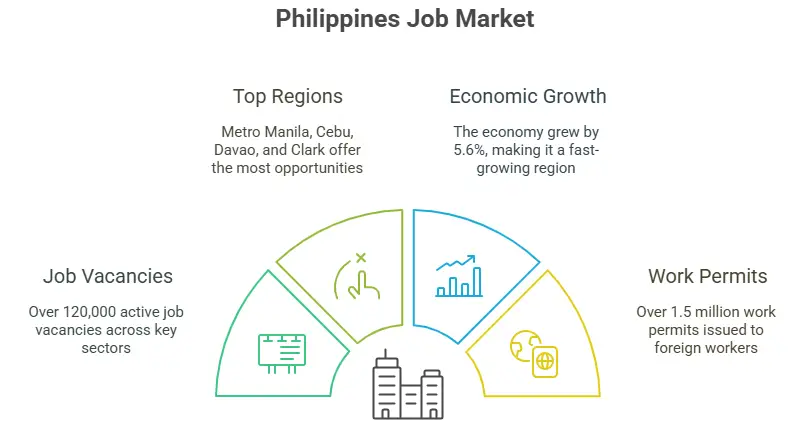
- The Philippines currently reports over 120,000 active job vacancies across key sectors including BPO, IT, healthcare, construction, manufacturing, and logistics.
- Metro Manila, Cebu, Davao, and Clark are the top regions offering the highest number of employment opportunities.
- The Philippine economy grew by 5.6%, making it one of the fastest-growing in Southeast Asia.
- The country has issued over 1.5 million+ work permits and employment authorizations to foreign workers over the past decade across major industries.
Job Outlook in the Philippines
Understanding the current job outlook is important for both employers and job seekers in the Philippines. The country continues to experience strong economic activity and growing opportunities across multiple industries. There are over 120,000 active job vacancies across sectors such as IT-BPM, healthcare, construction, logistics, manufacturing, and tourism. Major regions like Metro Manila, Cebu, Davao, Iloilo, and Clark offer abundant career opportunities for skilled professionals.
In recent years, the Philippines has welcomed a rising number of foreign workers in industries including education, engineering, IT, and healthcare. With its emphasis on work-life balance, affordable cost of living, and expanding economic zones, the Philippines has become a promising destination for individuals seeking stable employment and long-term career growth.
Choosing to work in the Philippines provides job seekers with diverse opportunities, a growing digital economy, and access to one of Southeast Asia’s fastest-growing labour markets. The country’s warm culture, English-speaking workforce, and developing infrastructure make it an attractive option for professionals considering relocation.
General employment trends for the year
Employment opportunities in the Philippines align closely with the growing demand for specialized and technical skills. Staying updated on the skills valued by employers is essential, especially as industries undergo rapid digital transformation. The country’s overall economic performance, driven by strong growth in IT-BPM, construction, logistics, manufacturing, and healthcare, continues to shape employment patterns.
The Philippines’ young and expanding workforce remains one of its competitive strengths. However, demographic shifts such as overseas migration and evolving skill requirements are influencing job availability across sectors. Government initiatives that support digitalization, infrastructure development, and workforce upskilling are contributing to increased employment in priority industries.
*Looking to work in the Philippines? Get in touch with experts at Y-Axis to guide you with the process.
Factors influencing job creation or reduction
Several key factors influence job creation and reduction across the Philippine job market:
- The country’s economic growth and investment inflow, especially from IT-BPM, manufacturing, and renewable energy.
- Availability of skilled labor, particularly in technology, engineering, healthcare, and business operations.
- Rise of emerging industries, such as fintech, digital services, e-commerce, and green technology.
- Rapid advancements in automation, AI, and digitalization, reshaping certain roles.
- Government policies and incentives that support industry expansion, MSMEs, and infrastructure projects.
- Population trends, including a young workforce, migration patterns, and changing skill needs.
- Global market dynamics and trade conditions, impacting export-driven sectors like semiconductors and manufacturing.
- Geopolitical and economic trends that influence outsourcing, supply chains, and foreign employment opportunities.
- Employers in the Philippines continue to seek skilled professionals across multiple sectors, creating abundant job opportunities for those with the right qualifications and in-demand skills.
In-Demand Industries and Occupations in the Philippines
The Philippines offers strong employment opportunities across fast-growing sectors driven by digital transformation, infrastructure development, foreign investment, and the expansion of the IT-BPM industry.
The table below are some of the most in-demand occupations in the Philippines along with the average annual salaries typically offered for each:
|
Occupation |
Average Annual Salary (PHP) |
|
Engineering |
₱800,000 |
|
IT & Software |
₱1,000,000 |
|
Healthcare |
₱800,000 |
|
Marketing & Sales |
₱700,000 |
|
Banking & Finance |
₱950,000 |
|
Nursing |
₱650,000 |
|
Education |
₱600,000 |
|
Hospitality |
₱575,000 |
|
Skilled Trades |
₱575,000 |
Read more…
Highest Paying Jobs in the Philippines for Indians
Workforce Demands in Different Regions of the Philippines
Details of the workforce demands and opportunities across major regions in the Philippines are given below:
Examination of Job Market Differences across Philippine Regions
Most skilled professionals are increasingly exploring opportunities in the Philippines as the nation continues to offer a growing number of job openings across diverse industries. With strong economic performance and an expanding digital and service-driven economy, the Philippines provides multiple high-paying and stable career opportunities for skilled professionals.
Regions such as Metro Manila (NCR), Central Visayas (Cebu), Davao Region, Central Luzon (Clark), and Western Visayas (Iloilo & Bacolod) offer some of the most attractive employment prospects. These areas are home to thriving sectors including IT-BPM, healthcare, construction, logistics, education, finance, hospitality, and manufacturing, creating abundant job opportunities for both local and foreign workers.
The Philippines' continued focus on digital transformation, infrastructure development, and foreign investment ensures that job seekers can find roles that match their skills, experience, and long-term career goals.
Areas with Notable Job Opportunities in the Philippines
There are over 120,000+ active job opportunities across various regions in the Philippines. The table below highlights key regions, estimated job vacancies, and average annual salaries:
|
Region |
Estimated Job Vacancies |
Average Annual Salary (PHP) |
|
Metro Manila (NCR) |
45,000+ |
₱950,000 |
|
Central Visayas (Cebu) |
18,000+ |
₱600,000 |
|
Davao Region |
10,000+ |
₱520,000 |
|
Central Luzon (Clark/Pampanga) |
12,000+ |
₱650,000 |
|
Western Visayas (Iloilo/Bacolod) |
8,000+ |
₱500,000 |
|
CALABARZON (Cavite/Laguna/Batangas) |
15,000+ |
₱700,000 |
|
Northern Mindanao |
6,000+ |
₱480,000 |
|
Bicol Region |
4,000+ |
₱420,000 |
|
SOCCSKSARGEN |
3,500+ |
₱430,000 |
*Want to apply for jobs abroad? Avail Y-Axis Resume Marketing services to find the right one.
Impact of Technology and Automation in the Philippines
The Philippines is experiencing rapid technological advancement and increased automation across multiple industries. These changes are transforming the job market and creating new opportunities for skilled professionals, particularly in digital and tech-driven roles.
Technological Advancements and Automation Shaping the Job Market
The Philippine job market has undergone significant transformation due to the acceleration of digitalization, automation, and artificial intelligence. Industries such as IT-BPM, fintech, e-commerce, manufacturing, logistics, and telecommunications are adopting new technologies to improve efficiency and productivity.
This shift highlights the increasing need for continuous skill development. Employers across the country now seek professionals who possess digital skills, technical expertise, and the ability to work with new tools and automated systems. As automation expands, demand grows for skilled workers in software development, data analytics, cybersecurity, cloud computing, technical support, robotics, and digital operations.
The rise of digital platforms and the Philippines’ strong IT-BPM sector continue to open opportunities for tech-ready talent.
Potential Opportunities and Challenges for Workers in the Evolving Landscape
Technology-driven growth presents both opportunities and challenges for Filipino and foreign professionals:
Opportunities
- High demand for skilled workers in IT, AI, data science, cybersecurity, Fintech, engineering, and digital marketing
- Expansion of the IT-BPM sector, offering jobs in tech support, analytics, HR, customer service, and project management
- New roles emerging in automation engineering, robotics, cloud services, and e-commerce logistics
- Better career growth and higher salaries for tech-enabled professionals
Challenges
- Workers without digital or technical skills may face difficulty adapting
- Automation may reduce demand for certain manual or repetitive roles
- Upskilling is crucial to stay competitive and meet changing job requirements
- Professionals in the Philippines must continuously upskill and reskill through training, certifications, and digital education to remain relevant in a rapidly evolving job market.
Also, read...
What are the most in-demand jobs in the Philippines for the next 10 years?
Skills in-demand in the Philippines
Philippine employers look for candidates who possess a combination of technical expertise, digital capabilities, and strong workplace competencies. As industries evolve through digital transformation and economic growth, the following skills are highly valued in today’s Philippine job market.
Key Skills Sought by Employers in the Philippines
- STEM (Science, Technology, Engineering & Mathematics)
- Technical and engineering skills
- IT and software development skills
- Communication and interpersonal skills
- Problem-solving and critical thinking
- Creativity and innovation
- Project management
- Marketing and digital marketing skills
- Sales and business development
- Financial analysis and accounting skills
- Customer service and support skills
- Digital literacy and computer proficiency
- Adaptability and flexibility
- Collaboration and teamwork
- Leadership and managerial skills
- Multilingual proficiency (English, Filipino, plus Spanish/Japanese/Korean/Mandarin preferred)
- Time management
- Creativity and innovation
- Emotional intelligence
Importance of Upskilling or Reskilling for Job Seekers in the Philippines
Upskilling and reskilling are essential for job seekers in the Philippines, especially as industries rapidly adopt digital technologies and automation. Continuous learning helps professionals stay relevant, flexible, and competitive in an evolving job market.
Through reskilling, employees can update their abilities and maintain effectiveness as roles shift due to new tools, digital systems, and industry requirements. Upskilling, on the other hand, equips individuals with advanced competencies that not only meet current demands but also prepare them for higher-level responsibilities and emerging opportunities.
Investing in skill development enables workers to contribute more to their organizations while strengthening long-term career resilience. This approach promotes a culture of continuous learning and innovation within Philippine businesses, helping both employees and employers adapt to market changes. Ultimately, upskilling and reskilling enhance professional growth, improve job security, and open doors to better-paying roles in high-demand sectors across the country.
Remote Work and Flexible Arrangements in the Philippines
Remote work is becoming increasingly common in the Philippines, with many companies adopting flexible and hybrid setups to support better work-life balance and improved productivity. The country’s growing digital economy, strong IT-BPM sector, and rapid adoption of online tools make remote work a viable and attractive option for many professionals.
The Philippines Digital Nomad Visa
The Philippine government approved the Digital Nomad Visa framework under Executive Order No. 86 (April 2025). The implementation is still underway, and official application guidelines will be released by the Bureau of Immigration (BI) once the program is fully launched.
Until then, foreign remote workers may stay in the Philippines using the visa options listed below.
Visa Options for Remote Workers in the Philippines (Until DNV Launches Fully):
- Tourist Visa (Short-Term Stay)
Allows foreigners to stay temporarily as long as they work for an employer outside the Philippines and do not engage in local employment.
- Temporary Visitor Visa (9A) – Extendable
- A commonly used option for long-term remote workers.
- Extensions of 1–6 months are available depending on approval.
- Special Resident Retiree’s Visa (SRRV)
- Provides long-term residency for eligible applicants (typically 35+ under certain categories).
- Often used by remote professionals who qualify and meet the criteria.
- 13A Marriage Visa
- For foreigners married to Filipino citizens.
- Allows long-term residence and remote work for overseas employers.
Exploration of the Continuing Trend of Remote Work in the Philippines
In the Philippines, companies are increasingly adopting hybrid and remote work models, allowing employees to split their time between home and the office. This shift enables workers to prioritize flexibility, reduce commuting stress, and achieve a healthier work-life balance. Organizations across IT-BPM, digital services, education, and creative industries are realizing that flexible work arrangements foster greater creativity, efficiency, and employee satisfaction, helping sustain the popularity of remote work nationwide.
Employers are also benefiting from remote work by gaining access to talent from across the Philippines and even outside the country. With digital tools and cloud-based systems becoming widely used, more job roles can be performed remotely, creating stronger demand for flexible work setups. As professionals continue to seek better integration between their professional and personal lives, remote work is expected to remain a long-term trend in the Philippine job market.
Implications for Both Employers and Employees
For Employers
Remote work enables companies to hire and retain top talent from a wider talent pool, regardless of location. It supports diversity, improves employee well-being, and reduces operational costs. Employers also gain access to specialized skills that may not be available locally, strengthening business competitiveness.
For Employees
Employees benefit from greater control over their schedules and improved work-life balance. Remote work reduces commuting time, lowers living costs, and allows professionals to explore job opportunities beyond their local region. Many workers report increased productivity, creativity, and job satisfaction due to flexible work environments. Remote work also opens doors to global roles while residing in the Philippines, expanding career prospects significantly.
Government Policies and Initiatives in the Philippines
The Government of the Philippines continues to implement policies aimed at expanding job opportunities, supporting economic growth, and attracting skilled foreign workers to fill talent gaps across key industries.
Overview of Government Programs or Policies Influencing Employment
The Philippines is actively working to strengthen its labour market by investing in economic reforms, digital transformation, and infrastructure development. The government aims to support both local and foreign professionals through initiatives that encourage job creation and skills development.
Several industries, including IT-BPM, engineering, healthcare, construction, logistics, renewable energy, and manufacturing are in need of skilled workers. To address these gaps, the Philippines has introduced multiple programs and policy measures:
- Digital Workforce Development through DICT and TESDA
- Build Better More Program, generating large-scale infrastructure and construction jobs
- Ease of Doing Business Law, attracting more foreign investment and business expansions
- Investment incentives under PEZA and BOI for technology, manufacturing, and export-oriented companies
- Skills development programs for digital jobs, tech, and entrepreneurship
- Overseas Filipino Worker (OFW) reintegration programs to support returning migrants and local employment
With these initiatives, the Philippines continues to improve its job market and create more opportunities for skilled professionals.
Challenges and Opportunities for Job Seekers in the Philippines
Job seekers in the Philippines often face certain challenges when trying to secure employment. Below are some of the most common obstacles, along with tips and strategies to help individuals successfully navigate the Philippine job market.
Challenges Faced by Job Seekers in the Philippines
- High competition in sectors like BPO, IT, and healthcare
- Skill gaps in digital, technical, and specialized fields
- Limited work experience for fresh graduates and young professionals
- Language or communication barriers in roles requiring multilingual skills
- Lack of professional networks, making it harder to access better opportunities
- Regional differences in job availability, with NCR offering more roles than other regions
- Adapting to workplace culture and expectations, especially for foreign workers
Tips and strategies for navigating the job market successfully
- Stay updated by upgrading skills through online courses, certifications, and training programs.
- Build professional networks using LinkedIn, job fairs, industry meet-ups, and webinars.
- Customize your resume and cover letter for each application, highlighting key achievements.
- Use trusted job portals, professional networking sites, and company career pages to apply for jobs.
- Gain practical experience through internships, volunteer work, freelancing, or project-based roles.
- Attend workshops, conferences, and skills-building events to strengthen your knowledge.
- Use career services offered by universities, TESDA, DICT programs, and government employment centers.
- Reach out to industry professionals for mentorship or informational interviews
- Optimize your LinkedIn profile and professional online profiles to highlight your skills and accomplishments.
Summary of Philippines Job Outlook
The Philippines’ job outlook is positive, with strong employment opportunities across key industries. Sectors such as IT-BPM, healthcare, construction, engineering, logistics, education, finance, and digital services continue to expand, driving demand for skilled professionals. The rapid digital transformation of businesses is creating new roles in technology, data analytics, cybersecurity, and e-commerce, while traditional sectors like manufacturing and construction remain essential contributors to the labor market.
With ongoing infrastructure projects, foreign investment, and a growing digital economy, the Philippines offers a wide range of opportunities for both local and foreign job seekers. The country’s English-speaking workforce, affordable cost of living, and increasing adoption of flexible work arrangements make it an attractive destination for individuals seeking stable and rewarding employment in Southeast Asia.
*Want to apply for jobs abroad? Get in touch with experts at Y-Axis to guide you with the process.