
- Many countries offer a temporary or PR visa in exchange for an investment
- Investment amounts can range from $50,000 to $500,000 or more
About Y-Axis: Y-Axis is your companion, guide, and facilitator, giving you purpose to immigrate and live opportunities. We help you prepare for the big leap abroad with our online language training courses and counseling sessions.
About Y-Axis: Y-Axis is your companion, guide, and facilitator, giving you purpose to immigrate and live opportunities. We help you prepare for the big leap abroad with our online language training courses and counseling sessions.

In demand occupations in South Korea,
Jobs abroad
Explore high-paying jobs in South Korea for Indians, salary ranges, visa types, work permit steps, skill shortages, and how to apply for jobs in South Korea.
Highest Paying Jobs in South Korea for Indians
The South Korean economy is expanding rapidly, driven by strong growth in technology, semiconductors, engineering, automotive manufacturing, Fintech, gaming, and healthcare. According to the latest reports from the Korea Development Institute (KDI) and Statistics Korea (KOSTAT), South Korea continues to record steady GDP growth, supported by a booming export sector.
As the country faces labour shortages in high-skilled fields, there is a rising number of jobs in South Korea for Indians across multiple in-demand industries. Foreign professionals with technical expertise, English proficiency, and global experience are highly valued in the South Korea job market.
India is now one of the top talent sources for Korean employers hiring through the E-7 Skilled Worker Visa, E-7-4 Points Visa, and D-10 Job Seeker Visa. Salaries in South Korea remain competitive, especially for professionals working in tech, engineering, finance, and healthcare.
Below are some of the highest paying jobs in South Korea that offer excellent career opportunities for Indians and foreign professionals.
|
Occupations |
Approx. Annual Salary (INR) |
Average Annual Salary (KRW) |
|
Engineering |
₹ 50,40,000 |
₩80,000,000 |
|
Information Technology (IT) |
₹ 53,55,000 |
₩85,000,000 |
|
Healthcare |
₹ 44,10,000 |
₩70,000,000 |
|
Marketing & Sales |
₹ 40,95,000 |
₩65,000,000 |
|
Banking & Finance |
₹ 47,25,000 |
₩75,000,000 |
|
Nursing |
₹ 28,35,000 |
₩45,000,000 |
|
Education |
₹ 25,20,000 |
₩40,000,000 |
|
Hospitality |
₹ 23,94,000 |
₩38,000,000 |
|
Skilled Trades |
₹ 31,50,000 |
₩50,000,000 |
Source: Talent Site
Why Apply for Jobs in South Korea from India?
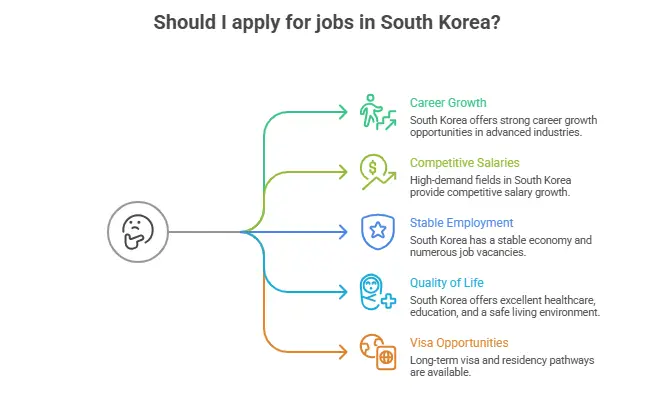
South Korea has emerged as a leading destination for skilled professionals seeking strong career growth, competitive salaries, and stable employment opportunities. The country’s advanced economy, expanding industries, and demand for global talent make it an attractive option for individuals wishing to work in South Korea and explore long-term prospects.
- Over 500,000 job vacancies in South Korea across IT, engineering, semiconductors, healthcare, hospitality, and skilled trades
- Standard 40-hour work week in most industries
- Competitive salary growth in high-demand fields such as IT, AI, finance, and engineering
- World-class healthcare and education, offering strong support for families
- Safe, modern, and efficient living environment with excellent public transport
- English-speaking work opportunities in multinational companies and tech firms
- Opportunity to apply for long-term visas and residency, including the E-7 and E-7-4 pathways
*Looking to work in South Korea? Talk to experts at Y-Axis to guide you with the process.
Number of Job Opportunities in South Korea by 2030
With steady economic growth, digital transformation, and an aging population, there is a rising demand for skilled professionals in South Korea. Sectors such as IT, semiconductors, engineering, healthcare, education, and finance are expected to create thousands of new job opportunities for both local and foreign workers by 2030.
Below is the projected labour demand across key sectors in the South Korea job market:
|
Occupation |
Estimated Job Demand (by 2030) |
|
Healthcare |
2,20,000 |
|
Accounting & Finance |
1,40,000 |
|
Engineering |
1,20,000 |
|
IT & Software |
1,50,000 |
|
Hospitality |
1,10,000 |
|
Marketing & Sales |
90,000 |
|
Teaching & Education |
85,000 |
|
Nursing |
95,000 |
|
Human Resources & Management |
70,000 |
Also, read…
What are the most in-demand jobs in South Korea for the next 10 years?
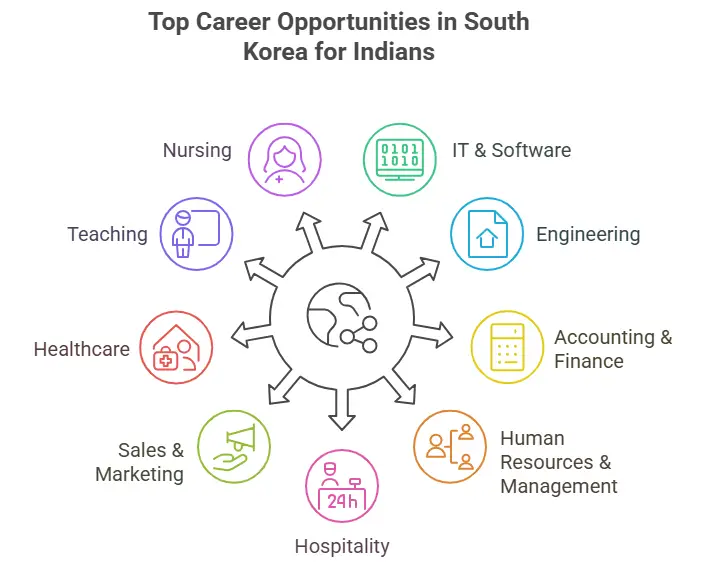
Top Careers in South Korea for Indians
IT & Software Jobs in South Korea
The IT sector in South Korea is expanding rapidly due to growth in artificial intelligence, cybersecurity, automation, and semiconductor technology.
The average salary for IT jobs in South Korea is ₩50,000,000 – ₩85,000,000 per year. Freshers typically earn around ₩40,000,000 per year, while experienced professionals earn ₩90,000,000+ per year.
*Looking for IT jobs abroad? Avail Y-Axis Resume marketing services to find the right one.
Engineering Jobs in South Korea
Engineering professionals are in high demand across Korea’s automotive, semiconductor, robotics, and manufacturing industries.
The average salary for engineering jobs in South Korea is ₩55,000,000 – ₩90,000,000 per year. Freshers earn approximately ₩40,000,000, while senior engineers earn ₩100,000,000+ annually.
*Looking for engineering jobs abroad? Y-Axis is here to provide personalized guidance!
Accounting & Finance Jobs in South Korea
South Korea offers high-paying opportunities in finance, accounting, auditing, and banking roles.
The average salary in accounting and finance is ₩40,000,000 – ₩75,000,000 per year. Entry-level salaries start from ₩30,000,000, while experienced finance professionals earn ₩90,000,000+ annually.
*Looking for finance jobs abroad? Let Y-Axis guide you with the process.
Human Resources & Management Jobs in South Korea
HR professionals are essential across all Korean organisations and multinational companies.
The average salary for HR management roles is ₩35,000,000 – ₩55,000,000 per year. Freshers begin at around ₩28,000,000, while experienced HR managers earn up to ₩80,000,000+ annually.
*Looking for HR jobs abroad? Talk to experts at Y-Axis for complete assistance!
Hospitality Jobs in South Korea
South Korea’s hospitality sector is growing, with rising demand for hotel staff, chefs, customer service roles, and tourism professionals.
The average salary in hospitality is ₩25,000,000 – ₩38,000,000 per year. Entry-level employees earn around ₩22,000,000, while experienced professionals earn ₩45,000,000+ annually.
*Looking for hospitality jobs abroad? Get in touch with Y-Axis to guide you with the process.
Sales & Marketing Jobs in South Korea
Sales and marketing are promising fields for foreigners due to the rise of global brands and Korean consumer companies.
The average salary for sales and marketing roles is ₩35,000,000 – ₩65,000,000 per year. Freshers earn around ₩28,000,000, while senior professionals make ₩80,000,000+ annually.
*Looking for sales & marketing jobs abroad? Let Y-Axis help you with the steps.
Healthcare Jobs in South Korea
Healthcare professionals, including doctors, nurses, therapists, and medical technicians, are in strong demand due to Korea’s aging population.
The average salary for healthcare roles is ₩45,000,000 – ₩70,000,000 per year. Entry-level earnings begin around ₩30,000,000, and experienced workers earn ₩90,000,000+ annually.
*Looking for healthcare jobs abroad? Talk to Y-Axis for complete assistance with the process!
Teaching Jobs in South Korea
Teaching—especially English teaching—is one of the most accessible careers for foreigners in Korea.
The average salary for teaching jobs is ₩28,000,000 – ₩40,000,000 per year. Freshers earn around ₩25,000,000, while experienced teachers earn ₩50,000,000+ annually.
*Looking for teaching jobs abroad? Y-Axis is here to provide complete assistance!
Nursing Jobs in South Korea
Nursing is one of the most in-demand professions in Korea, with thousands of vacancies expected through 2030.
The average salary for nursing jobs in South Korea is ₩30,000,000 – ₩45,000,000 per year. Freshers start at around ₩25,000,000, while experienced nurses earn ₩55,000,000+ annually.
*Searching for nursing jobs abroad? Talk to experts at Y-Axis to guide you with the process.
Also, read...
South Korea Job Market: Trends & Job Opportunities
How Can Indians Get Jobs in South Korea?
Indians looking for a job in South Korea can apply online through trusted portals, company websites, and recruitment agencies. Following the right steps can significantly improve your chances of getting hired in the South Korea job market.
The step-by-step process to apply for jobs in South Korea is listed below:
Step 1: Check Your Eligibility
Step 2: Prepare a Korean-Style Resume and Cover Letter
Step 3: Search for Jobs Online on trusted job portals, company career pages and take help from recruiting agencies
Step 4: Submit your applications to positions that match your skills and qualifications
Step 5: Attend Interviews with South Korean companies and showcase your skills effectively
Step 6: Once selected, you receive a job offer from a South Korean employer, and you can start your journey to work in South Korea
*Looking to apply for jobs abroad? Y-Axis is here to provide complete assistance.
How Can Indians Move to South Korea on a Work Permit?
Indians can move to South Korea on a Work Permit by securing a valid job offer from a South Korean employer. Once the employer issues an employment contract and initiates the visa sponsorship process, applicants can apply for the appropriate South Korea work visa online or through the Korean consulate. After visa approval, they can travel to South Korea and begin working legally for the sponsoring employer.
South Korea Work Permit Application Process
A South Korea Work Permit allows foreign nationals to work legally in the country for a specific employer, job role, and duration. Professionals wishing to work in South Korea temporarily or long-term must obtain the correct visa type based on their occupation and experience.
Foreign workers generally apply for work permits under programs such as the:
- E-7 Skilled Worker Visa
- E-7-4 Points-Based Skilled Visa
- D-10 Job Seeker Visa
- E-9 Employment Permit System (EPS) – for eligible nationalities
The E-7 and E-7-4 visas are the most common pathways for skilled Indian professionals who want to work in South Korea.
Also, read...
South Korea Introduces K-STAR Visa to Attract Global STEM Professionals. Apply now!
Types of South Korea Work Visas
South Korea offers several categories of work visas through which foreign nationals, including Indians, can apply to work in South Korea.
The most common South Korea work visa types are listed below:
1. E-7 Skilled Worker Visa
The most common work visa for Indians.
Issued to skilled professionals in fields such as:
- IT & Software
- Engineering & Manufacturing
- Semiconductors
- Finance & Accounting
- Healthcare
- Construction & Technical Services
- Hospitality and Business Services
This visa requires employer sponsorship and is ideal for long-term skilled employment.
2. D-10 Job Seeker Visa
- Allows qualified Indian professionals to stay in South Korea while searching for a job.
- Suitable for applicants seeking roles under the E-7 category.
- You can attend interviews and secure employment during your stay.
3. E-1 to E-6 Professional Visas (Depending on Occupation)
These visas apply to specialized and high-skilled roles:
- E-1 – Professor Visa
- E-2 – Foreign Language Instructor Visa (English or other languages)
- E-3 – Research Visa
- E-4 – Technology Transfer Visa
- E-5 – Professional Employment (Doctors, Lawyers, Accountants, etc.)
- E-6 – Entertainment & Arts Visa
Eligible Indian professionals in these fields can apply if they meet job-specific requirements.
4. E-7-4 Points-Based Skilled Visa
- A pathway for eligible workers to upgrade to a skilled visa category based on a points system.
- Often used by long-term foreign workers wishing to transition into skilled employment and eventually obtain residency.
5. F-2 Long-Term Residency Visa
- A residency visa that allows greater job flexibility.
- Eligible applicants can work for any employer, unlike the E-series visas which are employer-specific.
- Typically granted to highly skilled workers, high-income earners, or those meeting the points-based criteria.
6. F-5 Permanent Residency Visa
- Allows full employment freedom in South Korea with no restrictions.
- Usually obtained after meeting long-term stay, income, language, and visa criteria.
*Looking to work abroad? Y-Axis is here to provide complete assistance.
South Korea Work Permit Requirements
To apply for a South Korea Work Permit, applicants generally need the following:
- A valid passport
- Relevant qualifications and work experience for the job being applied for
- A valid job offer or employment contract from a South Korean employer
- Proof of sufficient funds to support your stay
- Medical fitness documents (if requested)
- Police Clearance Certificate (PCC)
- Korean language proficiency (TOPIK) may be required for certain visa categories
- Compliance with all South Korean laws and immigration conditions
- Proof of intention to comply with visa rules and leave Korea if the permit expires or is not renewed
South Korea Work Visa for On-Shore Candidates
On-shore applicants are those who are already living in South Korea on a study visa, dependent visa, job seeker visa, or other valid residence status.
The eligibility criteria for candidates applying for a South Korea work visa from within the country are as follows:
- Candidates must hold a valid D-2 (Student), D-4 (Training), D-10 (Job Seeker) or other eligible visa types.
- The spouse, parent, or dependent must hold a valid work or study visa if applying as a dependent.
- For students applying for work after graduation, their D-2 study visa must still be valid.
- Applicants transitioning to an E-7 Skilled Worker Visa must meet the job, experience, and salary requirements.
- Candidates must hold a valid residence permit with sufficient remaining validity to apply for a new visa.
- Refugees or protected persons recognized by the Korean government may also be eligible for work authorization.
- Some visa categories (D-2, D-4, D-10) allow limited or conditional work, but applicants must obtain an official work visa (E-7 or other categories) to change jobs or work full-time.
South Korea Work Visa for Off-Shore Candidates
Off-shore applicants are those living outside South Korea who want to apply for a work visa before entering the country.
The eligibility criteria for candidates who apply from outside South Korea are as follows:
- Candidates must meet the requirements set by Korean Immigration, including qualifications, job relevance, and employer sponsorship.
- Applicants must secure a valid job offer and employment contract from a South Korean employer before applying.
- Candidates must apply for the appropriate South Korea work visa (e.g., E-7 Skilled Worker Visa) before travelling.
- Applicants may enter Korea and apply after arrival only if:
- They hold a valid visa that permits a status change, such as the D-10 Job Seeker Visa.
- They meet all required eligibility and documentation standards for a visa conversion.
- Additional documents may be required depending on the visa type, such as experience letters, degree verification, background checks, or Korean language proof.
Steps to Apply for a South Korea Work Visa
Step 1: Check if you meet the eligibility criteria for a South Korea Work Visa based on your skills, experience, and visa category.
Step 2: Secure a valid job offer and employment contract from a South Korean employer.
Step 3: Prepare all required documents, including certificates, experience letters, passport, PCC, and employer sponsorship papers.
Step 4: Submit your South Korea Work Visa application at the Korean Embassy or Consulate along with the required fees.
Step 5: Wait for visa approval, receive your work visa, travel to South Korea, and start your employment.
How Y-Axis Helps You to Work in South Korea
Y-Axis, a leading immigration and overseas career consultancy, offers reliable and professional services to help you achieve your goal of working in South Korea. Our main services for South Korea include:
- Free eligibility check to assess your profile for the South Korea Work Visa
- Resume marketing services to help you find suitable jobs in South Korea that match your skills
- Resume writing, resume marketing, LinkedIn marketing, and resume zapping to make your profile stand out to Korean employers
- Expert consultation and guidance for South Korea immigration and visa processes
- Free career counselling—book your session to explore opportunities in the South Korea job market
- Complete assistance in the South Korea Work Visa application, from documentation to submission