Visa Country Page Content Flexy Body
Banner Image/video Desktop
Banner Image/video Mobile
Banner Heading
Sign up for a free expert consultation
Banner Sub Heading
Sign up for a free expert consultation
Bottom Text
Don't know what to do ?
bottom Icon
Image
15
Form Lines
Sub Title
I am
Hide Component
Off
Sub Title
looking for
Hide Component
Off
Sub Title
Visa for
Hide Component
Off
Sub Title
Connect me at
Hide Component
Off
Sub Title
and email.
Hide Component
Off
Sub Title
and email
Hide Component
Off
Placeholders
Sub Title
Name
Hide Component
Off
Sub Title
PR
Hide Component
Off
Sub Title
Select Country
Hide Component
Off
Sub Title
Phone No.
Hide Component
Off
Sub Title
Email ID
Hide Component
Off
Hide Component
Off
Prospect Fields
Prospect Contact
India Website
Prospect Source
Website
Prospect Contact Details
University of Jena Germany
Bizible Country
India
Prospect Record Type
Study
Faq Tilte
Types of Permanent Residency Visa
Faq Content
Title
Skilled Immigration
description
  • Points Based
  • Most people below the age of 51 years old, with an occupation (listed on each country’s list), 2+ years of work experience & good English / French are eligible for this
  • It is the most popular way of settling overseas
Hide Component
Off
Title
State/Territory/Province Sponsored Immigration
description
  • Similar to skilled immigration
  • Occupation must be listed on the state list
  • Long term visa converted to PR & citizenship
Hide Component
Off
Title
Employer Based Immigration
description
  • Very popular option for most countries
  • Candidates who find a full time job & an employer overseas are eligible for this visa
  • test

Y-Axis offers job search services to help candidates market themselves to overseas employers. We have a high success rate & have been very successful with this. For more information, please click here.

Hide Component
Off
Title
Family Migration
description
  • Some countries offer permanent residency anyone who has a parent, brother, sister, uncle, aunt or first cousin overseas
  • The sponsoring relative needs to be an citizen or a permanent resident of that country
  • test
Hide Component
Off
Title
Investment Migration
description
  • Many countries offer a temporary or PR visa in exchange for an investment
  • Investment amounts can range from $50,000 to $500,000 or more
Hide Component
Off
Sub Heading
Listed below are the popular ones. Most options offer a long term visa for the applicant, his spouse and children. The visa can be converted to citizenship in most cases. Free Education for children, healthcare & retirement benefits & visa free travel are some of the reasons people choose to immigrate.
Hide Component
On
Hide Component
Off
Title
Frequently Asked Questions
Heading Text
Choose country for pr visa
Image Field
Image
Migrate Canada
Multiple CTA's
Hide Component
Off
Hide Component
Off
Hide Component
Off
Canonicals
https://www.y-axis.com/visa/study/germany/top-universities-in-germany-for-masters/
Keywords

Best Universities in Germany for Master’s, Top Universities in Germany for Master’s, Study in Germany, MS in Germany, Public universities Germany, German universities list, International students Germany

Description

Explore the best universities in Germany for Master’s programs. Learn about top public and private universities, courses, fees, eligibility, and admissions for international students.

Content Component

Top Universities in Germany for Master’s

Germany is one of the most popular countries for international students seeking high-quality, affordable postgraduate education. German universities are known for academic excellence, world-class research, strong industry partnerships, and highly employable Master’s graduates.

Public universities in Germany offer tuition-free education, making it one of the most cost-effective destinations for Indian students. Private universities offer flexible programs in English with industry-focused learning.

Germany is particularly famous for Master’s programs in engineering, IT, management, natural sciences, data science, healthcare, and business.

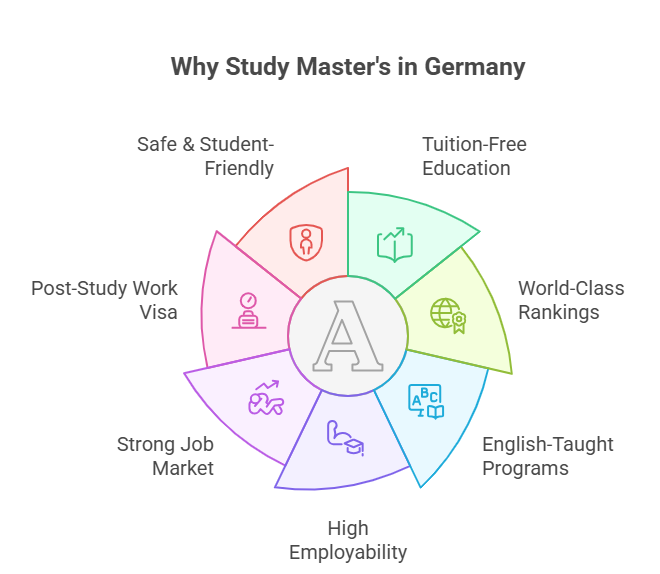
Why Study Master’s in Germany?

  • Tuition-Free Education: Most public universities charge zero tuition fees.
  • World-Class Rankings: Consistently in global top 100.
  • English-Taught Programs: Thousands of Master's programs available fully in English.
  • High Employability: German degrees are globally recognized and valued.
  • Strong Job Market: Germany has a high demand for engineers, IT professionals, healthcare experts, business graduates, and researchers.
  • Post-Study Work Visa: Students get 18 months to find a job after graduation.
  • Safe & Student-Friendly: Clean, affordable, and high-quality lifestyle.

*Planning to study in Germany? Contact Y-Axis to get expert assistance
Study Masters in Germany

Top Public Universities in Germany for Master’s

University Name

Popular Master’s Programs

Technical University of Munich (TUM)

Engineering, Computer Science, AI, Robotics, Data Science, Management

Ludwig Maximilian University Munich (LMU)

Life Sciences, Physics, Psychology, Economics, Business

RWTH Aachen University

Mechanical, Automotive, Civil, Electrical, Aerospace Engineering

Heidelberg University

Medicine, Biosciences, Chemistry, Research Science

University of Stuttgart

Aerospace, Automotive, Mechanical Engineering

Karlsruhe Institute of Technology (KIT)

Computer Science, Energy Engineering, Robotics

University of Hamburg

Economics, Marine Science, Physics, Sustainability

TU Berlin

Engineering, Architecture, Civil Engineering, IT

University of Bonn

Mathematics, Economics, Computer Science, Artificial Intelligence

Goethe University Frankfurt

Finance, Business, Economics, Life Sciences

Top Private Universities in Germany for Master’s

University Name

Popular Master’s Programs

IU International University of Applied Sciences

MBA, IT, Data Science, Business, Artificial Intelligence

Arden University Berlin

MBA, Project Management, Psychology, IT, Human Resource Management

SRH Berlin University of Applied Sciences

Engineering, Technology Management, Design, Entrepreneurship

GISMA Business School

Business Analytics, MBA, Leadership, Marketing

EBS University

International Business, Finance, Management

Popular Master’s Programs in Germany

Engineering & Technology

  • Master’s in Mechanical Engineering
  • Master’s in Automotive Engineering
  • Master’s in Electrical Engineering
  • Master’s in Industrial Engineering
  • Master’s in Robotics & Artificial Intelligence
  • Master’s in Computer Science
  • Master’s in Mechatronics

Data & IT

  • Master’s in Data Science
  • Master’s in Artificial Intelligence
  • Master’s in Cybersecurity
  • Master’s in Big Data Analytics
  • Master’s in Information Systems

Business & Management

  • Master of Business Administration (MBA)
  • Master’s in International Business
  • Master’s in Supply Chain Management
  • Master’s in Finance & Accounting
  • Master’s in Marketing & Human Resource Management

Health & Life Sciences

  • Master’s in Biomedical Sciences
  • Master’s in Public Health
  • Master’s in Biotechnology
  • Master’s in Neuroscience
  • Master’s in Chemistry

Tuition Fees in Germany for Master’s

Germany is one of the most affordable study destinations for international students. Most public universities charge no tuition fees, making higher education accessible to students from all backgrounds. Students only need to pay a small semester fee that covers administration and public transport. Private universities, however, charge tuition fees but offer flexible, industry-focused, English-taught programs. MBA programs generally have higher fees due to specialized curriculum and international exposure. The table below shows the fee breakdown for universities in Germany:

University Type

Annual Tuition Fee

Notes

Public Universities

€0 (only €250–€400 semester fee)

Tuition-free

Private Universities

€10,000 – €18,000

English-taught programs

MBA Programs

€15,000 – €25,000

Based on university

Scholarships for Master’s in Germany

Germany offers several generous scholarships for international students pursuing Master’s studies. These scholarships help reduce expenses by covering tuition fees, living costs, research activities, and travel allowances. Most scholarships are merit-based and awarded by the German government, the EU, or individual universities. Students with strong academic performance, good language skills, or research interest have higher chances of receiving funding. The table below shows the top scholarships to pursue master’s in Germany:

Scholarship Name

Amount / Benefit Provided

DAAD Scholarships

Full tuition coverage + monthly stipend (€934), travel allowance, health insurance

Erasmus+ Scholarship

Tuition fee support + monthly living allowance (€330–€450)

Deutschlandstipendium

€300 per month for high-achieving students

Heinrich Böll Foundation Scholarship

Monthly stipend (€934) + funding for study costs

Konrad-Adenauer-Stiftung (KAS) Scholarship

Monthly stipend (€934–€1,200) + health insurance

Friedrich Ebert Foundation Scholarship

Monthly stipend + health insurance + travel support

University-specific Scholarships

Benefits vary by university (partial to full fee waivers)

*Want to apply for scholarships to study in  Germany? Y-Axis is here to assist you in all the procedures.

Eligibility Requirements for Master’s in Germany

Public Universities

  • Bachelor’s degree with 65–75% minimum
  • Strong academic transcripts
  • English proficiency: IELTS 6.5 / TOEFL equivalent
  • GRE may be required for some courses
  • German proficiency (optional)

Private Universities

  • Bachelor’s degree with 55–60%
  • IELTS 6.0–6.5
  • Resume + SOP + LOR
  • No GRE required

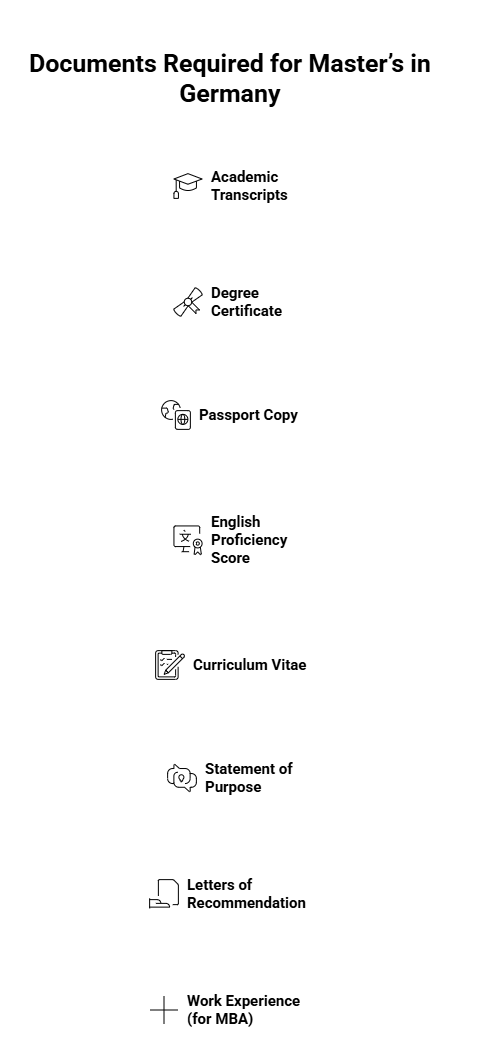
Documents Required for Master’s in Germany

  • Academic transcripts (10th, 12th, bachelor’s)
  • Degree certificate
  • Passport copy
  • English proficiency score
  • Curriculum Vitae (CV)
  • Statement of Purpose (SOP)
  • Letters of Recommendation (LORs)
  • Work experience (for MBA)

Documents Required for Master's in Germany

Steps to Apply for Master’s in Germany

Step 1: Choose your university and program

Step 2: Check eligibility and language requirements

Step 3: Prepare documents (SOP, LORs, IELTS, transcripts)

Step 4: Apply through the university portal or Uni-Assist

Step 5: Receive Admission Letter

Step 6: Pay semester fees (if public university)

Step 7: Apply for your Germany Student Visa

Step 8: Book your travel and arrange accommodation

Career Opportunities After Master’s in Germany

Graduates from German universities work in:

  • Information Technology
  • Engineering (Mechanical, Electrical, Civil)
  • Automotive Industry
  • Healthcare & Pharma
  • Business & Finance
  • Research & Development
  • Consulting
  • Manufacturing

Germany has a strong demand for skilled professionals, offering excellent salaries and long-term career opportunities.

Cost of Living for Master’s Students in Germany

Germany offers an affordable cost of living compared to many other European study destinations. The total monthly expenses for international students depend on the city, lifestyle, and accommodation choice. Larger cities like Munich or Frankfurt may be more expensive, while cities like Leipzig, Dresden, or Bonn are more budget-friendly. The table below provides an overview of the average monthly living expenses for Master’s students in Germany.

Expense

Average Cost (per month)

Accommodation

€400–€700

Food

€200–€300

Transportation

€50–€90

Health Insurance

€100–€120

Miscellaneous

€150–€250

Total monthly costs: €900–€1,300

Why Indian Students Prefer Germany for Master’s

  • Affordable or free education
  • High visa approval rate
  • Strong job opportunities
  • Globally recognized degrees
  • Safe and student-friendly cities
  • Excellent research ecosystem
  • 18-month post-study work visa

Your Future in Germany

Pursuing a Master’s degree in Germany opens the door to world-class education, global career opportunities, and an affordable lifestyle. With strong academic programs, practical training, and a growing job market, Germany remains one of the best destinations for Indian students seeking a successful international career.

How Y-Axis Can Help You

Y-Axis provides complete support for students planning to study a Master’s in Germany:

  • University & program selection
  • Application & documentation
  • SOP, LOR & CV preparation
  • Scholarship guidance
  • Germany student visa support
  • Y-Axis Coaching will assist you in learning the English Proficiency test along with IELTSTOEFLPTE.
  • Pre-departure & post-arrival support
Visa Country Seo Og Tags
locale
en_US
type
article
Title
Best Universities in Germany for Master’s – Public & Private Universities, Fees, Courses, Eligibility
Description
Explore the best universities in Germany for Master’s programs. Learn about top public and private universities, courses, fees, eligibility, and admissions for international students.
Url
https://www.y-axis.com/visa/study/germany/top-universities-in-germany-for-masters/
Site Name
Immigration and Visa Consultants, India | Y-Axis Overseas Careers
Article:Modified Time
2025-12-04T12:28:03+00:00
Image
https://y-axis.com/assets/cms/2025-12/top-universities-in-germany.webp
Image:Width
1350
Image:Height
340
Image:Type
webp
Schema & Structured Data
{
"@context": "https://schema.org",
"@graph": [
{
"@type": "WebPage",
"@id": "https://www.y-axis.com/visa/study/germany/top-universities-in-germany-for-masters/",
"url": "https://www.y-axis.com/visa/study/germany/top-universities-in-germany-for-masters/",
"name": "Top Universities in Germany for Masters – Eligibility, Costs, Scholarships & Jobs",
"description": "Learn about the top universities in Germany for Master’s programs, tuition-free public universities, eligibility requirements, English-taught courses, costs, scholarships, Uni-Assist, and post-study work options for international students.",
"inLanguage": "en",
"thumbnailUrl": "https://y-axis.com/assets/cms/2025-12/top-universities-in-germany.webp",
"primaryImageOfPage": {
"@id": "https://www.y-axis.com/visa/study/germany/top-universities-in-germany-for-masters/#primaryimage"
},
"potentialAction": [
{
"@type": "ReadAction",
"target": [
"https://www.y-axis.com/visa/study/germany/top-universities-in-germany-for-masters/"
]
}
]
},
{
"@type": "Article",
"@id": "https://www.y-axis.com/visa/study/germany/top-universities-in-germany-for-masters/#article",
"headline": "Top Universities in Germany for Masters – Tuition Fees, Eligibility, Scholarships & Careers",
"description": "A complete guide to the best public and private universities in Germany for Master’s, including tuition-free options, eligibility criteria, English-taught programs, required documents, DAAD scholarships, Uni-Assist applications, and post-study work visas.",
"image": "https://y-axis.com/assets/cms/2025-12/top-universities-in-germany.webp",
"author": {
"@type": "Organization",
"name": "Y-Axis",
"url": "https://www.y-axis.com/"
},
"publisher": {
"@type": "Organization",
"name": "Y-Axis",
"url": "https://www.y-axis.com/",
"logo": {
"@type": "ImageObject",
"url": "https://www.y-axis.com/assets/cms/2025-08/Y-Axis-Logo.webp"
}
},
"mainEntityOfPage": "https://www.y-axis.com/visa/study/germany/top-universities-in-germany-for-masters/"
},
{
"@type": "ImageObject",
"@id": "https://www.y-axis.com/visa/study/germany/top-universities-in-germany-for-masters/#primaryimage",
"contentUrl": "https://y-axis.com/assets/cms/2025-12/top-universities-in-germany.webp",
"url": "https://www.y-axis.com/visa/study/germany/top-universities-in-germany-for-masters/",
"caption": "Top universities in Germany for Master’s, eligibility, tuition-free public universities, scholarships and post-study work options for international students",
"representativeOfPage": true,
"creator": {
"@type": "Organization",
"name": "Y-Axis"
},
"creditText": "Image by Y-Axis",
"license": "https://www.y-axis.com/terms-conditions/",
"acquireLicensePage": "https://www.y-axis.com/terms-conditions/",
"copyrightNotice": "© 2025 Y-Axis, All rights reserved",
"height": 340,
"width": 1350
},
{
"@type": "BreadcrumbList",
"@id": "https://www.y-axis.com/visa/study/germany/top-universities-in-germany-for-masters/#breadcrumbs",
"itemListElement": [
{
"@type": "ListItem",
"position": 1,
"name": "Home",
"item": "https://www.y-axis.com/"
},
{
"@type": "ListItem",
"position": 2,
"name": "Visa",
"item": "https://www.y-axis.com/visa/"
},
{
"@type": "ListItem",
"position": 3,
"name": "Study",
"item": "https://www.y-axis.com/visa/study/"
},
{
"@type": "ListItem",
"position": 4,
"name": "Germany",
"item": "https://www.y-axis.com/visa/study/germany/"
},
{
"@type": "ListItem",
"position": 5,
"name": "Top Universities in Germany for Masters",
"item": "https://www.y-axis.com/visa/study/germany/top-universities-in-germany-for-masters/"
}
]
},
{
"@type": "FAQPage",
"@id": "https://www.y-axis.com/visa/study/germany/top-universities-in-germany-for-masters/#faq",
"mainEntity": [
{
"@type": "Question",
"name": "What are the top universities in Germany for Master’s programs?",
"acceptedAnswer": {
"@type": "Answer",
"text": "Germany has many top universities offering high-quality Master’s programs. Leading public universities include the Technical University of Munich (TUM), RWTH Aachen, LMU Munich, Heidelberg University, TU Berlin, KIT, and University of Stuttgart. These universities are globally ranked and known for engineering, IT, sciences, and research excellence. Private universities like IU, Arden, SRH, and GISMA also offer industry-focused Master’s programs in English."
}
},
{
"@type": "Question",
"name": "Are Master’s programs in Germany free for international students?",
"acceptedAnswer": {
"@type": "Answer",
"text": "Yes, most public universities in Germany offer tuition-free Master’s programs for international students. You only need to pay a small semester fee of around €250–€400, which may include public transport. However, some specialized programs may charge fees. Private universities charge tuition fees ranging from €10,000 to €18,000 per year. Overall, studying in Germany is very affordable compared to countries like the USA, UK, or Australia."
}
},
{
"@type": "Question",
"name": "What are the eligibility requirements for Master’s in Germany?",
"acceptedAnswer": {
"@type": "Answer",
"text": "The eligibility requirements to pursue Master’s in Germany are listed below:\n• A recognized Bachelor’s degree in a relevant field\n• Strong academic marks (usually 55–75% depending on university)\n• English proficiency: IELTS 6.0–6.5 or TOEFL equivalent\n• Some public universities may require GRE for technical programs\n• Additional required documents: SOP, CV, academic transcripts, LORs\n• Work experience may be needed for MBA programs\n• German language skills are optional but can be helpful\n• Requirements may vary depending on the university and course"
}
},
{
"@type": "Question",
"name": "Do German universities offer English-taught Master’s programs?",
"acceptedAnswer": {
"@type": "Answer",
"text": "Yes, Germany offers thousands of Master’s programs taught entirely in English, especially in engineering, IT, business, data science, and international management. These programs are designed for global students and do not require German language skills for admission. Many public universities and almost all private universities offer English-taught courses. However, learning basic German can help students with part-time jobs and daily life."
}
},
{
"@type": "Question",
"name": "Which public universities in Germany are best for engineering Master’s?",
"acceptedAnswer": {
"@type": "Answer",
"text": "Germany is famous for engineering, and top public universities include RWTH Aachen, TUM, University of Stuttgart, TU Berlin, KIT, and TU Darmstadt. These universities are known for mechanical, automotive, electrical, civil, aerospace engineering, and robotics. They offer strong research facilities, industry partnerships, and excellent placement opportunities with German companies like BMW, Mercedes-Benz, Bosch, Siemens, and Volkswagen."
}
},
{
"@type": "Question",
"name": "Which private universities in Germany offer Master’s programs in English?",
"acceptedAnswer": {
"@type": "Answer",
"text": "Popular private universities offering English-taught Master’s include IU International University, Arden University Berlin, SRH Berlin, GISMA Business School, and EBS University. These universities offer MBA, data science, project management, engineering management, finance, marketing, and psychology. Private universities have flexible learning options, smaller class sizes, and industry-focused teaching, making them attractive for international students."
}
},
{
"@type": "Question",
"name": "What documents are required to apply for a Master’s in Germany?",
"acceptedAnswer": {
"@type": "Answer",
"text": "The documents required to apply for a Master’s in Germany are listed below:\n• Academic transcripts for 10th, 12th, and bachelor’s degree\n• Bachelor’s degree certificate\n• Passport copy\n• English proficiency test scores (IELTS/TOEFL/PTE)\n• Curriculum Vitae (CV)\n• Statement of Purpose (SOP)\n• Letters of Recommendation (LORs)\n• GRE or GMAT scores (only if required by the program)\n• Work experience certificates for MBA or relevant programs\n• Any additional documents requested by the university"
}
},
{
"@type": "Question",
"name": "What are the popular Master’s courses in Germany for Indian students?",
"acceptedAnswer": {
"@type": "Answer",
"text": "Indian students commonly choose Master’s programs in Mechanical Engineering, Computer Science, Data Science, AI, Electrical Engineering, Biosciences, MBA, Automotive Engineering, Supply Chain Management, Cybersecurity, and Biotechnology. These courses offer strong career opportunities, global recognition, and high demand in Germany’s job market. Many of these programs are taught in English and offer practical training."
}
},
{
"@type": "Question",
"name": "Do I need IELTS or TOEFL to study a Master’s in Germany?",
"acceptedAnswer": {
"@type": "Answer",
"text": "Yes, most German universities require proof of English proficiency. IELTS (usually 6.0–6.5) or TOEFL iBT scores are commonly accepted. Some universities may accept Duolingo or PTE. If your previous education was entirely in English, you may request a waiver, but approval depends on the university. English scores are essential for smooth admission and visa processing."
}
},
{
"@type": "Question",
"name": "Is GRE required for Master’s programs in Germany?",
"acceptedAnswer": {
"@type": "Answer",
"text": "GRE is not required for most Master’s programs in Germany. However, some highly competitive programs in engineering, computer science, or data fields at top universities like TUM or RWTH Aachen may prefer or recommend GRE. Private universities typically do not require GRE. Submitting a good GRE score can strengthen your application but is usually optional."
}
},
{
"@type": "Question",
"name": "How much does it cost to study a Master’s in Germany?",
"acceptedAnswer": {
"@type": "Answer",
"text": "Public universities in Germany are tuition-free, so students only pay a semester fee of about €250–€400. Private universities charge tuition fees between €10,000 and €18,000 per year. MBA programs may cost €15,000 to €25,000. Overall, Germany is one of the most affordable study destinations for international students."
}
},
{
"@type": "Question",
"name": "What is the cost of living for Master’s students in Germany?",
"acceptedAnswer": {
"@type": "Answer",
"text": "The average monthly cost of living ranges from €900 to €1,300, depending on the city. Accommodation costs between €400–€700, food €200–€300, transportation €50–€90, health insurance €100–€120, and miscellaneous expenses €150–€250. Cities like Munich and Frankfurt are more expensive, while Leipzig and Dresden are more affordable."
}
},
{
"@type": "Question",
"name": "Are scholarships available for Master’s students in Germany?",
"acceptedAnswer": {
"@type": "Answer",
"text": "Yes, Germany offers many scholarships for international students, including DAAD, Erasmus+, Deutschlandstipendium, and foundation scholarships. These scholarships may cover tuition fees, living expenses, travel costs, or provide monthly stipends. Some universities also offer their own funding options. Scholarships are typically merit-based and require strong academic performance."
}
},
{
"@type": "Question",
"name": "How can international students apply for the DAAD scholarship?",
"acceptedAnswer": {
"@type": "Answer",
"text": "To apply for the DAAD scholarship, students must choose an eligible Master’s program, submit academic transcripts, English or German language scores, CV, SOP, and LORs. Applications are submitted through the DAAD portal. The scholarship is highly competitive and offers full funding along with a monthly stipend. Early preparation improves your chances."
}
},
{
"@type": "Question",
"name": "How long is the post-study work visa after a Master’s in Germany?",
"acceptedAnswer": {
"@type": "Answer",
"text": "After completing a Master’s degree, international students can apply for an 18-month post-study work visa to search for a job in Germany. Once employed, they can apply for an EU Blue Card or a residence permit, leading to long-term settlement options. This makes Germany one of the most student-friendly countries."
}
},
{
"@type": "Question",
"name": "Can international students work part-time while studying in Germany?",
"acceptedAnswer": {
"@type": "Answer",
"text": "Yes, international students can work 120 full days or 240 half days per year, as per German regulations. Students can work in restaurants, supermarkets, administrative offices, tutoring, or university jobs. Part-time work helps cover living expenses, but it should not affect academic performance. Knowledge of basic German improves job opportunities."
}
},
{
"@type": "Question",
"name": "Is Germany good for Indian students pursuing Master’s programs?",
"acceptedAnswer": {
"@type": "Answer",
"text": "Yes, Germany is excellent for Indian students due to free tuition, world-class universities, strong job opportunities, high visa approval rates, and a safe living environment. The country is known for engineering, IT, management, and research. German degrees are globally respected, and students benefit from an 18-month post-study work visa."
}
},
{
"@type": "Question",
"name": "Which Master’s courses in Germany offer high job opportunities?",
"acceptedAnswer": {
"@type": "Answer",
"text": "Courses with strong job prospects include Mechanical Engineering, Computer Science, Data Science, Automotive Engineering, Electrical Engineering, Cybersecurity, Biotechnology, Finance, Supply Chain, and AI. Germany has a shortage of skilled professionals in engineering, IT, healthcare, and manufacturing, making these fields ideal for international students."
}
},
{
"@type": "Question",
"name": "What is Uni-Assist and how does it work for applications?",
"acceptedAnswer": {
"@type": "Answer",
"text": "Uni-Assist is an online application platform used by many German universities. It evaluates international student applications, checks eligibility, verifies documents, and forwards qualified applications to universities. Students upload documents, pay processing fees, and track their application status. Not all universities use Uni-Assist; some allow direct applications."
}
},
{
"@type": "Question",
"name": "How do I choose between public and private universities in Germany?",
"acceptedAnswer": {
"@type": "Answer",
"text": "Public universities offer tuition-free education, strong research, and global rankings. They are ideal for academically strong students. Private universities offer flexible admissions, English-taught programs, smaller class sizes, and industry-oriented learning, making them suitable for students seeking practical skills. The choice depends on academic profile, budget, and career goals."
}
}
]
}
]
}
Twitter Card
summary_large_image
Twitter Image
https://y-axis.com/assets/cms/2025-12/top-universities-in-germany.webp
Twitter Label 1
Est. reading time
Twitter Data 1
36 minutes
Colour
Gray
Country
Visa Type
VISAS - Study Visa