
- Points Based
- Most people below the age of 51 years old, with an occupation (listed on each country’s list), 2+ years of work experience & good English / French are eligible for this
- It is the most popular way of settling overseas
- Similar to skilled immigration
- Occupation must be listed on the state list
- Long term visa converted to PR & citizenship
- Very popular option for most countries
- Candidates who find a full time job & an employer overseas are eligible for this visa
- test
Y-Axis offers job search services to help candidates market themselves to overseas employers. We have a high success rate & have been very successful with this. For more information, please click here.
- Some countries offer permanent residency anyone who has a parent, brother, sister, uncle, aunt or first cousin overseas
- The sponsoring relative needs to be an citizen or a permanent resident of that country
- test
- Many countries offer a temporary or PR visa in exchange for an investment
- Investment amounts can range from $50,000 to $500,000 or more



Study in Germany for Free, Study in Germany for free for Indian students, Tuition-free universities in Germany, Free education in Germany 2026, Germany public universities no tuition fee, Cost of living in Germany for students, Germany blocked account requirement, APS certificate Germany, Germany student visa requirements, Scholarships in Germany, Best universities in Germany without tuition fees
Study in Germany for free at public universities. Check tuition-free universities, eligibility, cost of living, scholarships, and student visa process for 2026.
Study in Germany for Free: Top Universities, Application and Eligibility
Germany is one of the very few countries where international students can study at public universities without paying tuition fees. This benefit is available not only for German citizens but also for Indian and other international students. In 2026, most public universities in Germany continue to follow this system, making higher education affordable and accessible.
In many bachelor’s and several master’s programs at public universities, students are not required to pay annual tuition fees. Instead, they pay a small semester contribution fee, usually between €250 and €350 per semester. This amount covers administrative services, student support, campus facilities, and often a public transport pass for the semester. Compared to countries like the USA or UK, where tuition fees can be very high, Germany offers a major financial advantage.
Free education in Germany does not mean lower standards. Public universities are well-funded by the government and are known for their modern infrastructure, research facilities, and qualified professors. Students benefit from a strong academic system that focuses on both theoretical knowledge and practical learning. Many universities also collaborate with industries, which helps students gain hands-on experience through projects and internships.
Although tuition is free, students must plan for living expenses such as accommodation, food, health insurance, and personal costs. They must also complete the admission process and obtain a student visa. With proper planning, studying in Germany becomes one of the most cost-effective ways to earn a globally recognized degree.
Why Study in Germany?
- No High Tuition Fees: Public universities do not charge heavy tuition fees for most programs.
- Globally Recognized Degrees: German degrees are respected worldwide.
- High-Quality Education: Universities offer strong research facilities and modern learning methods.
- Career Opportunities: Students can work part-time and explore post-study job options in Germany.
- Affordable Study Destination: Compared to other countries, overall education costs are much lower.
*Are you looking to study in Germany? Y-Axis is here to guide through the entire process!
Top Free Universities in Germany
Germany has around 400 public universities, and most of them do not charge tuition fees for international students, including Indians. These universities are funded by the German government, which is why students are allowed to study without paying annual tuition fees for most bachelor’s and many master’s programs.
Instead of tuition fees, students pay only a semester contribution fee, usually between €150 and €350 per semester. This fee covers administrative services, student welfare support, campus facilities, libraries, and in many cases, a public transport ticket for the entire semester. The semester fee is the same for both German and international students in most states.
These tuition-free universities include top-ranked research universities, technical universities, and universities of applied sciences. They offer a wide range of programs in engineering, computer science, business, natural sciences, humanities, and social sciences. Many master’s programs are also available in English, which makes it easier for international students to apply.
Below are some of the top public universities in Germany where you can study without paying tuition fees:
|
University |
Location |
QS World Ranking 2026 |
Major Fields of Study |
|
Munich |
22 |
Engineering, Computer Science, Artificial Intelligence, Data Science, Mechanical Engineering, Business & Management |
|
|
Munich |
58 |
Business Administration, Physics, Life Sciences, Medicine, Economics, Humanities |
|
|
Heidelberg |
80 |
Medicine, Life Sciences, Biotechnology, Law, Political Science, Natural Sciences |
|
|
Berlin |
88 |
Political Science, International Relations, Social Sciences, Humanities, Area Studies |
|
|
Aachen |
105 |
Mechanical Engineering, Electrical Engineering, Computer Science, Robotics, Automotive Engineering |
|
|
Karlsruhe |
98 |
Engineering, Information Technology, Physics, Energy Engineering, Computer Science |
|
|
Berlin |
130 |
Philosophy, Business, Economics, Social Sciences, Agriculture, Natural Sciences |
|
|
Berlin |
145 |
Engineering, Architecture, Computer Science, Urban Planning, Industrial Engineering |
|
|
University of Hamburg |
Hamburg |
193 |
Law, Economics, Social Sciences, Climate Studies, Natural Sciences |
|
Freiburg |
201 |
Environmental Sciences, Renewable Energy, Medicine, Biology, Forest Sciences |
|
|
University of Tübingen |
Tübingen |
215 |
Neuroscience, Medicine, Psychology, Theology, Humanities, Artificial Intelligence |
Read more....
Universities in Germany for Indians to Study Abroad
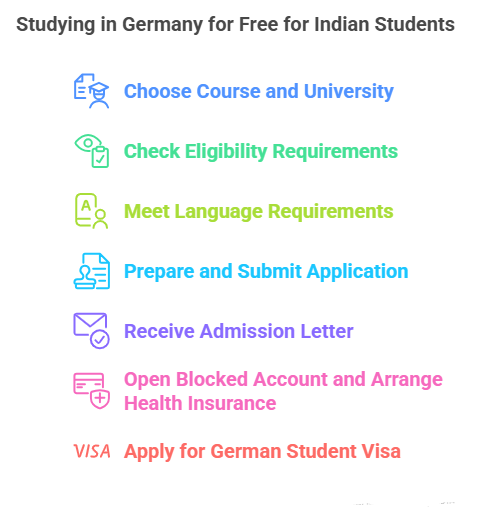
How to Study in Germany for Free for Indian Students?
Studying in Germany for free is possible if you follow the correct process and prepare your documents properly. Below is a clear and detailed step-by-step guide for Indian students planning to study in Germany in 2026.
Step 1: Choose the Right Course and University
The first step is to research and select a public university in Germany that offers your preferred course. Make sure the university does not charge tuition fees for your chosen program. Check out the course structure, intake (winter or summer), eligibility requirements, and language of instruction before making a decision.
Step 2: Check Eligibility Requirements
After selecting the program, carefully review the academic requirements. For bachelor’s programs, students must complete Class 12 with good marks and obtain the APS certificate, which is mandatory for Indian students. For master’s programs, a relevant bachelor’s degree with strong academic performance is required. Some courses may also require entrance exams like GRE or GMAT.
Step 3: Meet the Language Requirements
Depending on the language of instruction, you must provide proof of language proficiency. For English-taught programs, IELTS or TOEFL scores are usually required. For German-taught programs, exams such as TestDaF or DSH are necessary. Even if your program is in English, learning basic German will help you adjust to daily life in Germany.
Step 4: Prepare and Submit Your Application
Once you meet the eligibility criteria, prepare all required documents. These usually include academic transcripts, APS certificate, statement of purpose, letters of recommendation, language test scores, passport copy, and CV. Applications are submitted either through the university’s official portal or through Uni-Assist, depending on the institution. Apply before the deadline to improve your chances.
Step 5: Receive Admission Letter
If your application is successful, you will receive an official admission letter from the university. This letter is important for the next steps, especially for the student visa process.
Step 6: Open a Blocked Account and Arrange Health Insurance
Even though tuition is free, students must show proof that they can cover living expenses. For 2026, you need to open a German blocked account with approximately €11,000 to €12,000 for one year. You must also arrange valid German-recognized health insurance before applying for your visa.
Step 7: Apply for a German Student Visa
The final step is to apply for a German student visa. You need to book an appointment at the German Consulate or VFS and submit your admission letter, blocked account confirmation, health insurance, academic documents, and completed visa application form. Once your visa is approved, you can travel to Germany and complete your university enrollment.
*Want to apply for Germany student visa? Contact Y-Axis for end-to-end guidance
Admission Requirements to Study in Germany for Free for Indian Students
Indian students who want to study in Germany for free at public universities must meet the following admission requirements:
- A Valid Passport
- Academic Qualifications: For bachelor’s programs, students must complete Class 12 with good marks. For master’s programs, a relevant bachelor’s degree with strong academic performance from a recognized university is required.
- APS Certificate: Mandatory for Indian students applying to German universities. This verifies your academic documents.
- Language Proficiency Proof: For English-taught programs, students must submit IELTS or TOEFL scores. For German-taught programs, proof of German language skills such as TestDaF, DSH, or a Goethe certificate is required.
- Statement of Purpose (SOP): A written explanation of your academic background, career goals, and why you chose the course and university.
- Letters of Recommendation (LORs): Usually required for master’s programs. These are provided by professors or employers.
- Updated CV/Resume: Including academic details, internships, projects, and work experience (if any).
- GRE/GMAT: Some engineering, technical, or management programs may ask for these scores.
- Portfolio: Needed for creative courses such as design, architecture, or fine arts.
- Proof of Financial Resources: Even though tuition is free, students must show proof of funds for living expenses while applying for a student visa.
Requirements may vary slightly depending on the university and course, so students should always check the official university website before applying.
Cost of Living in Germany for Students
Germany offers tuition-free education at most public universities, but students must still manage their personal living expenses. Free education only means there are no annual tuition fees. It does not cover daily costs such as rent, food, insurance, and transportation.
Before moving to Germany, students should carefully plan their monthly budget. The cost of living depends on the city, lifestyle, and type of accommodation. Bigger cities may be slightly more expensive than smaller towns. To ensure students can support themselves, the German government requires proof of funds through a blocked account while applying for a student visa.
On average, students need around €850 to €1,100 per month to cover their expenses in Germany. Below is a general idea of monthly costs:
- Accommodation (Rent): €300 – €700
- Food & Groceries: €150 – €250
- Health Insurance: Around €90 – €120
- Transportation: €50 – €100
- Personal & Miscellaneous Expenses: €50 – €150
For visa purposes, students must show approximately €11,000 to €12,000 per year in a blocked account to prove they can manage these expenses. In simple words, while tuition fees are free in Germany, students must plan their living expenses properly to have a smooth and comfortable study experience.
Read more....
Cost of doing master’s in Germany for Indian Students
Scholarships for Paid Programs in Germany
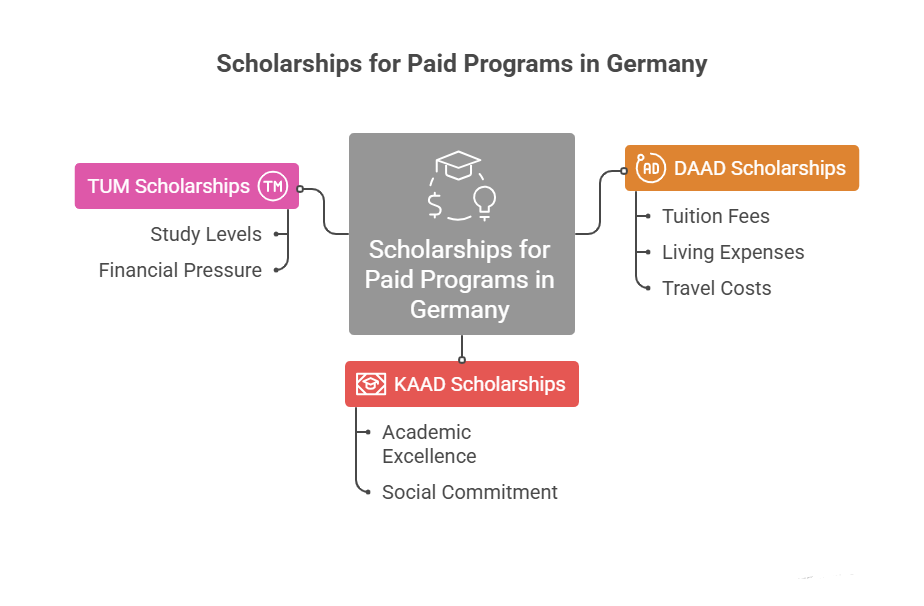
While most public universities in Germany offer tuition-free education, there are some programs or universities that may charge tuition fees, especially certain specialized master’s programs or private universities. In such cases, students do not need to worry because there are several scholarship options available that can reduce the cost or even cover the full tuition fee. Scholarships are offered by government bodies, universities, and private organizations to support talented and deserving students. These scholarships help cover tuition fees, living expenses, or both, making education more affordable.
Here are some important scholarship options for international students:
DAAD Scholarships: The German Academic Exchange Service (DAAD) offers scholarships to international students who wish to study in Germany. Students with strong academic records and good qualifications can apply. Many DAAD scholarships cover tuition fees, monthly living expenses, and even travel costs.
KAAD Scholarships: This scholarship is mainly for postgraduate students from developing countries. It supports students who show academic excellence and social commitment. Selected students receive financial support to help manage their studies in Germany.
TUM Scholarships: The Technical University of Munich offers different scholarship programs for students at various study levels. These scholarships can help reduce financial pressure, especially for students enrolled in programs that require fees.
*Read more...
Top Scholarships in Germany for Indian students
Why Does Germany Provide Free Education?
Many students feel surprised when they hear that Germany offers free education. It may sound strange because countries like the USA and UK charge high tuition fees. But Germany’s system is not a scam. It is part of the country’s long-term planning and economic strategy.
Germany Needs Young Skilled Workers
Germany has an aging population. This means there are more older people and fewer young people joining the workforce. Many industries, especially engineering, IT, healthcare, and manufacturing, need skilled professionals. Big companies require qualified engineers, developers, and technical experts. By offering free education, Germany attracts talented students from countries like India. After graduation, many international students stay back and work, helping the German economy grow.
It Is a Long-Term Investment
Germany sees education as an investment, not a loss. The government supports students during their studies. After graduation, if students get jobs in Germany, they start paying taxes. Over time, these taxes help the government recover the money spent on education. So, free education benefits both students and the country. Students get affordable, high-quality education, and Germany gains skilled professionals and future taxpayers.
Education Is a Public Responsibility
In Germany, education is considered a public good. The belief is that knowledge should be accessible to everyone, not only to those who can afford high fees. Public universities are funded by the government, and both German and international students are treated equally. That is why tuition fees are not charged in most public universities.
A Win-Win Situation
Germany’s free education system benefits both sides. Students receive a globally recognized degree without heavy tuition costs, and Germany gains skilled graduates who can contribute to its workforce and economy. It is a practical and well-planned system that supports long-term growth.
Begin Your Journey to Free Education in Germany
Studying in Germany without paying tuition fees is a valuable opportunity for Indian students who want high-quality education and strong career growth. With globally ranked public universities, diverse study programs, and a welcoming international environment, Germany continues to be one of the most preferred destinations for higher education in 2026.
While tuition fees are not charged at most public universities, students should carefully plan their admission process, finances, and visa application. Proper preparation and timely action can make the entire journey smooth and successful. The effort you put in today can open doors to international exposure, better job opportunities, and long-term career success.
How Can Y-Axis Help You Study in Germany for Free?
Y-Axis provides complete support for students who want to study in Germany at tuition-free public universities. We guide you at every step of the process, from selecting the right university to successfully obtaining your student visa.
When your goal is to study in Germany for free, choosing the correct public university and understanding the admission requirements is very important. Our experts help you identify tuition-free universities that match your academic profile and career goals.
At Y-Axis, we offer:
- Y-Path Guidance to help you choose the right tuition-free public university and program based on your academic background
- Y-Axis Coaching Centre to improve your IELTS, TOEFL, or German language test scores
- Complete assistance for APS certification and university applications
- Support in preparing strong SOPs, LORs, and academic documents
- Step-by-step guidance for the Germany student visa and blocked account process