
- Many countries offer a temporary or PR visa in exchange for an investment
- Investment amounts can range from $50,000 to $500,000 or more
About Y-Axis: Y-Axis is your companion, guide, and facilitator, giving you purpose to immigrate and live opportunities. We help you prepare for the big leap abroad with our online language training courses and counseling sessions.
About Y-Axis: Y-Axis is your companion, guide, and facilitator, giving you purpose to immigrate and live opportunities. We help you prepare for the big leap abroad with our online language training courses and counseling sessions.

F-1 Visa, us student visa
F-1 Visa
F-1 visa requirements
USA F-1 visa
F-1 student visa USA
F-1 visa fees
Learn everything about the F-1 student visa for the USA. Explore eligibility, requirements, fees, application steps, processing time, and visa rules for international students.
F1 Visa: Complete Guide to Requirements, Application and Costs
The F-1 visa is the most common student visa for international students who want to study in the United States. It allows students to enroll in full-time academic programs such as universities, colleges, high schools, language training programs, and other approved institutions. Every year, thousands of students from around the world choose the USA for its high-quality education, global exposure, and career opportunities.
The F-1 visa allows students to work part-time on campus and apply for Optional Practical Training (OPT) after graduation. Understanding the visa requirements, documents, and interview process is important for a smooth and successful application.
What is an F-1 Student Visa and Who Needs It?
The F-1 visa is a non-immigrant student visa that allows international students to study in the United States at approved schools. It is required for students who want to study full-time at universities, colleges, high schools, language training institutes, or other academic programs approved by the U.S. government.
The main purpose of the F-1 visa is to allow students to study in the U.S. for a limited period and then return to their home country after completing their education. The length of stay depends on the course duration mentioned on the Form I-20 issued by the school.
Difference Between F-1 and Other Student Visas
The United States mainly offers two student visa types:
- F-1 Visa: For academic studies such as universities, colleges, and English language programs. F-1 students can work part-time on campus and may apply for Optional Practical Training (OPT) after completing their studies.
- M-1 Visa: For vocational or non-academic programs such as technical or skill-based training. M-1 students usually cannot work during their studies.
Tourist visas (B-1/B-2) or visa-free entry programs cannot be used for studying. Students must apply for the correct student visa to study legally in the U.S.
F1 Visa Requirements
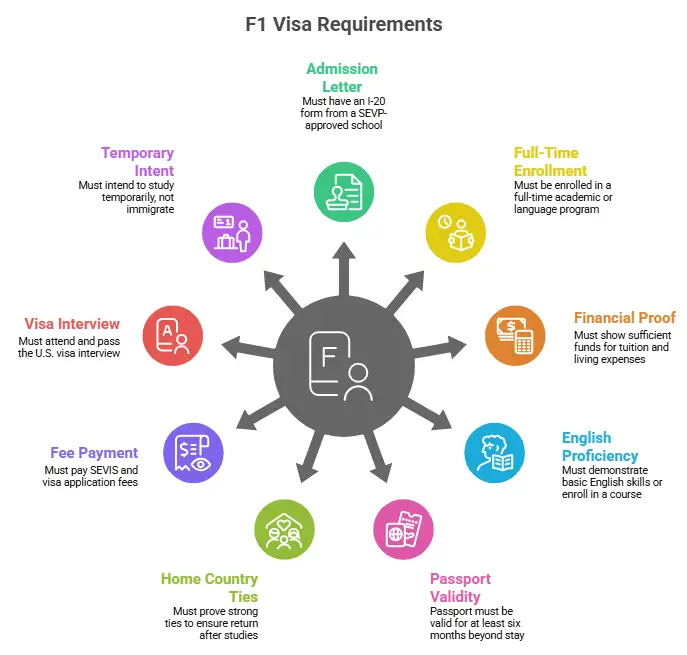
You can apply for an F1 student visa if you meet these requirements:
- You must have an admission letter (Form I-20) from a SEVP-approved U.S. school.
- You must enroll as a full-time student in an academic or language program.
- You must show proof of sufficient funds to pay for tuition, living expenses, and other costs.
- You must have basic English language skills or be enrolled in an English training course.
- Your passport must be valid for at least six months beyond your planned stay in the U.S.
You must prove strong ties to your home country, such as family, job, or property, showing you will return after studies.
- You must pay the SEVIS fee and the U.S. visa application fee before your interview.
- You must attend and pass the U.S. visa interview at the embassy or consulate.
- You must intend to study temporarily, not immigrate permanently to the U.S
Step-by-Step Guide to Applying for a U.S. F-1 Student Visa
Step 1: Get admission from a SEVP-approved U.S. college or university and receive your Form I-20.
Step 2: Check your I-20 details carefully and sign it before starting the visa process.
Step 3: Pay the SEVIS I-901 fee online using your I-20 details and save the payment receipt.
Step 4: Fill out the DS-160 form online with your personal, education, and travel details.
Step 5: Book your visa interview at the nearest U.S. embassy or consulate.
Step 6: Prepare all required documents, including passport, I-20, SEVIS receipt, financial proof, and academic records.
Step 7: Attend the visa interview and clearly explain your study plans, finances, and intention to return home.
Step 8: Wait for visa approval and collect your passport once the visa is issued.
Step 9: Travel to the U.S. up to 30 days before your program start date.
*Want to study in USA? Contact Y-axis for expert guidance
F-1 Visa Processing Time
The processing time for an F-1 student visa depends on factors such as your country, visa appointment availability, and background checks. Below is the general timeline:
| Stage | Estimated Time |
|---|---|
| SEVIS Fee Payment & DS-160 Form | 1–2 days |
| Visa Interview Appointment Wait Time | 1–6 weeks (varies by country and season) |
| Visa Interview Decision | Same day or within a few working days |
| Passport Return with Visa | 3–10 working days after approval |
Total Estimated Processing Time would be around 2 to 8 weeks on average, depending on appointment availability and case complexity.
F-1 Visa Fees and Costs for Indian Students
Applying for an F-1 student visa involves several mandatory government fees that must be paid before your visa interview. These fees are required to process your student record, visa application, and security checks. All payments must be completed on time to avoid delays or rejection. The total cost may vary slightly depending on exchange rates, but the main charges remain the same for all applicants.
Below is a clear breakdown of the official F-1 visa fees you need to pay when applying from India:
| Fee Type | Amount (USD) | Approx. Amount (INR) | Details |
|---|---|---|---|
| SEVIS I-901 Fee | $350 | ₹29,000 – ₹31,000 | Required to register your details in the SEVIS system before attending the visa interview |
| Visa Application Fee (DS-160 | $185 | ₹15,000 – ₹16,000 | Mandatory visa processing fee paid while booking the interview |
| Visa Integrity Fee (from 2026) | $250 | ₹21,000 – ₹23,000 | Additional fee introduced for most non-immigrant visa applicants |
| Total Estimated Cost | $785 | ₹65,000 – ₹70,000 | Does not include travel, medical exams, or document-related costs |
Where to Apply for an F-1 Student Visa
Students applying for an F-1 student visa must submit their application at a U.S. Embassy or Consulate in their country of residence. Applications are submitted online, but the visa interview is conducted in person.
Steps After Receiving Your I-20 Form
Once you receive your Form I-20 from a SEVP-approved U.S. institution, follow these steps carefully:
Step 1: Pay the SEVIS I-901 Fee
After receiving your I-20, you must pay the SEVIS I-901 fee to activate your student record.
- Fee amount: USD $350
- Purpose: Supports the Student and Exchange Visitor Information System (SEVIS)
- Proof required: Print and keep the payment receipt for your visa interview
Step 2: Complete the DS-160 Visa Application Form
The DS-160 is the official U.S. non-immigrant visa application form.
- Fill out the form online using accurate personal and travel details
- Upload a passport-style photo
- Submit the form and print the confirmation page with barcode
DS-160 Application Fee: USD $185
Step 3: Schedule Your Visa Interview
After completing the DS-160 form, book your visa appointment at the nearest U.S. Embassy or Consulate.
- Appointments should be scheduled early, especially during peak intake seasons
- You can apply for an F-1 visa up to 365 days before your program start date
Step 4: Attend the Visa Interview
Attend your interview with the required documents:
- Passport (valid for at least 6 months beyond stay)
- Form I-20 (signed)
- DS-160 confirmation page
- SEVIS fee receipt
- Visa fee payment receipt
- Academic documents and financial proof
How to Prepare for the F1 Visa Interview
Your F1 visa interview is the final step toward your American education. Your preparation and presentation will determine how things turn out.
Most F1 visa interview questions fit into five main categories:
- Study plans - Why study in the USA? Why not in your home country?
- University choice - Why this specific institution? How many schools did you apply to?
- Academic capability - What are your test scores? How good is your English?
- Financial status - How will you fund your education? Who is your sponsor?
- Post-graduation plans - Will you return to your home country after completion?
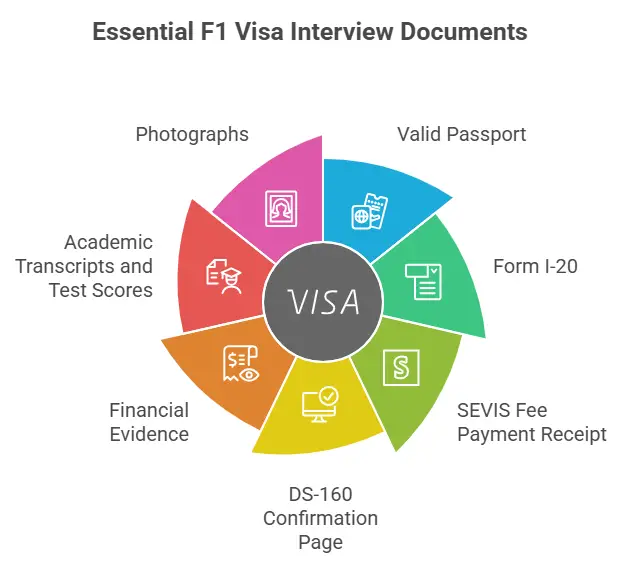
Documents required for F1 visa interview USA
These documents are needed at your interview:
- Valid passport (valid for at least six months beyond your intended stay)
- Form I-20 (signed by both you and your DSO)
- SEVIS fee payment receipt
- DS-160 confirmation page
- Financial evidence (bank statements, scholarships, loans)
- Academic transcripts and standardized test scores
- Photographs meeting visa requirements
F-1 Visa Validity
The F-1 visa allows international students to study in the United States for the full length of their academic program. The visa itself may be valid for several years, but your actual stay in the U.S. depends on the duration mentioned on your Form I-20. As long as you remain enrolled full-time, follow visa rules, and keep your I-20 valid, you can stay legally under Duration of Status (D/S). After finishing your course, you are allowed a 60-day grace period.
Even if your visa stamp expires while you are studying, you can stay legally as long as your student status is active. Students may apply for Optional Practical Training (OPT) after completing their studies, which allows them to work for up to 12 months, or up to 36 months for STEM courses.
F-1 Visa Rules
Full-Time Study Requirement
- You must study full-time at an SEVP-approved school. Undergraduate students usually need 12 credits per semester.
Valid Form I-20
- You must always maintain a valid Form I-20. Any changes must be reported to your Designated School Official (DSO).
Work Restrictions
Allowed up to 20 hours per week during semesters and full-time during breaks for on-campus work. Off-campus work is allowed only with special authorization (CPT or OPT).
- Maintain Legal Status
You must follow all visa rules and maintain academic progress. - Address Update Rule
Update your U.S. address within 10 days of moving. - Travel Rules
Carry a valid passport, visa, and signed I-20 while traveling. - Program Completion & Grace Period
You receive a 60-day grace period after program completion. - Employment Authorization
- CPT (Curricular Practical Training): Part of your academic program
- OPT (Optional Practical Training): Up to 12 months (24 months extra for STEM students)
- Change of Status Rules
Apply for a change of status if you switch schools or visa categories. - Visa Validity vs Status
The visa allows entry, but your legal stay depends on maintaining valid F-1 status.
F1 Visa Application Timeline (2026 and beyond)
Planning your F-1 visa application early is essential for a smooth study abroad journey. Students can apply for a U.S. student visa up to 365 days before their program start date, but they are allowed to enter the U.S. only 30 days before classes begin.
Typical F-1 Visa Timeline
1. Early Preparation Phase (8–12 months before intake)
Students should begin shortlisting universities, preparing documents, and arranging finances well in advance. Once admitted, the university issues the Form I-20, which is required to start the visa process.
2. Application & Documentation Phase (6–8 months before intake)
During this stage, students pay the SEVIS fee, complete the DS-160 visa application, and gather all required documents, including financial proof and academic records.
3. Visa Interview Phase (3–4 months before intake)
Most students attend their visa interview during this period. Interview slots can fill quickly, so early booking is recommended. The visa decision is usually given within a few days, although some cases may require additional processing.
4. Final Preparation Phase (1–2 months before intake)
After visa approval, students can book flights, arrange accommodation, and prepare for travel. Entry into the U.S. is allowed only 30 days before the program start date.
How can Y-Axis help Indian students get an F1 visa?
Y-Axis helps Indian students successfully apply for the F-1 student visa with expert guidance at every step. Our services include:
- Expert guidance on choosing the right U.S. university and course.
- Step-by-step support for F-1 visa application and documentation.
- Assistance with SEVIS fee payment and DS-160 form submission.
- Mock visa interviews to help students prepare confidently.
- Guidance on financial documents and proof of funds.
- Help with scheduling visa appointments and interview preparation.
- Support for understanding visa rules and compliance.
- End-to-end assistance until visa approval and travel preparation.