
Skilled Immigration
State Territory
Employer Based Immigration
Some countries offer permanent residency anyone who has a parent,brother,sister,uncle,aunt or first cousin overseas
Investment Migration



estonia job market
Estonia jobs
Jobs in Estonia for foreigners
Work in Estonia
Estonia job outlook
Estonia’s job market will have over 1 lakh job vacancies in the next 5 years, with high-paying opportunities for professionals across IT, engineering, and key sectors.
Estonia Job Market in 2026-30
- Over 1 lakh job openings projected between 2026–2030
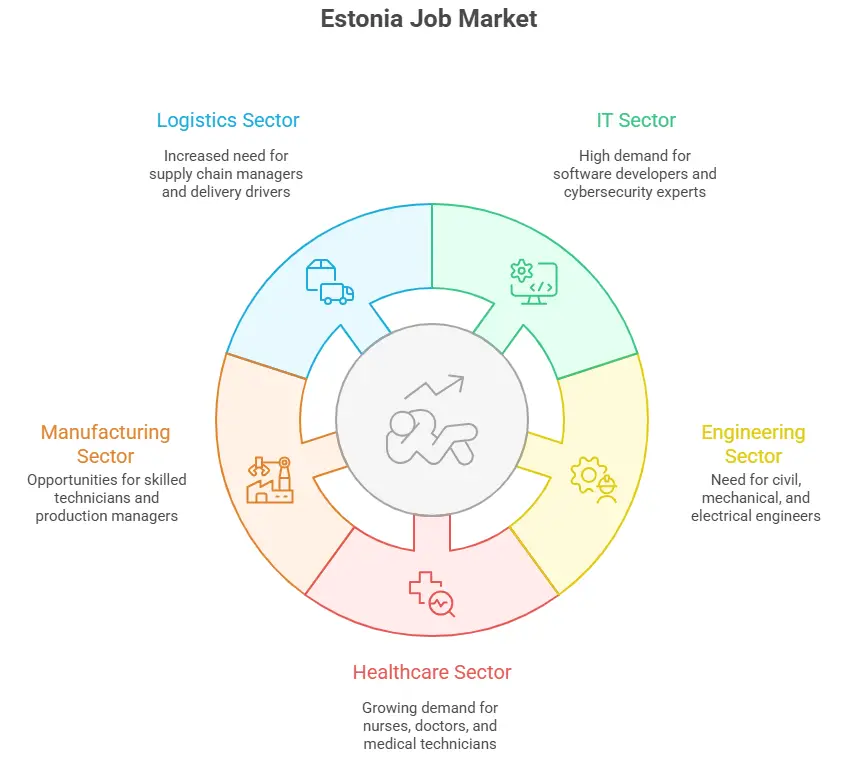
- IT, Engineering, Healthcare, Manufacturing, and Logistics are the top hiring industries
- Estonia’s digital economy ranks among the top in Europe
- More than 1,500 active start-ups driving strong demand for skilled talent
Job Outlook in Estonia
Understanding the job outlook in Estonia is essential for professionals planning to work in one of Europe’s most digitally advanced economies. Estonia offers strong employment opportunities across multiple high-demand sectors, especially for skilled international workers. The country has over 45,000–75,000 job vacancies annually, with rising demand projected through 2030. Key industries such as IT, engineering, manufacturing, logistics, and healthcare continue to hire extensively.
Major cities including Tallinn, Tartu, Pärnu, and Narva offer diverse roles for global talent. Estonia’s modern digital infrastructure, expanding start-up ecosystem with 1,500+ active start-ups, and shortage of skilled professionals make it a highly attractive destination for foreign workers.
Estonia’s welcoming work environment, competitive salaries, and strong emphasis on innovation and technology offer outstanding career opportunities. With its safe living conditions, efficient public services, and high-quality lifestyle, Estonia is an ideal choice for individuals looking to relocate and build a successful career in Europe.
*Willing to work in Estonia? Y-Axis will guide you in all the steps.
General Employment Trends in Estonia
The employment trends in Estonia are closely linked to the country’s rapidly developing digital economy and the growing demand for specialized skills. Estonia continues to prioritize highly skilled professionals, especially in IT, engineering, manufacturing, logistics, and healthcare.
The country’s overall economic performance, labour shortages, and rising technology investments shape its job market dynamics. Estonia’s aging population, limited local workforce, and evolving demographic structure are also driving demand for foreign talent. Government initiatives supporting the tech sector, start-ups, renewable energy, and automation are further contributing to increased employment opportunities across multiple industries.
Factors influencing job creation or reduction
- Digital Economy Growth: Estonia’s strong digital infrastructure and e-governance systems drive demand for IT, cybersecurity, and software roles.
- Skill Shortages: Limited local workforce and shortages in IT, engineering, healthcare, and manufacturing increase hiring needs.
- Aging Population: An older demographic creates long-term demand in healthcare, social services, and skilled labour roles.
- Technological Advancements: Automation, AI, and robotics create new tech-driven jobs while reducing some manual positions.
- Government Policies: Support for tech, start-ups, renewable energy, and industrial upgrades contributes to new job opportunities.
- Start-up Ecosystem Expansion: Estonia’s 1,500+ start-ups generate consistent hiring in tech, product, and business functions.
- Foreign Talent Recruitment: Employers increasingly hire international professionals to meet labour shortages.
- Economic Performance: Growth or slowdown in exports, manufacturing, and digital services influences job creation across sectors.
- EU Labour Dynamics: Changes within the European labour market impact Estonia’s supply of workers and job demand.
- Global Market Conditions: International trade, economic shifts, and geopolitical trends affect export-oriented industries in Estonia.
In-Demand Industries and Occupations in Estonia
The table below has the most in demand occupations in Estonia along with their salaries:
|
Occupations |
Average Salaries per annum |
|
Engineering |
€ 65,000 |
|
IT |
€ 75,000 |
|
Marketing & Sales |
€ 60,000 |
|
HR |
€ 50,000 |
|
Healthcare |
€ 75,000 |
|
Teachers |
€ 55,000 |
|
Accountants |
€ 60,000 |
|
Hospitality |
€ 50,000 |
|
Nursing |
€ 68,000 |
*Know more details about in demand occupations in Estonia.
Workforce Demands across Estonia’s Key Regions
Estonia’s workforce demand varies across its major regions, with job opportunities concentrated in areas that drive the country’s digital economy, manufacturing output, academic innovation, and industrial development. Instead of provinces, Estonia’s job market is shaped by economic hubs, each offering unique employment opportunities for skilled professionals.
The strongest workforce demand is found in Tallinn, Tartu, Pärnu, and Ida-Viru, where industries such as IT, engineering, healthcare, logistics, manufacturing, finance, and energy are actively hiring both local and international talent. These regions continue to face skill shortages, making Estonia an attractive destination for skilled professionals seeking stable and high-growth careers.
Major Employment Regions in Estonia
Below is an overview of Estonia’s most active employment regions and the types of jobs available:
|
Region / City |
Key Industries Hiring |
Why It’s a Major Hub |
|
Tallinn (Capital, Harju County) |
IT, Finance, Engineering, Start-ups, Logistics |
Home to Estonia’s largest employers, 1,500+ start-ups, and top salaries |
|
Tartu (Education & R&D Hub) |
Research, IT, Education, Biotechnology |
University-driven innovation, strong tech and research ecosystem |
|
Pärnu (Southwest Estonia) |
Tourism, Energy, Manufacturing, Services |
Fast-growing energy & manufacturing base; coastal tourism jobs |
|
Ida-Viru County |
Energy, Oil Shale, Manufacturing, Engineering |
Major industrial and energy region with strong demand for engineers |
|
Lääne-Viru County |
Food Processing, Forestry, Manufacturing |
Agriculture & food industries with growing labour needs |
|
Saaremaa (Saare County) |
Tourism, Maritime, Manufacturing |
Strong hospitality sector and export-oriented production |
|
Central & Southern Estonia |
Agriculture, Wood Industry, Skilled Trades |
Consistent demand in rural industries and essential services |
Regions with Notable Job Opportunities
Estonia offers excellent opportunities for skilled workers in:
- IT & Software Development (Tallinn, Tartu)
- Engineering & Manufacturing (Ida-Viru, Lääne-Viru, Pärnu)
- Healthcare & Nursing (nationwide shortages)
- Logistics & Warehouse Operations (Tallinn & Harju region)
- Business, Finance & HR (Tallinn, Tartu)
- Tourism & Hospitality (Pärnu, Saaremaa)
Also, read...
What are the most in-demand jobs in Estonia for the next 10 years?
Impact of Technology and Automation in Estonia
Estonia’s job market has experienced rapid growth driven by technology, automation, and one of the world’s most advanced digital ecosystems. These developments are creating strong demand for skilled workers across IT, engineering, manufacturing, logistics, healthcare, and business services.
Technological Advancements and Automation Shaping the Job Market
Estonia is known globally as a pioneering digital nation, with innovations such as e-governance, digital ID, blockchain-based public services, and an automation-friendly industrial sector. These advancements have transformed the country’s employment landscape, increasing demand for specialists in software development, cybersecurity, cloud engineering, data analytics, and AI.
Automation in manufacturing, logistics, retail, and financial services is also reshaping how companies operate. As digital tools and smart technologies continue to expand, employers are prioritising candidates with strong technical skills, adaptability, and experience with modern digital systems. Estonia’s job market increasingly favours professionals who embrace continuous learning and upskilling.
Potential Opportunities and Challenges for Workers in the Evolving Landscape
The evolving technological landscape in Estonia presents both opportunities and challenges for local and international professionals. On one hand, the booming tech ecosystem and rapid automation have created a surge in demand for talent across high-growth industries such as IT, engineering, fintech, cybersecurity, biotechnology, and smart manufacturing. Estonia’s start-up sector—home to 1,500+ active companies—continues to generate new, high-paying roles.
On the other hand, automation is gradually reducing the need for some traditional roles in administrative support, retail, manufacturing, and other routine-based services. To stay competitive, professionals must continuously reskill and upskill, especially in digital competencies, programming, data literacy, and AI-related skills.
Overall, Estonia offers exceptional career opportunities for skilled professionals ready to adapt, innovate, and grow in a fast-evolving digital economy.
Estonia’s Start-Up Ecosystem and Government Investments
Estonia is widely recognised as one of the world’s most dynamic start-up hubs, offering exceptional opportunities for skilled professionals. With one of the highest number of start-ups per capita in Europe, Estonia has built a thriving entrepreneurial ecosystem supported by strong government policies, digital innovation, and targeted investments in high-growth sectors. The country’s digital-first environment, transparent regulations, and ease of doing business make it a magnet for tech talent and global investors.
Estonia as a Global Start-Up Hub
Estonia is home to 1,500+ active start-ups, a remarkable number for a population of just 1.3 million. Many globally recognised companies—including Bolt, Wise, Skype, Pipedrive, Starship Technologies, Veriff, and Skeleton Technologies—originated in Estonia and now operate across international markets. Tallinn and Tartu serve as major innovation clusters, hosting incubators, accelerators, venture funds, and research-driven tech companies.
This fast-growing ecosystem consistently creates new job opportunities in software development, product management, cybersecurity, AI, robotics, fintech, and data engineering—making Estonia a top destination for foreign professionals.
Government Investments and Priority Sectors
The Estonian government continues to support start-up growth through Enterprise Estonia, Startup Estonia, and strategic national programmes focused on innovation and digital transformation. Key investment areas include:
- Information Technology & Digital Innovation
Estonia invests heavily in digital public services, AI-driven solutions, cybersecurity, and cloud technologies. Government-backed digitalisation programmes support both start-ups and established tech companies, creating strong demand for IT and software professionals.
- Cybersecurity & Digital Trust Technologies
As a global leader in cyber defence, Estonia invests significantly in cybersecurity infrastructure and training. The NATO Cooperative Cyber Defence Centre is based in Tallinn, strengthening the country’s role as a security innovation hub.
- Green Technology & Renewable Energy
Government initiatives target clean technologies, energy efficiency, and renewable energy solutions. Estonia is expanding wind power, solar energy, hydrogen technologies, and sustainable mobility, opening new opportunities for engineers and environmental specialists.
- Smart Manufacturing & Industry Digitalisation
Manufacturing is undergoing transformation with automation, robotics, and Industry 4.0 investments. Government support for digital factories and high-tech production boosts demand for engineers, technicians, and process specialists.
- Biotechnology & Health Technologies
Tartu’s research ecosystem promotes growth in biotechnology, pharmaceuticals, genetics, and healthtech start-ups supported by national innovation grants and university partnerships.
- Logistics, Mobility Tech & Smart Transport
Estonia supports investments in modern logistics, AI-powered mobility platforms, drone delivery technologies, and maritime innovation—making this sector a growing employer of engineering and digital talent.
Skills In-Demand in Estonia
Estonian employers actively seek skilled professionals who can contribute to the country’s fast-evolving digital economy and innovation-driven industries. As Estonia continues to expand its technology, manufacturing, engineering, and service sectors, professionals with strong technical and soft skills are in high demand across multiple fields.
Key Skills Sought by Employers in Estonia
- IT & Software Development Skills
- Cybersecurity and Digital Security
- Engineering Skills (Mechanical, Electrical, Industrial)
- Data Analytics & Machine Learning
- STEM Skills (Science, Technology, Engineering, Math)
- Technical & Programming Skills (Java, Python, C++, DevOps)
- Cloud Computing & Digital Infrastructure
- Project Management & Agile Methodologies
- Business Development & Sales
- Marketing and Digital Marketing Skills
- Financial Analysis & Accounting
- Customer Support & Client Relations
- Digital Literacy & Technology Adoption
- Problem-Solving & Critical Thinking
- Communication and Interpersonal Skills
- Adaptability & Flexibility
- Collaboration & Teamwork
- Leadership & Management Skills
- Creativity & Innovation
- Multilingual Proficiency (English + Estonian beneficial)
These skills are especially valuable in Estonia’s top hiring sectors such as IT, engineering, manufacturing, logistics, finance, and healthcare.
Importance of Upskilling or Reskilling for Job Seekers
Upskilling and reskilling play a critical role in helping job seekers remain competitive in Estonia’s fast-moving digital economy. As automation, AI, and smart technologies reshape workplaces, professionals must continuously develop new capabilities to stay relevant and advance in their careers.
Reskilling enables workers to transition into high-demand fields such as IT, data analytics, digital marketing, and cybersecurity — all of which are growing rapidly in Estonia. Upskilling strengthens existing expertise, helping individuals improve performance, adapt to new tools, and contribute more effectively to their organisations.
This commitment to continuous learning not only enhances employability but also supports Estonia’s broader culture of innovation and digital transformation. Professionals who invest in new skills are better positioned to secure high-growth opportunities and build long-term careers in Estonia.
Remote Work and Flexible Arrangements in Estonia
Remote work has become a widely accepted practice in Estonia, supported by the country’s advanced digital infrastructure and strong work-life balance culture. Many Estonian companies—especially those in the IT, finance, engineering, and start-up sectors—offer hybrid or fully remote work options to attract global talent and increase workplace flexibility.
Estonia’s Remote Work Environment
Estonia is one of the world’s most digitally advanced nations, making remote work easy, secure, and efficient. With nationwide high-speed internet, paperless government services (e-Residency, digital signatures, e-Tax), and a strong start-up ecosystem, employers are well-equipped to support remote and hybrid work models.
Many firms in Tallinn, Tartu, and other regions now offer remote roles in IT, software development, cybersecurity, customer support, design, and digital marketing. Estonia’s digital-first environment enables professionals to collaborate seamlessly across borders, making it an attractive destination for remote-friendly employers.
Estonia Digital Nomad Visa
Estonia was one of the first countries in the world to introduce a Digital Nomad Visa, allowing remote workers to live in Estonia for up to 1 year while working for a company located outside Estonia.
Requirements include:
- Working remotely for a foreign employer or owning a location-independent business
- Proof of sufficient income
- Valid health insurance
- Ability to work fully online
The Digital Nomad Visa allows individuals to live in Estonia legally while maintaining their remote job. After their stay, those who secure an Estonian employer may apply for a work visa or residence permit.
*Want to apply for an Estonia Digital Nomad Visa? Talk to experts at Y-Axis to help you with the process.
Exploring the Continuing Trend of Remote Work in Estonia
Estonia strongly embraces hybrid and flexible work arrangements. Companies increasingly allow employees to split their time between home and the office, promoting work-life balance and employee well-being. Remote work has become a standard practice across tech, financial services, digital marketing, e-commerce, and consulting sectors.
This flexible environment fosters higher productivity, creativity, and job satisfaction. Estonia’s digital infrastructure—including e-services, secure digital identity, and cloud-based systems—supports employees in working efficiently from anywhere.
Remote work also opens doors for global hiring, enabling Estonian employers to recruit international talent to meet skill shortages in IT, engineering, healthcare, and business services.
Implications for Both Employers and Employees
For Employers
- Access to a global pool of highly skilled professionals
- Improved employee satisfaction and retention
- Lower operational costs due to reduced office needs
- Ability to hire specialists in high-demand fields such as IT and data analytics
- Increased workforce diversity and inclusion
For Employees
- Greater control over work schedules
- Better work-life balance and reduced commuting time
- Increased productivity and job satisfaction
- Ability to work for Estonian companies while living anywhere in the EU/EEA
- Enhanced career prospects, especially in digital-first industries
- Flexibility to balance personal and professional goals
Remote work continues to thrive in Estonia, supported by digital innovation, government-friendly policies, and a future-ready work culture.
Government Policies and Initiatives
The Government of Estonia is actively working to attract and retain skilled foreign workers to support its growing digital economy, expanding industries, and ongoing labour shortages. Estonia’s policies focus on simplifying immigration processes, supporting start-ups, strengthening digital governance, and encouraging international talent to contribute to the country’s long-term economic growth.
Overview of Government Programs or Policies Influencing Employment
Estonia continues to welcome skilled foreign professionals to help meet workforce demands across key sectors such as IT, engineering, healthcare, manufacturing, and logistics. Through initiatives led by Startup Estonia, Work in Estonia, and the Ministry of Economic Affairs and Communications, the government promotes talent mobility, digital innovation, and job creation.
Several measures support foreign workers, including:
- Simplified work visa and residence permit pathways (D-Visa, EU Blue Card, TRP for employment)
- Digital Nomad Visa allowing remote workers to live in Estonia temporarily
- E-Residency program enabling global entrepreneurs to run EU businesses digitally
- Government funding for start-ups, digitalisation, and tech innovation
- Investment in AI, cybersecurity, and automation which directly boosts employment
With 45,000–75,000 job vacancies each year and 100,000+ openings projected between 2025 and 2030, Estonia continues to rely on skilled international workers to support economic growth and fill persistent skill shortages.
Challenges and Opportunities for Job Seekers in Estonia
Like any competitive job market, Estonia offers both opportunities and challenges for foreign job seekers. Understanding these factors helps professionals navigate the market successfully and secure suitable roles in high-demand sectors.
Challenges Faced by Job Seekers
Job seekers may encounter:
- Competition for roles in top industries, especially IT and engineering
- Skill mismatches, particularly when applying to digital or highly technical jobs
- Limited local networks, which can affect initial job search efforts
- Language barriers, although many tech and multinational companies operate in English
- Need for Estonian-equivalent qualifications for regulated professions (e.g., healthcare)
- Differences in work culture or communication styles for newcomers
These challenges can be overcome with the right preparation, skills, and job search strategy.
Tips and Strategies for Navigating the Estonian Job Market Successfully
- Upskill and reskill through courses, certifications, and digital skills training to stay competitive
- Build strong professional networks using LinkedIn, local meetups, industry events, and online communities.
- Tailor your resume and cover letter to match Estonian job requirements and highlight relevant skills
- Explore reputable job portals such as Work in Estonia, CV.ee, and company career pages
- Gain practical experience through internships, part-time roles, or volunteering if you are new to the job market
- Attend workshops, webinars, hackathons, and tech meetups to expand your industry knowledge
- Use career support services offered by local universities, expat centres, or international talent programs
- Reach out to industry professionals for informational interviews and mentorship
- Optimize your LinkedIn profile to showcase your skills, achievements, and industry-specific keywords
- Stay open to hybrid or remote positions, which are increasingly common in Estonia’s digital-first work culture
- Implementing these strategies can significantly improve your chances of securing employment and building a successful long-term career in Estonia.
Summary of Estonia Job Outlook
Estonia’s job outlook remains highly positive, driven by strong demand across its rapidly developing technology, engineering, manufacturing, logistics, and healthcare sectors. As one of Europe’s most digitally advanced nations, Estonia’s technology sector continues to expand, creating consistent demand for IT professionals, software developers, cybersecurity experts, and data specialists.
Engineering, healthcare, finance, business services, and skilled trades are also experiencing talent shortages, opening opportunities for qualified foreign professionals. With its thriving start-up ecosystem, government-backed digital innovation, and rising workforce needs, Estonia stands out as an attractive destination for job seekers looking to build successful careers in Europe.
*Looking for jobs abroad? Talk to Y-Axis for expert guidance.