
Skilled Immigration
State Territory
Employer Based Immigration
Some countries offer permanent residency anyone who has a parent,brother,sister,uncle,aunt or first cousin overseas
Investment Migration


Austria Work Visa, Work Permit Austria
Want to apply for an Austrian work visa? Talk to experts at Y-Axis to help you with Austria work visa requirements.
Why apply for an Austria Work Visa?
- Austria has over 218,000 job vacancies.
- The average annual income of Austria is 32,000 Euros.
- The average working hours in Austria is 33 hours.
- Austria has an excellent healthcare system.
- The country has an efficient social security system.
Austria has more than just mountain air, picturesque cities, extensive transportation, and stunning landscape. It offers a good quality of life. The capital of Austria, Vienna, is considered one of the most liveable cities in the world. It also offers supportive labor and employee wellness policies.
Capital: Vienna | Population: 9.1 million | Language: German (English widely used in multinational workplaces and international organisations)
*Want to Austria work visa? Let Y-Axis assist you with the process.
Benefits of working in Austria
Professionals working in Austria benefit from competitive salaries, strong labour protections, universal healthcare, excellent public transport, and one of the most comprehensive social security systems in Europe. With a high quality of life, a stable economy, and a unique 14-salary payment structure, Austria is an attractive destination for skilled professionals seeking long-term career growth and financial security.
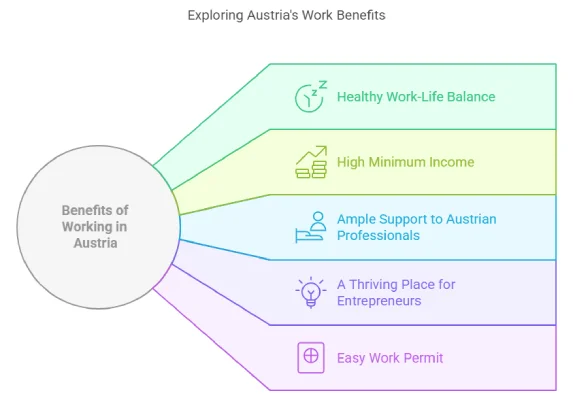
Following are the benefits of working in Austria:
- Average gross salary of €51,500 per year
- Work for 38.5–40 hours per week
- Vienna consistently ranks among the world's most liveable cities
- Access to world-class universal healthcare and education system
- Comprehensive medical and accident insurance covered through social security
- Robust pension and retirement benefits.
- 13th and 14th monthly salary payments (holiday bonus in June and Christmas bonus in November)
- Minimum 25 days paid annual leave.
- Maternity and paternity benefits with generous parental leave provisions
- Unemployment insurance coverage through the national social security scheme
- Overtime pay at a minimum rate of 150% of regular salary
*Planning to work in Austria? Y-Axis can guide you step-by-step.
Why Should Indians Migrate to Austria?
Following are the reasons why Indians should immigrate to Austria:
- Diverse Indian diaspora of approximately 31,000 members, with communities spread across Vienna, Graz, Linz, Innsbruck, and Salzburg.
- Austria faces a critical shortage of skilled workers, with 73% of Austrian companies reporting severe difficulty finding qualified candidates.
- Nearly 40,000 unfilled vacancies in technical and skilled roles across healthcare, construction, engineering, and IT.
- Austria's Red-White-Red Card and its flagship skilled worker visa operates on a transparent points-based system, making the immigration pathway clear and structured.
- Austria is consistently ranked among the world's most liveable countries, with Vienna holding the top spot globally for quality of life for multiple years running.
- Working in Austria gives Indians full access to the European Union job market and Schengen Zone.
- Austria permits dual citizenship allowing Indian professionals who naturalise toretain their Indian nationality while gaining the right to live and work across all 27 EU member states.
Also, read...
What Are the Most In-Demand Jobs in Austria for the Next 10 Years?
Austria work visa
An Austria work visa allows foreign professionals to legally live and work in Austria. The most popular option for skilled workers is the Red-White-Red Card, which is a points-based permit that assesses qualifications, work experience, age, and language skills. A confirmed job offer from an Austrian employer is required in most cases. The visa is initially valid for 2 years and can be renewed. After 5 years of legal stay, workers can apply for permanent residency. Austria has a high demand for skilled professionals in IT, healthcare, engineering, and construction, making it an attractive destination for Indian workers.
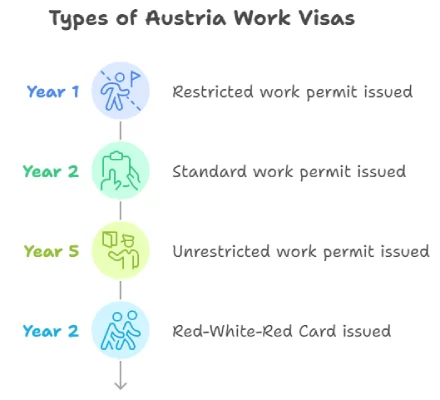
Types of Austria Work Visas
Here are the different types of work visas in Austria:
- Red-White-Red Card (RWR Card): Austria's flagship points-based work and residence permit for skilled third-country nationals. It is issued for 24 months and ties the holder to a specific employer. It is available across several sub-categories: Very Highly Qualified Workers (minimum 70 points), Skilled Workers in Shortage Occupations, Other Key Workers (minimum 55 points, minimum monthly gross salary of €3,465), and Graduates of Austrian Universities. A points calculator is available on the official migration portal.
- Red-White-Red Card Plus: An upgraded permit issued after the primary RWR Card holder has been employed for at least 21 months within the preceding 24 months. It grants unrestricted access to the Austrian labour market — allowing the holder to change employers and sectors freely. Valid for one to three years depending on integration milestones.
- EU Blue Card: A combined work and residence permit for highly qualified non-EU professionals with a job offer and a minimum gross annual salary of €47,855 (2024). Issued for 24 months and tied to a specific employer. After holding it for two years, holders can apply for the Red-White-Red Card Plus for unrestricted labour market access.
- Job Seeker Visa (Category D): A six-month visa that allows very highly qualified professionals (minimum 70 points on the RWR points system) to enter Austria and search for employment before securing a work permit. If a matching job offer is found within the validity period, the applicant can apply for the RWR Card directly from within Austria.
- Salaried Employment Work Permit: Issued to non-EU nationals with a confirmed job offer from a specific Austrian employer. Primarily used for roles in sectors requiring specific technical skills or manual labour that do not meet the higher thresholds of the RWR Card or EU Blue Card.
- Seasonal Work Permit: For temporary employment in agriculture, horticulture, and tourism/hospitality. Issued for short-term contracts and requires the employer to apply through the Public Employment Service (AMS). A special Red-White-Red Card for Regular Seasonal Workers is available for those who have completed two or more seasons with a demonstrated level of German language skills.
- Intra-Company Transfer (ICT) Permit: For managers, specialists, and trainee employees being transferred to an Austrian branch or subsidiary of a multinational company. Valid for the duration of the assignment, subject to maximum stay limits.
- Researcher / Student Visa: For academics, scientists, and international students enrolled at Austrian universities. Graduates of Austrian institutions can remain in the country for an additional six months after graduation to seek employment and apply for the RWR Card without a labour market test.
*Need assistance applying for Austria work visa? Sign-up with Y-Axis for end-to-end support.
Eligibility for Austria work visa
The eligibility for an Austria Work Visa is based on points. You have to score a minimum of 55/90. The table below gives you the list of criteria. Check your eligibility now!
| Eligibility criteria for skilled workers | Points |
|---|---|
| Qualifications | 30 |
| Completed vocational education/training in the shortage occupation | 30 |
| Work experience matching one's qualification | 20 |
| Work experience (per half-year) | 1 |
| Work experience in Austria (per half-year) | 2 |
| Language skills | 25 |
| German language skills (A1 level) | 5 |
| German language skills (A2 level) | 10 |
| German language skills (B1 level) | 15 |
| English language skills (A2 level) | 5 |
| English language skills (B1 level) | 10 |
| French language skills (B1 level) | 5 |
| Spanish language skills (B1 level) | 5 |
| Bosnian, Croatian or Serbian language skills (B1 level) | 5 |
| Age | 15 |
| Up to 30 years of age | 15 |
| Up to 40 years of age | 10 |
| Up to 50 years of age | 5 |
| The sum total of maximum allowable points | 90 |
| Additional points for corporate language English | 5 |
| Required minimum | 55 |
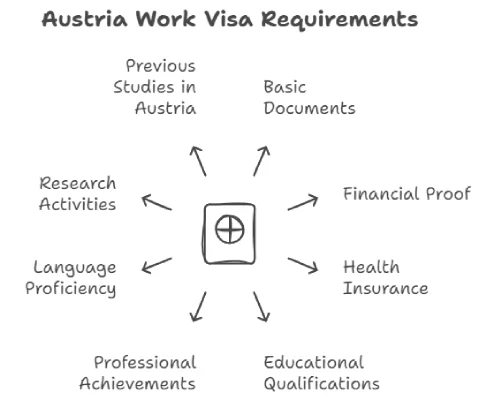
Austria Work Visa Requirements
To apply for an Austria work visa, candidates must have a relevant degree or professional qualification in a high-demand or shortage occupation field, along with a confirmed job offer from an Austrian employer. Austria operates a transparent points-based immigration system (Red-White-Red Card) that prioritises highly skilled professionals. A clean criminal record and proof of health insurance are mandatory for all applicants.
| Category | Details |
|---|---|
| Ideal Candidate Profile | IT professionals (software developers, data scientists, cybersecurity specialists), engineers (mechanical, civil, electrical, chemical), healthcare professionals (doctors, nurses, physiotherapists), skilled trades (electricians, plumbers, welders), logistics workers, researchers, academics, and managers or executives in multinational companies. |
| Education Requirements | A bachelor’s degree or higher (minimum 3 years) is usually required for skilled roles. Vocational or trade certificates are accepted for shortage occupations. Degrees must be apostilled and may require German translation. Austrian university graduates can access a simplified process without a labour market test. |
| Work Experience | Relevant experience is important under Austria’s points-based system. Most IT, engineering, and healthcare jobs require 2–3 years of experience, while senior roles require 5+ years. Indian work experience is accepted if qualifications meet Austrian standards. |
| Language Requirements | German (A1 or A2 level) is generally required for Red-White-Red Card applications. English (A2 or B1 level) may be accepted for some skilled roles. Accepted certificates include IELTS, TOEFL, TOEIC, Cambridge, Goethe-Institut, and ÖSD. |
| Salary Thresholds | Minimum salary requirements apply depending on the permit type. Other Key Workers: about €3,465 per month (2026). EU Blue Card: about €47,855 per year. Salaries in Austria are usually paid 14 times a year (including bonus payments). |
| Additional Requirements | A valid passport, Police Clearance Certificate (PCC) from India, health insurance, proof of accommodation, and a job contract from an Austrian employer are required. A labour market test may apply unless the job is in a shortage occupation or for highly qualified workers. |
The documents required for the work visa in Austria are given as follows:
- Valid passport
- Birth certificate or a document having an equivalent value
- A photograph taken in the last 6 months
- Proof of accommodation
- Proof of sufficient funds to cover your expenses
- Proof of health insurance
- Submission of biometric data
- A degree from an authorized university or higher education
- Average annual income for a senior management position
- Activities in research and innovation
- Awards and prizes
- Work certificates and testimonials
- Proof of language proficiency
- Study transcripts in Austria
Job Market in Austria
Austria offers strong job opportunities for skilled professionals across IT, engineering, healthcare, construction, logistics, and green energy sectors. With over 110 new occupations added to the national shortage list in 2025 and 73% of Austrian companies reporting a severe shortage of skilled labour, Austria actively recruits foreign professionals to sustain its growing economy. The government has streamlined the Red-White-Red Card system and expanded the shortage occupation list to attract global talent, with Red-White-Red Card approvals rising by 35% year-on-year.
Also, read...
What are the fast-track hiring options in Austria for Skilled Professionals?
Top Jobs in Austria for Indians
Austria continues to invest in digital infrastructure, healthcare, clean energy, and construction. Many employers offer visa sponsorship, competitive salaries, and comprehensive social security benefits to attract skilled workers.
| Industry | Job Roles |
|---|---|
| IT & Software | Software Developers, Cloud Engineers, Cybersecurity Specialists, Data Scientists, Agile/Scrum Masters |
| Engineering | Mechanical, Civil, Electrical, Chemical Engineers, Power Engineers, Agricultural Machinery Engineers |
| Healthcare | Doctors, Registered Nurses, Midwives, Physiotherapists, Dietitians, Social Workers |
| Construction & Skilled Trades | Electricians, Plumbers, Welders, Site Supervisors, Foremen — construction sector alone has 24,000+ unfilled vacancies |
| Transport & Logistics | Train Drivers, Bus Drivers, Conductors, Warehouse Staff, Supply Chain Coordinators |
| Hospitality & Tourism | Chefs, Hotel Staff, Restaurant Managers, Housekeeping — especially in Vienna, Salzburg, Tyrol, and Carinthia |
| Finance & Business Services | Accountants, Cost Controllers, Procurement Managers, HR, Admin |
| Education & Social Services | Childcare Workers, STEM Teachers, Training & Development Specialists |
Also, read...
Austria Job Market: Trends and Opportunities
Average Salary of Skilled Workers in Austria
Austria has one of the top 10 highest average salaries in the EU, with full-time employees benefiting from a unique 14-salary payment structure. Workers also receive automatic collective bargaining wage adjustments, comprehensive social security, and employer-funded healthcare and pension contributions.
| Experience Level | Average Gross Salary (EUR / Year) | Approx. Salary (INR / Year) |
|---|---|---|
| Entry-Level | €24,000 – €36,000 | ≈ ₹22 – ₹33 LPA |
| Mid-Level | €36,000 – €55,000 | ≈ ₹33 – ₹51 LPA |
| Senior-Level | €55,000 – €90,000+ | ≈ ₹51 – ₹83 LPA |
Also, read...
How to apply for an Austria work permit
- Step 1:Have a valid job offer from Austria
- Step 2: Apply for the Austrian work permit or Austria work visa for Indian
- Step 3:Complete the online application form
- Step 4:Give your fingerprint and Submit your Photographs
- Step 5:Pay the required fees
- Step 6:Make an appointment at your destination country’s embassy
- Step 7:Submit the form with all necessary documents.
- Step 8: Attend visa interview
- Step 9:If eligibility criteria are met, you will get a work visa to Austria
*Interested in Austria immigration? Let Y-Axis assist you with the steps.
Austria work visa processing time
The processing time if Austria work permit is about 7-8 weeks. However, it usually takes less time for restricted work visa visas, about 3 weeks.
| Visa Type | Processing Time |
|---|---|
| Red-White-Red Card (RWR Card) | 4–8 weeks |
| Red-White-Red Card Plus | 4–6 weeks |
| EU Blue Card | 4–8 weeks |
| Job Seeker Visa (Category D) | 2–4 weeks |
| Short-term Schengen Visa (Type C) | 10–15 working days |
| Long-term National Visa (Type D) | 6–12 weeks |
| Intra-Company Transfer Permit | 4–8 weeks |
| Researcher / Student Visa | 2–4 weeks (simplified fast-track for certified research institutions) |
Austria Work Visa Cost
The Red-White-Red Card application involves a three-part fee structure. This involves an initial application fee of €120, a granting fee of €20 when the card is issued, and a personalisation fee of €20 for biometric data (fingerprints, photograph, and signature) bringing the total to €160.
| Visa Type | Total Cost (EUR) | Approx. Cost (USD) |
|---|---|---|
| Red-White-Red Card (RWR Card) | €160 | ~$175 |
| Job Seeker Visa | €150 | ~$165 |
| Short-term Schengen Visa (Type C) | €80 | ~$88 |
| Long-term National Visa (Type D) | €100 | ~$110 |
Dependent Benefits for Austria Work Visa Holders
Dependents such as spouses and children of Austria work visa holders can benefit in the following ways:
| Category | Details |
|---|---|
| Dependent Benefits | Spouses and unmarried children under 18 can join the main applicant through Austria’s Family Reunification programme. The main visa holder must show stable income and suitable housing. The dependent visa is usually valid for 12 months initially and can be renewed while the main applicant remains employed in Austria. |
| Family / Spouse Work Rights | Spouses can apply for the Red-White-Red Card Plus, which allows them to work for any employer in Austria without separate sponsorship. After 2 years of residence and basic German language skills, the card can be renewed for 3 years. |
| Children’s Education | Children can study in free public schools in Austria, which are highly ranked in Europe. |
| Healthcare Access | Dependents are covered under the main applicant’s public health insurance, giving access to doctor visits, hospital care, and medicines at low cost through Austria’s universal healthcare system. |
| Family Financial Benefits | Families with children may receive child allowance of about €110 per child per month, along with childcare support and an annual climate bonus from the Austrian government. |
Pathway to Long-Term Residency in Austria
Foreign professionals can seek long-term residency in Austria through stable employment and continuous legal stay. Austria's residency pathway is structured and transparent, offering a clear step-by-step route from a work permit to permanent residency and eventually EU citizenship.
| Category | Details |
|---|---|
| Permanent Residency (PR) | After 5 years of continuous legal residence in Austria, work permit holders can apply for permanent residency. This grants the right to live and work in Austria without restrictions, access to healthcare, education, and social benefits. The permit must be renewed every 5 years but cannot be taken away as long as the holder resides in Austria. |
| Citizenship / Naturalisation | Austrian citizenship can be applied for after 10 years of continuous legal residence, with at least 5 of those years on a permanent residence permit. Applicants must show stable income for the last 36 months, pass a German language test (B1 level), pass a basic civics and history test, and have a clean criminal record. Early citizenship is possible after 6 years for those who show strong integration into Austrian society. |
| Special Pathways | The EU Blue Card is a fast-track option for highly skilled professionals earning a minimum of €47,855 gross per year. Holders can apply for unrestricted work rights after 2 years. An exceptional merit pathway also exists for entrepreneurs, scientists, and artists who make a significant contribution to Austria. Qualifying investments typically range from €800,000 to €10 million. |
| PR Eligibility Timeline | Work permit holders start with a Red-White-Red Card (valid 2 years, tied to one employer). After 21 months of employment, they qualify for the Red-White-Red Card Plus (valid 3 years, work for any employer). After 5 years total legal stay, they can apply for permanent residency, and after 10 years for full citizenship. |
| Dual Citizenship | Austria generally does not permit dual citizenship. Indian professionals who naturalise as Austrian citizens are normally required to renounce their Indian nationality. An exception applies to those granted citizenship under the extraordinary merit pathway, who may be allowed to retain their previous nationality. |
How can Y-Axis assist you to get work visa in Austria?
- Y-Axis is the best route to get work in Austria. Our impeccable services are:
- Y-Axis has helped multiple clients to work overseas.
- The exclusive Y-axis resume marketing services will help you search for your desired job overseas.
- Y-Axis coaching will help you ace the standardized test required for immigration.