
Study Country Page Content Flexy Body
Banner Image/video Desktop
Banner Image/video Mobile
Banner Heading
Study in Italy
Bottom Text
Don't know what to do?
bottom Icon
Image
icon
Form Lines
Sub Title
I am
Hide Component
Off
Sub Title
wanted to
Hide Component
Off
Sub Title
study
Hide Component
Off
Sub Title
You can connect me at
Hide Component
Off
Sub Title
and email
Hide Component
Off
Sub Title
and email
Hide Component
Off
Placeholders
Sub Title
Name
Hide Component
Off
Sub Title
Italy
Hide Component
Off
Sub Title
Mobile Number
Hide Component
Off
Sub Title
Email ID
Hide Component
Off
Hide Component
Off
Prospect Fields
Prospect Contact
India Website
Prospect Source
Website
Prospect Contact Details
Study in Italy
Bizible Country
India
Prospect Record Type
Study
Title
Why Study In Italy
Description
  • Affordable education and living expenses
  • High-quality education and well-structured course curriculum
  • Place of many top universities in various specializations
  • One of the most preferred destinations by international students
  • You can explore many places in the country at significantly less cost
  • 98% student visa success rate
Attach Pdf
Hide Component
On
Pdf Icon
Title
Eligibility criteria for Italy
Description

Educational Qualification

  • Candidates wishing to study in Italy must score at least 60% from a recognized university.

Age Limit

  • The candidate must be 18 years or older to enroll in an undergraduate program in Italy. 

English Proficiency Test Results

  • IELTS = 5.5 bands or TOEFL PBT = 507 to 557 or TOEFL CBT = 180 to 217
Hide Component
On
Title
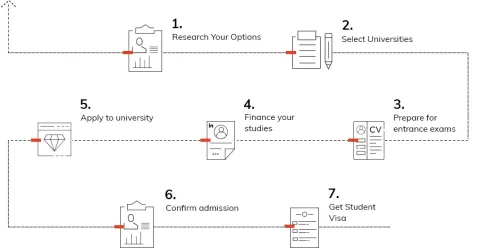
Steps to study in Italy
Sub Heading
You can check the steps given below
Chart Image
Image
Steps to study in Italy
Hide Component
On
Title
Student visa Requirement
Description

You will generally need the following to apply for the Italy Student Visa application

Sub Point
Sub Title
Valid Passport
Hide Component
On
Sub Title
Attested Copies
Hide Component
On
Sub Title
Academic References
Hide Component
On
Sub Title
Employee References
Hide Component
On
Sub Title
Certificates of Extra Curricular achievements
Hide Component
On
Sub Title
SOP (Statement of purpose)
Hide Component
On
Sub Title
An acceptance letter from educational institution
Hide Component
On
Sub Title
Proof of Payment & financial funds
Hide Component
On
Sub Title
Passport size photographs
Hide Component
On
Sub Title
Study Permit and Visa
Hide Component
On
Sub Title
English Proficiency
Hide Component
On
Sub Title
Any additional requirements from the university
Hide Component
On
Hide Component
On
Title
Cost of Study in Italy
Sub Heading
Check the Italy university fees of private/public universities, accommodation, food, and transport costs from the following table.
Points Para
Title
Tuition Fees – Public Universities
description

€900 – €8000/year

Hide Component
Off
Title
Tuition Fees – Private Universities
description

€6000 – €30000/year

Hide Component
Off
Title
Accommodation Costs
description

€300 – €1200/month

Hide Component
Off
Title
Food and Transportation Costs
description

€150 – €600/month

Hide Component
Off
Hide Component
On
Title
Upcoming intakes in Italy
Sub Heading
Italy's public and private universities offer two main intakes. The two intakes available in Italy are:
Points Para
Title
Intake 1:
description

September

Hide Component
Off
Title
Intake 2:
description

February

Hide Component
Off
Hide Component
On
Title
Work Authorization for Students:
Description

Student Applicant

  • The age group of the student applicants must be over 18 years old. 
  • Internal students are allowed to work in Italy during their studies. 20 hours of part-time work per semester and 40 hours of full-time work during the holidays are permitted. 

Spouse

  • In general, spouses are already allowed to work as students in Italy. They can support their partner financially by working part-time or full-time. 
Hide Component
On
Title
Top Universities in Canada The QS World University Rankings 2021 includes 25 top Canadian universities. The first 10 highest-ranked universities in Canada are:
Bottom Title
POST STUDY WORK OPTIONS
Bottom Description
The Canadian government offers options for international students to stay after their course and gain some work experience. The Immigration, Refugees, and Citizenship Canada (IRCC) provides the Post-Graduate Work Permit Program. Under this program, international graduates can get an open work permit valid for three years. With this permit Canadian employers can work for any employer without the need of having a job offer before making an application.
Points Para
Title
Global Rank
description

Universities

Title
#26
description

University of Toronto

Title
#27
description

McGill University

Title
#46
description

McGill University

Title
#111
description

Université de Montréal

Title
#126
description

University of Alberta

Title
#140
description

McMaster University

Title
#149
description

University of Waterloo

Title
#170
description

Western University

Title
#235
description

University of Calgary

Title
#240
description

Queen’s University at Kingston

Title
#272
description

Dalhousie University

Title
#298
description

Simon Fraser University

Title
#334
description

University of Victoria (UVic)

Title
#414
description

Université Laval

Title
#458
description

University of Saskatchewan

Title
#494
description

York University

Title
521-530
description

Concordia University

Title
581-590
description

University of Guelph

Title
591-600
description

Université du Québec

Title
601-650
description

Carleton University

Title
601-650
description

University of Manitoba

Title
651-700
description

University of New Brunswick

Title
701-750
description

University of Windsor

Title
751-800
description

Memorial University of Newfoundland

Title
751-800
description

Université de Sherbrooke

Title
801-1000
description

Ryerson University

Title
#298
description

Simon Fraser University

Title
#26
description

univercity of toronto

Hide Component
On
Heading Text
WORK OPTIONS
Sub Text
The Italy government offers options for international students to stay after their course and gain some work experience. International students are allowed to stay for 2-years after graduation. Post-study work visa can be extended another 5 years.
Image Field
Image
Work options
Country List
Hide Component
Off
Hide Component
On
Heading Text
Migrate Opportunity
Sub Text
Lorem ipsum dolor sit amet, consectetur adipiscing elit. Nunc eros ligula, pellentesque eu dapibus
Image Field
Image
Migrate Opportunity
Country List
Hide Component
Off
Hide Component
On
Heading Text
Invest Opportunity
Sub Text
Lorem ipsum dolor sit amet, consectetur adipiscing elit. Nunc eros ligula, pellentesque eu dapibus
Image Field
Image
Invest Opportunity
Country List
Hide Component
Off
Hide Component
On
Study Country Seo Og Tags
locale
en_US
type
article
Title
Study in Italy: Top Universities, Fees, Scholarships and Application Process
Description
Study in Italy with details on top universities, tuition fees, eligibility, scholarships, student visa process, and application steps.
Url
https://www.y-axis.com/visa/study/italy/
Site Name
Immigration and Visa Consultants, India | Y-Axis Overseas Careers
Article:Modified Time
2026-03-20T07:24:32+00:00
Image
https://www.y-axis.com/assets/cms/2026-03/study-visa-italy.webp
Image:Width
675
Image:Height
450
Image:Type
webp
Schema & Structured Data
{
"@context": "https://schema.org",
"@graph": [

{
"@type": "Organization",
"@id": "https://www.y-axis.com/#organization",
"name": "Y-Axis",
"url": "https://www.y-axis.com/",
"logo": {
"@type": "ImageObject",
"url": "https://www.y-axis.com/assets/cms/2025-08/Y-Axis-Logo.webp"
}
},

{
"@type": "WebPage",
"@id": "https://www.y-axis.com/visa/study/italy/",
"url": "https://www.y-axis.com/visa/study/italy/",
"name": "Study in Italy for Indian Students",
"description": "Complete guide to studying in Italy including costs, universities, visa process, scholarships, and requirements.",
"publisher": {
"@id": "https://www.y-axis.com/#organization"
}
},

{
"@type": "Article",
"headline": "Study in Italy for Indian Students – Complete Guide",
"description": "Learn everything about studying in Italy including costs, universities, scholarships, visa process, and requirements.",
"author": {
"@type": "Organization",
"name": "Y-Axis"
},
"publisher": {
"@id": "https://www.y-axis.com/#organization"
},
"mainEntityOfPage": {
"@id": "https://www.y-axis.com/visa/study/italy/"
}
},

{
"@type": "BreadcrumbList",
"itemListElement": [
{"@type": "ListItem","position": 1,"name": "Home","item": "https://www.y-axis.com/"},
{"@type": "ListItem","position": 2,"name": "Visa","item": "https://www.y-axis.com/visa/"},
{"@type": "ListItem","position": 3,"name": "Study Visa","item": "https://www.y-axis.com/visa/study/"},
{"@type": "ListItem","position": 4,"name": "Italy","item": "https://www.y-axis.com/visa/study/italy/"}
]
},

{
"@type": "FAQPage",
"mainEntity": [

{
"@type": "Question",
"name": "Is Italy a good country for Indian students to study?",
"acceptedAnswer": {"@type": "Answer","text": "Yes, Italy is a very good country for Indian students who want quality education at an affordable cost. Many universities in Italy are ranked globally and offer degrees that are accepted worldwide. Students can choose from a wide range of courses, including engineering, business, arts, and design. Many programs are available in English, so language is not always a barrier. Italy also offers a rich cultural experience, historical places, and a safe environment for international students. Overall, it is a great option for study abroad."}
},

{
"@type": "Question",
"name": "How much does it cost to study in Italy?",
"acceptedAnswer": {"@type": "Answer","text": "The cost of studying in Italy is lower compared to many other European countries. Public universities usually charge between €900 and €4,000 per year, depending on the course and university. Private universities are more expensive and may charge between €6,000 and €20,000 per year. The fees can also vary based on the student’s family income in some cases. Many universities offer flexible payment options. Overall, Italy provides good quality education at a reasonable price, making it a popular choice for international students."}
},

{
"@type": "Question",
"name": "What are the living expenses in Italy for students?",
"acceptedAnswer": {"@type": "Answer","text": "Living expenses in Italy depend on the city and lifestyle of the student. On average, students spend around ₹50,000 to ₹90,000 per month. This includes accommodation, food, transport, and other daily expenses. Cities like Rome and Milan are more expensive, while smaller cities are more affordable. Students can reduce costs by sharing accommodation and using student discounts for transport and services. Cooking at home also helps save money. With proper planning, students can manage their expenses comfortably while studying in Italy."}
},

{
"@type": "Question",
"name": "Are there scholarships available in Italy for Indian students?",
"acceptedAnswer": {"@type": "Answer","text": "Yes, there are many scholarships available in Italy for Indian students to reduce their study costs. Popular options include DSU scholarships, Italian Government Scholarships, and Erasmus+ programs. These scholarships may cover tuition fees, accommodation, and sometimes provide a monthly allowance. Some universities also offer their own scholarships based on academic performance. Students need to apply early and meet eligibility criteria to receive these benefits. Scholarships make studying in Italy more affordable and help students focus on their education without financial stress."}
},

{
"@type": "Question",
"name": "Can I study in Italy without IELTS?",
"acceptedAnswer": {"@type": "Answer","text": "Yes, some universities in Italy allow students to study without IELTS. Instead of IELTS, students can provide proof that they have studied their previous education in English medium. This is usually done through a Medium of Instruction (MOI) certificate from their school or college. However, not all universities accept this, so it is important to check the requirements of each university. In some cases, students may also need to attend an online interview to prove their English skills. So, IELTS is not always mandatory."}
},

{
"@type": "Question",
"name": "How many intakes are there in Italy?",
"acceptedAnswer": {"@type": "Answer","text": "Italy mainly has two intakes for international students. The first intake is the Autumn intake, which starts in September or October. The second intake is the Spring intake, which begins in February. Most universities offer a wide range of courses during the Autumn intake, while fewer courses are available in the Spring intake. Students should choose the intake based on course availability and application deadlines. It is always better to apply early to increase chances of admission and scholarship opportunities in Italy."}
},

{
"@type": "Question",
"name": "What are the requirements to study in Italy?",
"acceptedAnswer": {"@type": "Answer","text": "To study in Italy, students need to meet some basic requirements. They must have the required academic qualifications, such as completing 12th grade for bachelor’s programs or a degree for master’s programs. Some universities may ask for IELTS or other English language test scores, especially for English-taught courses. Students also need to show financial proof to cover tuition fees and living expenses. Other important documents include a valid passport, academic transcripts, statement of purpose, and recommendation letters. Requirements may vary depending on the university and course."}
},

{
"@type": "Question",
"name": "How can I apply to universities in Italy?",
"acceptedAnswer": {"@type": "Answer","text": "The steps to apply for universities in Italy are listed below: Step 1: Choose your course and university based on your interest and career goals. Step 2: Check the eligibility requirements for the selected program carefully. Step 3: Fill out the online application form on the official university website. Step 4: Upload required documents like academic certificates, passport copy, resume, and statement of purpose. Step 5: Pay the application fee if required by the university. Step 6: Attend an interview or entrance test if the university asks. Step 7: Receive the admission letter, which is needed to apply for your Italy student visa."}
},

{
"@type": "Question",
"name": "How long does it take to get an Italy student visa?",
"acceptedAnswer": {"@type": "Answer","text": "The processing time for an Italy student visa usually takes around 3 to 6 weeks. However, it may take longer during peak application seasons or if additional documents are required. Students should apply for the visa as early as possible to avoid delays. The process includes submitting documents, attending a visa interview, and biometric verification. It is important to ensure that all documents are correct and complete to avoid rejection or delays. Planning early helps students receive their visa on time before the course begins."}
},

{
"@type": "Question",
"name": "What is the cost of an Italy student visa?",
"acceptedAnswer": {"@type": "Answer","text": "The cost of an Italy student visa generally ranges from €80 to €110, depending on the visa type and duration of stay. This fee is paid at the time of submitting the visa application. In addition to the visa fee, students may also need to pay service charges, biometric fees, and document processing costs. These extra charges can vary based on the application center. It is important to check the latest fee details before applying. Overall, the visa cost is reasonable compared to many other countries."}
},

{
"@type": "Question",
"name": "Can international students work in Italy while studying?",
"acceptedAnswer": {"@type": "Answer","text": "Yes, international students in Italy are allowed to work while studying. They can work up to 20 hours per week during their academic sessions. During holidays, students may be allowed to work full-time. Part-time jobs help students manage their living expenses and gain work experience. Common job options include working in restaurants, cafes, retail stores, or as university assistants. However, students must balance work and studies to maintain good academic performance. Having basic Italian language skills can also improve job opportunities in Italy."}
},

{
"@type": "Question",
"name": "What is the average salary for part-time jobs in Italy?",
"acceptedAnswer": {"@type": "Answer","text": "Students working part-time in Italy can earn around €8 to €12 per hour, depending on the job role and city. Jobs in larger cities may offer slightly higher pay compared to smaller towns. Common part-time roles include working in cafes, restaurants, shops, or doing freelance work. Some university jobs may also be available for students. Although part-time income may not cover all expenses, it can help with daily costs like food and transport. Learning basic Italian can help students find better-paying job opportunities."}
},

{
"@type": "Question",
"name": "What are the best courses to study in Italy?",
"acceptedAnswer": {"@type": "Answer","text": "Italy offers many popular courses for international students. Some of the best courses include Engineering, Business and Management, Fashion Design, Architecture, and Computer Science. Italy is especially famous for its fashion and design programs, with many top institutions in this field. Engineering and business courses are also highly valued and recognized globally. Students can choose from a wide range of English-taught programs. Selecting the right course depends on the student’s interests and career goals. Italy provides strong academic support and career opportunities."}
},

{
"@type": "Question",
"name": "Are degrees from Italy recognized globally?",
"acceptedAnswer": {"@type": "Answer","text": "Yes, degrees from Italy are recognized all over the world. Italy follows the Bologna Process, which is a European education system that ensures degrees are accepted internationally. This makes it easier for students to continue higher studies or find jobs in other countries. Italian universities maintain good academic standards and offer quality education in many fields. Employers and universities worldwide value Italian degrees. So, studying in Italy can open global career opportunities and help students build a strong future in different countries."}
},

{
"@type": "Question",
"name": "Are there English-taught programs in Italy?",
"acceptedAnswer": {"@type": "Answer","text": "Yes, Italy offers more than 500 English-taught programs, especially at the master’s level. Many universities provide courses in fields like engineering, business, design, and science in English. This makes it easier for international students who do not know Italian. English-taught programs follow international standards and are recognized globally. Students can study comfortably without language barriers. However, learning basic Italian can still be helpful for daily life and part-time jobs. Overall, Italy is a good option for students looking for English-medium education in Europe."}
},

{
"@type": "Question",
"name": "Can I stay in Italy after graduation?",
"acceptedAnswer": {"@type": "Answer","text": "Yes, international students can stay in Italy after graduation to search for a job. Students are usually allowed to stay for up to 12 months after completing their studies. During this time, they can look for full-time job opportunities related to their field. Once they find a job, they can apply for a work permit or convert their student visa into a work visa. This opportunity helps students gain international work experience and start their careers in Italy or other European countries."}
},

{
"@type": "Question",
"name": "Is health insurance required for students in Italy?",
"acceptedAnswer": {"@type": "Answer","text": "Yes, health insurance is mandatory for all international students in Italy. Students must have valid health coverage to apply for a student visa and stay in the country. They can either choose private health insurance or register for the Italian public healthcare system. Health insurance helps cover medical expenses, doctor visits, and emergencies. It ensures that students receive proper medical care when needed. Having insurance also gives peace of mind and helps students focus on their studies without worrying about health issues."}
},

{
"@type": "Question",
"name": "What documents are required for an Italy student visa?",
"acceptedAnswer": {"@type": "Answer","text": "The documents required to apply for an Italy student visa are listed below: Valid passport, Official admission letter from an Italian university, Proof of financial support, Health insurance coverage, Academic certificates and transcripts, Completed visa application form, Passport-sized photographs, Proof of accommodation in Italy, Travel itinerary"}
},

{
"@type": "Question",
"name": "What are the highest-paying jobs in Italy?",
"acceptedAnswer": {"@type": "Answer","text": "Some of the highest-paying jobs in Italy are in fields like STEM, IT, healthcare, engineering, and finance. Professionals in these areas often earn higher salaries due to their skills and demand in the job market. Roles such as software developers, engineers, doctors, and financial analysts are well-paid. Experience and qualifications also affect salary levels. Students who choose these fields can expect better career growth and job opportunities. Learning new skills and gaining experience can help increase earning potential in Italy."}
},

{
"@type": "Question",
"name": "Is Italy safe for international students?",
"acceptedAnswer": {"@type": "Answer","text": "Yes, Italy is generally considered safe for international students. Most cities, especially those with universities, are student-friendly and have a welcoming environment. Students can move around safely during the day and follow basic precautions at night. Like any country, it is important to be aware of surroundings and avoid unsafe areas. Universities also provide support services for international students. Overall, Italy offers a safe and comfortable environment for students to live, study, and enjoy their experience abroad."}
},

{
"@type": "Question",
"name": "Do I need to learn Italian to study in Italy?",
"acceptedAnswer": {"@type": "Answer","text": "Learning Italian is not mandatory if you are studying in an English-taught program. Many universities offer courses in English, so students can study without knowing Italian. However, learning basic Italian can be very helpful in daily life. It can make it easier to communicate with locals, shop, travel, and find part-time jobs. Knowing the language also helps students feel more comfortable and confident. So, while it is not required for studies, learning Italian is definitely useful for living in Italy."}
},

{
"@type": "Question",
"name": "Why choose Italy over other European countries?",
"acceptedAnswer": {"@type": "Answer","text": "Italy is a great choice for students because it offers a mix of affordable education, rich culture, and good career opportunities. Tuition fees are lower compared to many European countries, and there are several scholarships available. Italy is known for its history, art, food, and lifestyle, giving students a unique cultural experience. Many universities offer English-taught programs, making it accessible for international students. It also provides post-study work options. Overall, Italy gives a balanced experience of education, culture, and career growth."}
}

]
}

]
}
Twitter Card
summary_large_image
Twitter Image
https://www.y-axis.com/assets/cms/2026-03/study-visa-italy.webp
Twitter Label 1
Est. reading time
Twitter Data 1
12 minutes
Canonicals
https://www.y-axis.com/visa/study/italy/
Keywords

Study in Italy, Study in Italy from India, Italy Student Visa, Italy study visa requirements, Italy university admission, Tuition fees in Italy, Study abroad Italy, Italian universities, Italy student visa processing time, Masters in Italy, Italy education

Description

Study in Italy with details on top universities, tuition fees, eligibility, scholarships, student visa process, and application steps.

Content Component

Study in Italy: Universities, Courses, Visa, Scholarships & Cost

Italy has become one of the top study destinations in Europe because of its high-quality education, affordable tuition fees, and rich cultural experience. Over 32,000 international students choose to study in Italy every year.

Italy is famous for its history, art, architecture, and design. It is home to some of the oldest universities in the world and is especially strong in fields like fashion, design, engineering, science, and business. Students from across the world, including India, choose Italy for both academic excellence and a vibrant student life.

Italy has more than 90 universities offering a wide range of courses. Many universities provide over 500 English-taught programs, especially at the postgraduate level, making it easier for international students to study without knowing Italian initially.

The country follows the Bologna education system, which ensures that degrees are recognized globally. Along with classroom learning, students also gain practical experience through internships, projects, and industry exposure.

Another big advantage is Italy’s location in the center of Europe, which allows students to travel easily to other European countries. With its affordable education, diverse courses, and unique cultural lifestyle, Italy offers the perfect balance of learning and life experience for students planning to study abroad.

*Want to study abroad? Sign-up with Y-Axis for expert guidance

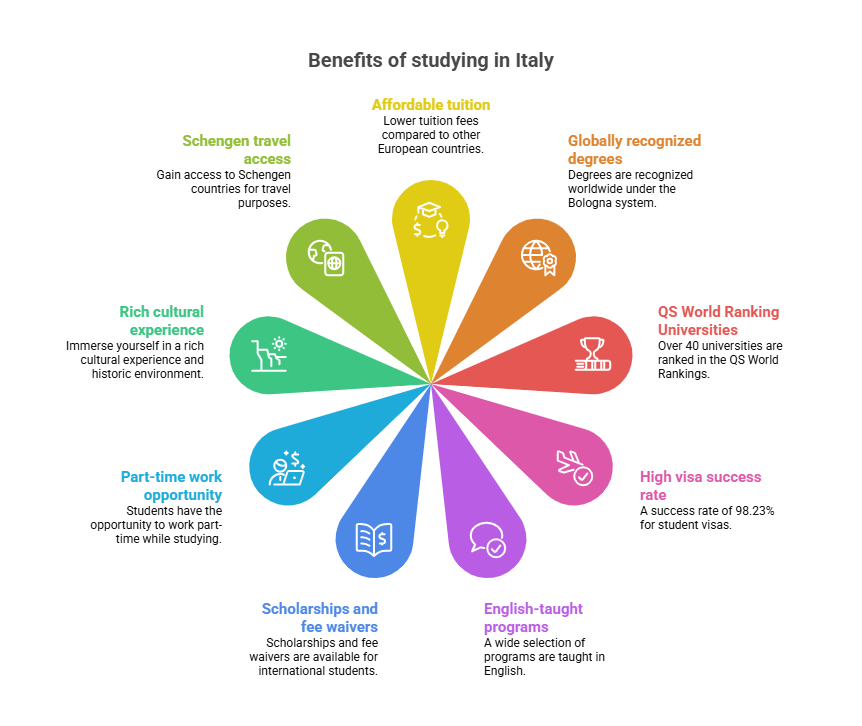
Why Study in Italy?

  • Affordable tuition fees compared to other European countries
  • Globally recognized degrees under the Bologna system
  • 40+ QS World Ranking Universities
  • 98.23% Student Visa success rate
  • Wide range of English-taught programs
  • Scholarships and fee waivers available for international students
  • Opportunity to work part-time during studies
  • Rich cultural experience and historic environment
  • Access to Schengen countries for travel
Study in Italy

Why Indian Students Choose Italy for Higher Education?

Affordable Education

Italy is a great option for Indian students who want quality education at a lower cost. Compared to countries like the USA, UK, or Australia, studying in Italy is much more affordable. Public universities usually charge between €900 and €4,000 per year, while private universities may charge €6,000 to €20,000 per year. In addition, many universities offer tuition fee reductions based on the student’s family income. This makes it easier for students from different financial backgrounds to study in Italy without a heavy financial burden.

Globally Recognized Degrees

Degrees from Italian universities are accepted and respected all over the world. Italy follows the European education system, which ensures high academic standards and global recognition. Students who graduate from Italy can apply for jobs or higher studies in many countries. Italy is especially famous for courses in fashion and design, architecture, engineering, and arts and humanities. The strong academic reputation helps students build a successful international career.

Scholarships & Financial Support

Italy provides many scholarship options for international students, including Indians. One of the most popular options is the DSU regional scholarship, which can fully cover tuition fees and even provide support for accommodation and living expenses. Apart from this, there are Italian government scholarships and university-specific scholarships. These financial aids reduce the overall cost of studying and make education more accessible for students.

Strong Career Opportunities

Italy offers good career opportunities for international students after completing their studies. There is a growing demand for skilled professionals in fields like engineering, design, business, and hospitality. After graduation, students can stay in Italy for up to 12 months to search for a job. During this time, they can attend interviews and explore job opportunities. This gives students a chance to start their career in Europe and gain international work experience.

Well-Structured and Globally Accepted Education System

Italy has more than 90 universities offering many courses for students. The education system is simple, with 3 years for a Bachelor’s, 2 years for a Master’s, and 3–5 years for a PhD. Italy follows the Bologna system, which means degrees are recognized across Europe and worldwide. This also allows students to study or work in other countries easily.

There are 500+ English-taught programs, especially for master’s courses, making it easier for international students. Universities focus on both theory and practical learning, including research and projects, which helps students gain skills needed for global careers.

Top Universities in Italy for Indian Students

Italy has many well-known universities that offer high-quality education and are recognized around the world. These universities are known for their strong academic standards, experienced faculty, and modern research facilities. They provide a wide range of courses in fields like engineering, business, science, and arts. Many of these universities are ranked in global rankings like QS World University Rankings. They also offer affordable tuition fees compared to other countries. Students can benefit from practical learning, research opportunities, and industry exposure, which helps them build strong careers after graduation. Italy also has a mix of public and private universities. Public universities are more popular among international students because of their lower fees and strong reputation. The below table shows the top 10 universities in Italy:

University

QS Ranking

Average Tuition Fee

Politecnico di Milano

98

€3,000–€4,000

Sapienza University of Rome

128

€1,000–€3,000

University of Bologna

138

€2,000–€3,500

University of Padova

219

€2,500–€3,500

Politecnico di Torino

242

€2,500–€3,500

University of Milan

276

€1,500–€3,500

University of Pisa

343

€2,000–€3,500

University of Florence

404

€2,000–€3,500

*Read more....

Most affordable universities in Italy

Popular Courses to Study in Italy

Italy offers a wide range of courses for international students across different fields. Universities are especially known for their strong programs in engineering, business, design, and technology. Many courses are designed to provide both theoretical knowledge and practical skills, helping students prepare for real-world careers.

Students can choose from undergraduate and postgraduate programs based on their interests and career goals. Italy is also popular for specialized courses like fashion design, architecture, and hospitality, which are highly valued globally.

Programme

Duration

Popular Specializations

Engineering

2–4 years

Mechanical, Civil, Automotive, Electrical, Mechatronics, Robotics

Business / MBA

1–2 years

Finance, Marketing, International Business, Supply Chain, Entrepreneurship

Arts & Design

3 years

Fashion Design, Interior Design, Graphic Design, Fine Arts, Visual Communication

Computer Science & IT

2 years

Artificial Intelligence, Data Science, Cybersecurity, Software Engineering, Cloud Computing

Architecture

3–5 years

Urban Planning, Sustainable Architecture, Landscape Design, Interior Architecture

Hospitality & Tourism

2–3 years

Hotel Management, Tourism Management, Event Management, Culinary Arts

Natural Sciences

2–3 years

Physics, Chemistry, Biology, Environmental Science, Biotechnology

Social Sciences

2–3 years

Psychology, Sociology, International Relations, Political Science

Law

1–3 years (LLM)

International Law, Business Law, European Law, Human Rights Law

Medicine & Healthcare

5–6 years

General Medicine, Dentistry, Pharmacy, Medical Research

*Willing to apply for Masters in Italy? Contac Y-axis for end-to-end support

Cost of Studying in Italy

The cost of studying in Italy is one of the key reasons why many Indian students choose this country. Compared to countries like the USA, UK, or Australia, Italy offers quality education at a much lower cost. Both tuition fees and living expenses are relatively affordable. Below is a simple breakdown of the main costs you should plan for.

Tuition Fees at Public and Private Universities

There is a clear difference between public and private universities in Italy. Public universities are more affordable and charge tuition fees based on the student’s family income. On average, fees range between €900 and €4,000 per year.

Private universities are more expensive and usually charge between €6,000 and €20,000 per year, depending on the course and institution. Specialized programs like MBA can have higher fees, ranging from €10,000 to €35,000 in total.

University Type

Tuition Fee Range

Notes

Public Universities

€900–€4,000 per year

Fees may vary based on family income

Private Universities

€6,000–€20,000 per year

Higher fees for specialized and English-taught programs

MBA Programs

€10,000–€35,000 (total)

Fees depend on university and course

Additional Charges and Fees

Apart from tuition fees, students may need to pay some additional charges. These can include administrative fees, exam fees, and student service charges. Compared to other countries, these costs are usually low and manageable.

Some universities also include benefits like access to libraries, student support services, and discounted transport facilities.

Cost of Living in Italy

Living expenses in Italy depend on the city you choose. Major cities like Milan and Rome are more expensive, while smaller cities are more affordable.

Average Monthly Expenses:

  • Accommodation: ₹25,000 – ₹50,000
  • Food: ₹10,000 – ₹15,000
  • Transport: ₹3,000 – ₹6,000
  • Estimated monthly cost: ₹50,000 – ₹90,000
  • Estimated annual cost: ₹6 lakh – ₹10 lakh

*Read more...

Study in Italy for free

Top Scholarships to Study in Italy for Indian Students

Italy offers several scholarship opportunities for international students, including Indians. These scholarships are provided by the Italian government, regional authorities, universities, and European programs. Since tuition fees in Italy are already affordable, scholarships mainly help students cover living expenses, accommodation, tuition fees, and other study-related costs.

Scholarships are available for Bachelor’s, Master’s, and PhD students. Some are based on academic merit, while others are based on financial need. Below is a list of the most popular scholarships in Italy, along with the amount and eligibility criteria.

Scholarship Name

Scholarship Amount

Eligibility

DSU Scholarship

Fully funded (covers tuition fees, accommodation, and meals in many cases)

Based on financial need; open to international students including Indians

Italian Government Scholarship

Around €900 per month

Merit-based; open to international students applying for higher education programs

University Scholarships

Varies depending on university

Based on academic performance; offered by individual universities

Erasmus+ Scholarship

Covers tuition fees, travel, and living expenses

Open to students enrolled in Erasmus partner or exchange programs

*Want to apply for scholarships to study in Italy? Contact Y-Axis for guidance

Study in Italy Requirements

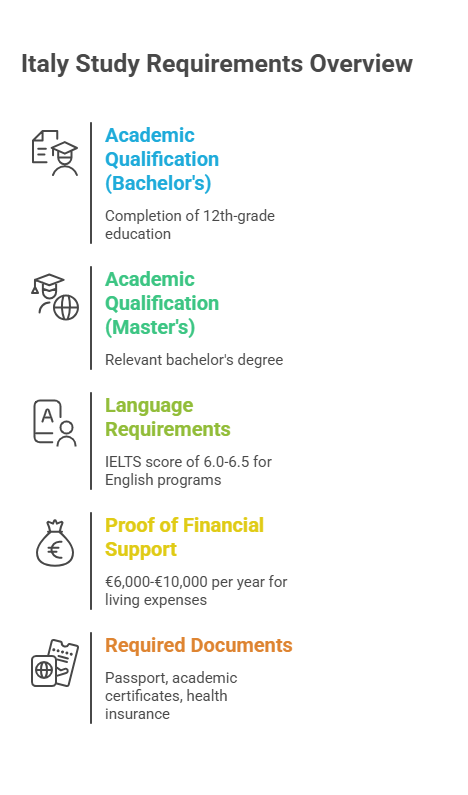
Before applying to universities in Italy, students must meet some basic academic and eligibility requirements. These may vary depending on the course and university, but the general requirements are:

  • Academic Qualification (Bachelor’s): Completion of 12th-grade education from a recognized board
  • Academic Qualification (Master’s): A relevant bachelor’s degree from a recognized university
  • Language Requirements:

IELTS score of 6.0–6.5 for English-taught programs. Some universities may accept other English proficiency tests

Proof of Financial Support: Around €6,000–€10,000 per year to cover living expenses

  • Required Documents: Valid passport, Academic certificates and transcripts, Other documents as required by the university, Health Insurance
Italy Student Visa Requirements

Step-by-Step Application Process to Study in Italy

The application process for studying in Italy is simple and can be completed step by step.

Step 1: Choose a University
First, select the course and university based on your interest, budget, rankings, and location.

Step 2: Check Admission Requirements
Review the eligibility criteria, required documents, and language requirements for your chosen program.

Step 3: Prepare Financial Documents
Arrange proof of funds to show that you can support your studies and living expenses in Italy.

Step 4: Apply to Universities
Submit your application through the university’s official website along with all required documents.

Step 5: Apply for Health Insurance
Purchase health insurance, which is compulsory for international students in Italy.

Step 6: Apply for Italy Student Visa
After receiving the admission letter, apply for a student visa at the Italian embassy or consulate.

Step 7: Find Accommodation
Search for housing options such as student dormitories or shared apartments based on your budget.

Step 8: Complete Enrollment
After arriving in Italy, submit your documents to the university and pay the required fees to complete enrollment.

Italy Student Visa

The Italy student visa is an important step for international students who want to study in Italy for more than 90 days. This is usually a long-stay visa (Type D), which allows students to enter Italy and stay for the duration of their course. To apply for this visa, students must first receive an official admission letter from a recognized Italian university.

Applicants are required to submit documents such as a valid passport, completed visa application form, proof of admission, academic records, and passport-size photographs. One of the key requirements is proof of financial means, showing that the student can cover tuition fees and living expenses during their stay. Students must also provide health insurance coverage and proof of accommodation in Italy.

How to Apply for an Italy Student Visa from India?

Step 1: Make sure you meet all the requirements, including admission to an Italian university, financial proof, and valid documents before applying.

Step 2: Collect all necessary documents such as passport, admission letter, academic certificates, financial proof, health insurance, and photographs. Ensure all documents are correct and updated.

Step 3: Fill out the Italy student visa application form online and submit your application through the Italian Embassy or VFS center. You may also need to attend a visa appointment.

Step 4: After submitting your application, wait for the visa decision. You may be asked for additional documents or clarification during this time.

Step 5: Once your visa is approved, you can travel to Italy and start your studies. After arrival, apply for a residence permit (Permesso di Soggiorno).

Italy Student Visa Fee

The cost of an Italy student visa depends on the type of visa you apply for. A short-term student visa usually costs around €80–€100, while a long-term student visa costs approximately €76–€110. The visa fee may change depending on government rules and currency variations. Students should check the latest fee before applying.

Italy Student Visa Processing Time

The processing time for an Italy student visa is usually 3 to 6 weeks. However, it can sometimes take longer if there are many applications or if additional document verification is required. To avoid delays, students should submit complete and accurate documents and apply well in advance.

Part-Time Jobs in Italy for Students

Part-time jobs are a good way for students in Italy to manage their daily expenses and gain work experience. International students are allowed to work up to 20 hours per week during their studies. During holidays or semester breaks, they may work more hours depending on their schedule.

The average pay for part-time jobs in Italy is around €8 to €12 per hour, depending on the type of job, city, and experience. Working part-time not only helps students financially but also improves their communication skills and gives them exposure to the local work culture. Knowing basic Italian can also help students find better job opportunities.

Best Part-Time Jobs for Students in Italy

  • Retail Assistant – Work in shops or supermarkets, helping customers and managing billing
  • Restaurant / Café Staff – Jobs like waiter, barista, or kitchen helper in restaurants and cafés
  • Delivery Jobs – Delivering food or parcels through apps or local services
  • University Assistant – Working within the university as a library assistant or helping professors
  • Private Tutor – Teaching school subjects or English to local students
  • Hotel Staff – Working in hotels or hostels in roles like reception or housekeeping
  • Freelance / Online Jobs – Content writing, graphic design, or other remote work opportunities

These jobs help students support themselves while also gaining useful skills and experience for their future careers.

Post-Study Visa and Work Opportunities in Italy

After completing their studies in Italy, international students have the opportunity to stay back and look for a job. Italy allows graduates to apply for a post-study residence permit (up to 12 months), which gives them time to search for a job related to their field of study. During this period, students can attend interviews and explore different career options.

Once students find a job, they can convert their student permit into a work permit, which allows them to stay and work legally in Italy. This is an important step for those who want to build their career in Europe.

With continuous legal stay and employment, students can later apply for Permanent Residency (PR) in Italy after 5 years. This gives them the right to live and work in Italy long-term and enjoy more stability and benefits.

Some of the highest paying jobs in Italy are listed below:

Occupation

Average Annual Salary

IT and Software

€93,432

Healthcare

€85,713

Engineering

€77,500

Accounting and Finance

€75,210

Nursing

€78,000

Sales and Marketing

€68,220

STEM

€95,500

Human Resource Management

€53,000

Tourism

€55,000

Teaching

€55,225

*Read more....

In-demand jobs in Italy

Intakes in Italy

Italy has 2 main study intakes for international students. Students can choose based on course availability and deadlines.

Intake

Study Program

Intake Period

Application Deadlines

Autumn (Fall)

Undergraduate & Postgraduate

September / October

Usually January to June (can start as early as Dec and end by June/July)

Spring (Winter)

Limited Undergraduate & Postgraduate programs

February / March

Usually October to December (previous year)

Build Your Future in Italy

Italy is a great choice for students who want good quality education at an affordable cost. It offers a perfect balance of strong academic programs, practical learning, and a rich cultural experience. Students can choose from many courses and also benefit from scholarships that help reduce their expenses.

Studying in Italy also gives students international exposure, which helps them build global career opportunities. With good education, part-time work options, and post-study job opportunities, Italy provides a strong path for students to grow personally and professionally. For Indian students who want to study in Europe, Italy can be a smart and valuable choice for building a successful future.

How can Y-Axis help you?

Y-Axis offers complete support for students planning to study in Italy, with transparent and personalized guidance.

Our services include:

  • Free Counseling: Free Counseling on university and course selection.
  • Expert guidance on course and university selection
  • IELTS/PTE coaching through Y-Axis coaching services
  • SOP, LOR, and application assistance
  • Italy student visa documentation and interview support
Colour
Yellow
Country