

Lithuania Tourist Visa, Lithuania Visa, Lithuania Visit Visa
How to get a Lithuania Tourist Visa from India? Know the key eligibility requirements, fees for Indian citizens for the quick online visa application process.
Why Apply for a Lithuania Tourist Visa?
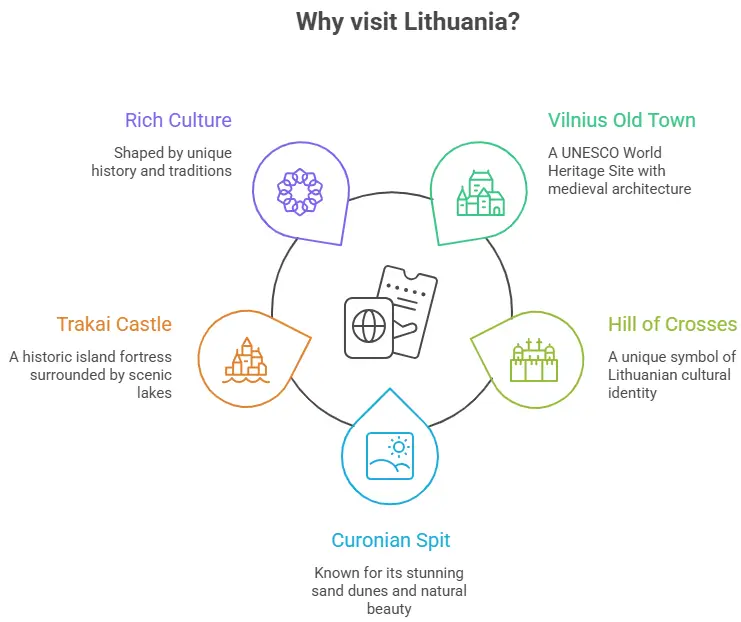
- Explore Vilnius Old Town, a UNESCO World Heritage Site with rich medieval architecture.
- Visit the Hill of Crosses, a unique symbol of Lithuania’s cultural identity.
- Experience the Curonian Spit, known for its stunning sand dunes and natural beauty.
- Discover Trakai Castle, a historic island fortress surrounded by scenic lakes.
- Experience Lithuania’s rich culture, shaped by its unique history and traditions.
Lithuania Visa for Indians
Indian passport holders must apply for a Schengen visa to enter Lithuania for tourism, leisure, or short stays. The Lithuania tourist visa, officially known as the Type C Short-Stay Schengen Visa, allows Indians to stay for up to 90 days within a 180-day period and grants access to all 29 Schengen member states with a single visa. With proper preparation and assistance from Y-Axis, applying for a Lithuania visa can be a smooth process.
*Want to apply for a Lithuania tourist visa? Sign up with Y-Axis to help you with the process.
Types of Lithuania Tourist Visa
Type A Visa — Airport Transit Visa
The Type A Airport Transit Visa is for travellers passing through a Lithuanian airport en route to a non-Schengen country. Holders of this visa are permitted to remain within the international transit area of the airport only and cannot enter Lithuanian territory.
Type C Visa — Short-Stay Schengen Visa
The Type C Short-Stay Schengen Visa is the standard Lithuania tourist visa issued for short stays of up to 90 days within any 180-day period. It covers a wide range of purposes, including tourism, visiting family or friends, and short-term business visits. The Lithuania tourist visa can be issued as a Single-entry, Double-entry, or Multiple-entry visa, with a multiple-entry visa valid for up to 5 years. As Lithuania is part of the Schengen area, this visa also grants access to all 29 Schengen member states.
*Want to apply for a Schengen visa? Let Y-Axis guide you with the steps.
Benefits of a Lithuania Tourist Visa
- Grants access to all 29 Schengen member states on a single visa, making it ideal for multi-country travel across Europe.
- Available in Single-entry, Double-entry, and Multiple-entry options, offering flexibility to suit different travel needs and frequencies.
- Allows a stay of up to 90 days within any 180-day period across the entire Schengen area.
- A Multiple-entry Lithuania tourist visa is valid for up to 5 years, eliminating the need to reapply for every trip.
- Covers a wide range of travel purposes, including tourism, visiting family or friends, and short-term business visits.
Top 5 Best Places to Visit in Lithuania
Lithuania is a destination that offers a compelling mix of medieval history, Baltic coastal landscapes, and a rich cultural heritage that remains largely undiscovered by mainstream tourism. From its UNESCO-listed capital city to the extraordinary natural landscapes of the Curonian Spit, Lithuania has something distinctive to offer every kind of traveller.
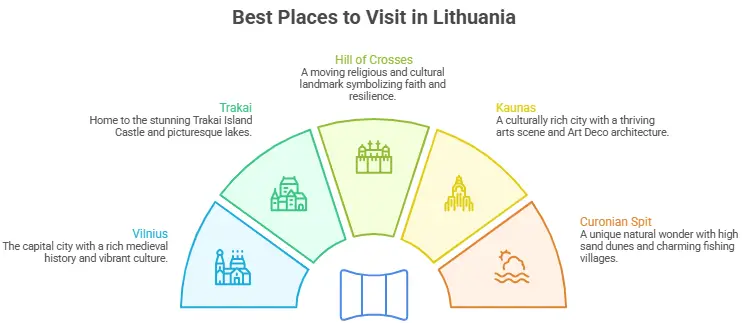
Here are the top 5 places to visit in Lithuania:
- Vilnius: The capital of Lithuania and home to one of the largest medieval old towns in Northern Europe, Vilnius is a UNESCO World Heritage Site celebrated for its cobblestone streets, Baroque churches, and a fascinating blend of Gothic, Renaissance, and Baroque architecture. The city is home to iconic landmarks such as the Cathedral Basilica of St Stanislaus and St Vladislav, the Gediminas Castle Tower, and the charming bohemian district of Užupis, which famously declared itself an independent republic in 1997. Vilnius is also home to Vilnius University, the oldest university in the Baltic states, founded in 1579, and a thriving café culture that makes the city a pleasure to explore on foot.
- Trakai: Located just 30 kilometres from Vilnius, Trakai is one of the most visited destinations in Lithuania and home to the magnificent Trakai Island Castle, a 14th-century Gothic castle perched on an island in Lake Galvė. The castle was the only island castle in Eastern Europe at the time of its construction and served as the primary residence of the Grand Duke of Lithuania. The surrounding landscape of lakes, forests, and islands makes Trakai one of the most picturesque destinations in the entire Baltic region. The town is also home to the Karaim community, a Turkic-speaking ethnic group with a unique cultural heritage, whose traditional pastries, known as Kibinai, are a must-try for visitors.
- The Hill of Crosses: Situated near Šiauliai in northern Lithuania, the Hill of Crosses is one of the most extraordinary and moving sites in the Baltic region. The hill is covered with over 100,000 crosses of all shapes and sizes, placed there by Lithuanians over centuries as a symbol of faith, national identity, and resistance to occupation. The site has been destroyed multiple times, including by the Soviet authorities in 1961, yet the crosses continued to reappear overnight, making it a powerful symbol of Lithuanian resilience and perseverance. In 1993, Pope John Paul II visited the Hill of Crosses and blessed the site, cementing its status as one of Lithuania's most significant religious and cultural landmarks.
- Kaunas: Lithuania's second-largest city, Kaunas, is a vibrant and culturally rich destination with a thriving arts scene and a wealth of historical landmarks. The city's medieval Old Town, centred on the confluence of the Nemunas and Neris rivers, is home to the impressive Kaunas Castle, one of the oldest stone castles in Lithuania, dating back to the 14th century. Kaunas served as the temporary capital of Lithuania between 1920 and 1939, during which time it developed a distinctive Art Deco architectural style that sets it apart from other Baltic cities. The city is also home to the Žalgiris Arena, one of the largest indoor arenas in the Baltic states.
- The Curonian Spit: A UNESCO World Heritage Site shared between Lithuania and Russia, the Curonian Spit is a 98-kilometre-long, narrow strip of land that separates the Curonian Lagoon from the Baltic Sea and is home to the highest drifting sand dunes in Europe, rising to 60 metres above sea level. The Lithuanian portion of the spit, known as Neringa, comprises a series of charming fishing villages, including Nida, Juodkrantė, and Pervalka, surrounded by pine forests, white sand beaches, and dramatic dune landscapes. The spit is accessible from the port city of Klaipėda via a short ferry crossing. It is one of the most popular natural destinations in the entire Baltic region for walking, cycling, and nature exploration.
Eligibility Criteria for Lithuania Tourist Visa
- Must hold a valid passport with a minimum validity of 3 months beyond the intended date of departure from the Schengen area, containing at least two blank pages.
- Sufficient funds to cover all expenses for the entire duration of the stay in Lithuania.
- A clean criminal record with no history of visa violations or overstays in the Schengen area.
- Strong ties to the home country, such as employment, family, or property, demonstrate a clear intent to return after the visit.
- A genuine and clearly stated purpose of visit, whether for tourism, visiting family or friends, or short-term business.
Requirements for Lithuania Tourist Visa
- Duly completed Schengen visa application form, filled in online through the official MIGRIS system at migracija.lt, printed and signed.
- Two recent passport-sized colour photographs as per Schengen specifications.
- Valid passport with at least two blank pages, issued within the last 10 years, and valid for at least 3 months beyond your intended date of departure.
- Copies of previously issued visas, if any.
- Cover letter stating the purpose and duration of your visit to Lithuania.
- Confirmed round-trip flight itinerary.
- Confirmed hotel booking or other valid proof of accommodation.
- Travel insurance with a minimum coverage of €30,000, valid across the entire Schengen area.
- Bank statements for the last 3 months as proof of sufficient financial means.
- Proof of employment or business ownership, including a No Objection Certificate (NOC) from your employer if applicable.
*Want to apply for a visit visa? Let Y-Axis guide you with the steps.
Steps to Apply for a Lithuania Tourist Visa from India
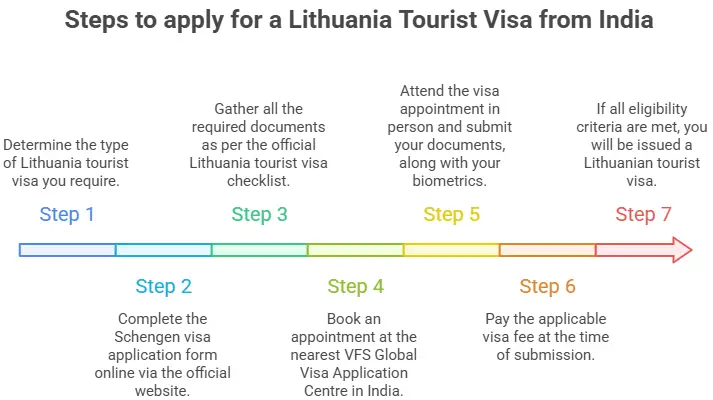
The steps to apply for a Lithuania Tourist Visa from India are given below:
Step 1: Determine the type of Lithuania tourist visa you require.
Step 2: Complete the Schengen visa application form online via the official website.
Step 3: Gather all the required documents as per the official Lithuania tourist visa checklist.
Step 4: Book an appointment at the nearest VFS Global Visa Application Centre in India.
Step 5: Attend the visa appointment in person and submit your documents, along with your biometrics.
Step 6: Pay the applicable visa fee at the time of submission.
Step 7: If all eligibility criteria are met, you will be issued a Lithuanian tourist visa.
Lithuania Tourist Visa Processing Time
The standard processing time for a Lithuania Tourist Visa is 15 calendar days from the date of application submission. In cases where further examination or additional documentation is required, the processing time may be extended to up to 30 days. It is strongly recommended to apply at least 4 to 6 weeks before your intended travel date to avoid any delays.
Lithuania Tourist Visa Fees
| Type | Fee |
|---|---|
| Adults | € 90 |
| Children (6–11 years) | € 45 |
| Children below 6 years | Free |
*Need assistance with Schengen visa appointments? Get in touch with experts at Y-Axis to help you with the process.
How Can Y-Axis Help You?
Y-Axis is one of the world’s leading visa and immigration consultancies. Our experience and expertise in the Schengen visa process makes us your partner of choice for your visa application. Our teams will help you with:
- Immigration documents checklist
- Complete application processing
- Forms, documentation & application filing
- Assistance with booking appointments for Interviews
- Preparing the client to face the Interview at the Consulate
- Updates & Follow-up