
- Points Based
- Most people below the age of 51 years old, with an occupation (listed on each country’s list), 2+ years of work experience & good English / French are eligible for this
- It is the most popular way of settling overseas
- Similar to skilled immigration
- Occupation must be listed on the state list
- Long term visa converted to PR & citizenship
- Very popular option for most countries
- Candidates who find a full time job & an employer overseas are eligible for this visa
- test
Y-Axis offers job search services to help candidates market themselves to overseas employers. We have a high success rate & have been very successful with this. For more information, please click here.
- Some countries offer permanent residency anyone who has a parent, brother, sister, uncle, aunt or first cousin overseas
- The sponsoring relative needs to be an citizen or a permanent resident of that country
- test
- Many countries offer a temporary or PR visa in exchange for an investment
- Investment amounts can range from $50,000 to $500,000 or more


Best Universities in Germany for Master’s, Top Universities in Germany for Master’s, Study in Germany, MS in Germany, Public universities Germany, German universities list, International students Germany
Explore the best universities in Germany for Master’s programs. Learn about top public and private universities, courses, fees, eligibility, and admissions for international students.
Top Universities in Germany for Master’s
Germany is one of the most popular countries for international students seeking high-quality, affordable postgraduate education. German universities are known for academic excellence, world-class research, strong industry partnerships, and highly employable Master’s graduates.
Public universities in Germany offer tuition-free education, making it one of the most cost-effective destinations for Indian students. Private universities offer flexible programs in English with industry-focused learning.
Germany is particularly famous for Master’s programs in engineering, IT, management, natural sciences, data science, healthcare, and business.
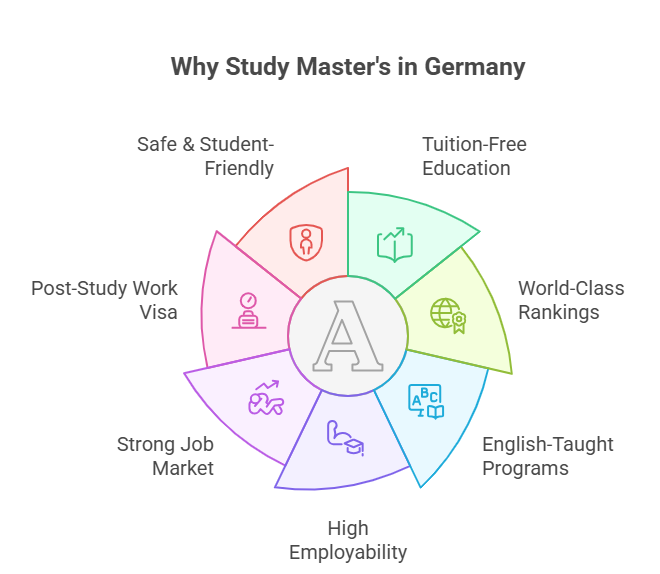
Why Study Master’s in Germany?
- Tuition-Free Education: Most public universities charge zero tuition fees.
- World-Class Rankings: Consistently in global top 100.
- English-Taught Programs: Thousands of Master's programs available fully in English.
- High Employability: German degrees are globally recognized and valued.
- Strong Job Market: Germany has a high demand for engineers, IT professionals, healthcare experts, business graduates, and researchers.
- Post-Study Work Visa: Students get 18 months to find a job after graduation.
- Safe & Student-Friendly: Clean, affordable, and high-quality lifestyle.
*Planning to study in Germany? Contact Y-Axis to get expert assistance
Top Public Universities in Germany for Master’s
|
University Name |
Popular Master’s Programs |
|
Technical University of Munich (TUM) |
Engineering, Computer Science, AI, Robotics, Data Science, Management |
|
Ludwig Maximilian University Munich (LMU) |
Life Sciences, Physics, Psychology, Economics, Business |
|
RWTH Aachen University |
Mechanical, Automotive, Civil, Electrical, Aerospace Engineering |
|
Heidelberg University |
Medicine, Biosciences, Chemistry, Research Science |
|
University of Stuttgart |
Aerospace, Automotive, Mechanical Engineering |
|
Karlsruhe Institute of Technology (KIT) |
Computer Science, Energy Engineering, Robotics |
|
University of Hamburg |
Economics, Marine Science, Physics, Sustainability |
|
TU Berlin |
Engineering, Architecture, Civil Engineering, IT |
|
University of Bonn |
Mathematics, Economics, Computer Science, Artificial Intelligence |
|
Goethe University Frankfurt |
Finance, Business, Economics, Life Sciences |
Top Private Universities in Germany for Master’s
|
University Name |
Popular Master’s Programs |
|
IU International University of Applied Sciences |
MBA, IT, Data Science, Business, Artificial Intelligence |
|
Arden University Berlin |
MBA, Project Management, Psychology, IT, Human Resource Management |
|
SRH Berlin University of Applied Sciences |
Engineering, Technology Management, Design, Entrepreneurship |
|
GISMA Business School |
Business Analytics, MBA, Leadership, Marketing |
|
EBS University |
International Business, Finance, Management |
Popular Master’s Programs in Germany
Engineering & Technology
- Master’s in Mechanical Engineering
- Master’s in Automotive Engineering
- Master’s in Electrical Engineering
- Master’s in Industrial Engineering
- Master’s in Robotics & Artificial Intelligence
- Master’s in Computer Science
- Master’s in Mechatronics
Data & IT
- Master’s in Data Science
- Master’s in Artificial Intelligence
- Master’s in Cybersecurity
- Master’s in Big Data Analytics
- Master’s in Information Systems
Business & Management
- Master of Business Administration (MBA)
- Master’s in International Business
- Master’s in Supply Chain Management
- Master’s in Finance & Accounting
- Master’s in Marketing & Human Resource Management
Health & Life Sciences
- Master’s in Biomedical Sciences
- Master’s in Public Health
- Master’s in Biotechnology
- Master’s in Neuroscience
- Master’s in Chemistry
Tuition Fees in Germany for Master’s
Germany is one of the most affordable study destinations for international students. Most public universities charge no tuition fees, making higher education accessible to students from all backgrounds. Students only need to pay a small semester fee that covers administration and public transport. Private universities, however, charge tuition fees but offer flexible, industry-focused, English-taught programs. MBA programs generally have higher fees due to specialized curriculum and international exposure. The table below shows the fee breakdown for universities in Germany:
|
University Type |
Annual Tuition Fee |
Notes |
|
Public Universities |
€0 (only €250–€400 semester fee) |
Tuition-free |
|
Private Universities |
€10,000 – €18,000 |
English-taught programs |
|
MBA Programs |
€15,000 – €25,000 |
Based on university |
Scholarships for Master’s in Germany
Germany offers several generous scholarships for international students pursuing Master’s studies. These scholarships help reduce expenses by covering tuition fees, living costs, research activities, and travel allowances. Most scholarships are merit-based and awarded by the German government, the EU, or individual universities. Students with strong academic performance, good language skills, or research interest have higher chances of receiving funding. The table below shows the top scholarships to pursue master’s in Germany:
|
Scholarship Name |
Amount / Benefit Provided |
|
DAAD Scholarships |
Full tuition coverage + monthly stipend (€934), travel allowance, health insurance |
|
Erasmus+ Scholarship |
Tuition fee support + monthly living allowance (€330–€450) |
|
Deutschlandstipendium |
€300 per month for high-achieving students |
|
Heinrich Böll Foundation Scholarship |
Monthly stipend (€934) + funding for study costs |
|
Konrad-Adenauer-Stiftung (KAS) Scholarship |
Monthly stipend (€934–€1,200) + health insurance |
|
Friedrich Ebert Foundation Scholarship |
Monthly stipend + health insurance + travel support |
|
University-specific Scholarships |
Benefits vary by university (partial to full fee waivers) |
*Want to apply for scholarships to study in Germany? Y-Axis is here to assist you in all the procedures.
Eligibility Requirements for Master’s in Germany
Public Universities
- Bachelor’s degree with 65–75% minimum
- Strong academic transcripts
- English proficiency: IELTS 6.5 / TOEFL equivalent
- GRE may be required for some courses
- German proficiency (optional)
Private Universities
- Bachelor’s degree with 55–60%
- IELTS 6.0–6.5
- Resume + SOP + LOR
- No GRE required
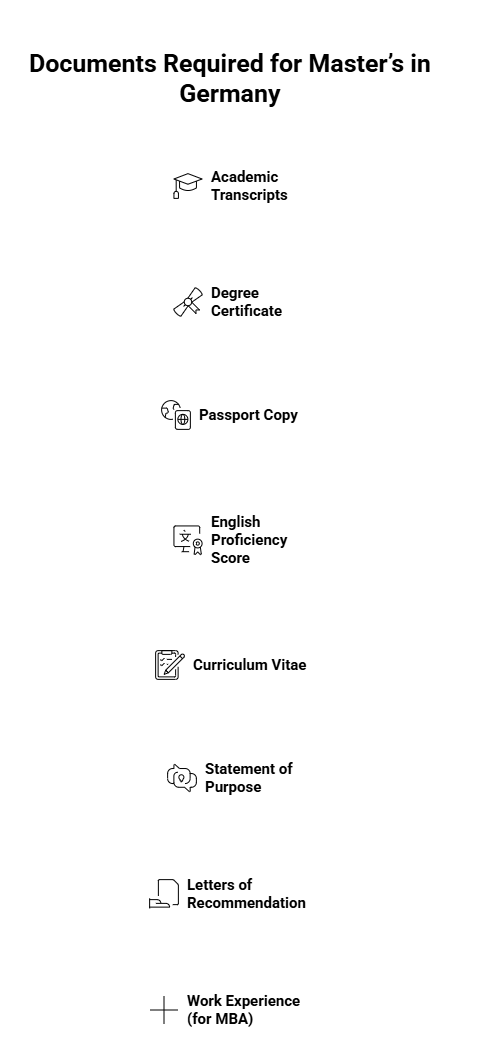
Documents Required for Master’s in Germany
- Academic transcripts (10th, 12th, bachelor’s)
- Degree certificate
- Passport copy
- English proficiency score
- Curriculum Vitae (CV)
- Statement of Purpose (SOP)
- Letters of Recommendation (LORs)
- Work experience (for MBA)
Steps to Apply for Master’s in Germany
Step 1: Choose your university and program
Step 2: Check eligibility and language requirements
Step 3: Prepare documents (SOP, LORs, IELTS, transcripts)
Step 4: Apply through the university portal or Uni-Assist
Step 5: Receive Admission Letter
Step 6: Pay semester fees (if public university)
Step 7: Apply for your Germany Student Visa
Step 8: Book your travel and arrange accommodation
Career Opportunities After Master’s in Germany
Graduates from German universities work in:
- Information Technology
- Engineering (Mechanical, Electrical, Civil)
- Automotive Industry
- Healthcare & Pharma
- Business & Finance
- Research & Development
- Consulting
- Manufacturing
Germany has a strong demand for skilled professionals, offering excellent salaries and long-term career opportunities.
Cost of Living for Master’s Students in Germany
Germany offers an affordable cost of living compared to many other European study destinations. The total monthly expenses for international students depend on the city, lifestyle, and accommodation choice. Larger cities like Munich or Frankfurt may be more expensive, while cities like Leipzig, Dresden, or Bonn are more budget-friendly. The table below provides an overview of the average monthly living expenses for Master’s students in Germany.
|
Expense |
Average Cost (per month) |
|
Accommodation |
€400–€700 |
|
Food |
€200–€300 |
|
Transportation |
€50–€90 |
|
Health Insurance |
€100–€120 |
|
Miscellaneous |
€150–€250 |
Total monthly costs: €900–€1,300
Why Indian Students Prefer Germany for Master’s
- Affordable or free education
- High visa approval rate
- Strong job opportunities
- Globally recognized degrees
- Safe and student-friendly cities
- Excellent research ecosystem
- 18-month post-study work visa
Your Future in Germany
Pursuing a Master’s degree in Germany opens the door to world-class education, global career opportunities, and an affordable lifestyle. With strong academic programs, practical training, and a growing job market, Germany remains one of the best destinations for Indian students seeking a successful international career.
How Y-Axis Can Help You
Y-Axis provides complete support for students planning to study a Master’s in Germany:
- University & program selection
- Application & documentation
- SOP, LOR & CV preparation
- Scholarship guidance
- Germany student visa support
- Y-Axis Coaching will assist you in learning the English Proficiency test along with IELTS, TOEFL, PTE.
- Pre-departure & post-arrival support