Explore Australia immigration options including PR visa, eligibility criteria, points system, visa types, fees, processing time, and how to apply from India.
Australia Immigration
Australia PR visa
Migrate to Australia from India
Australia skilled migration
Australia PR process
Skilled Occupation List
Australia Skill Assessment
Australia Visa Fees
Australia Visa processing time





Australia is one of the world’s most desired migration destinations, with a welcoming culture, vibrant cities, and sunny beaches. Highly-skilled professionals from all over the world come to Australia for its great quality of life and stable economic prospects. An English-speaking country, Australia is easy to assimilate into.
Australia has a more cosmopolitan culture thanks to a significant migrant population. The enviable citizen benefits and progressive policies of Australia make it a great destination to settle with your family.




it will fetch you a high-paying job. This becomes
more important if you are thinking of moving to
another country on a job.
it will fetch you a high-paying job. This becomes
more important if you are thinking of moving to
another country on a job.
it will fetch you a high-paying job. This becomes
more important if you are thinking of moving to
another country on a job.
PR Visa applications through Y-Axis?
PR Visa applications through Y-Axis?
PR Visa applications through Y-Axis?



Australia Immigration on a PR Visa
- 800,000 job vacancies
- Earn an average salary of AUD 85,000 to 95,000 per year.
- 'NO' recession from the past 25 years
- Free education for your children
- Best healthcare facilities
- High returns on investment
- Family members can be included in the PR application
Australia Immigration on a PR Visa gives skilled immigrants the opportunity to settle in Australia permanently. It allows you and your family to enjoy long-term stability, career growth, and a high quality of life.
Migrate to Australia from India
Australia has become one of the world’s most desired destinations for immigrants, with a welcoming culture, vibrant cities, and sunny beaches. You can migrate to Australia permanently from India on a PR visa. An Australian PR visa allows you to live, study, work, or start a business in the country for five years.
Australia has a diverse culture because many people from different countries live there. It offers excellent benefits for citizens and family-friendly policies, making it a great place to settle with your family. Since English is the main language, it is easy for migrants to adjust and feel comfortable.
* Need guidance to apply for Australia PR? Get expert advice with Migrate to Australia Flipbook.
Benefits of Australian Immigration
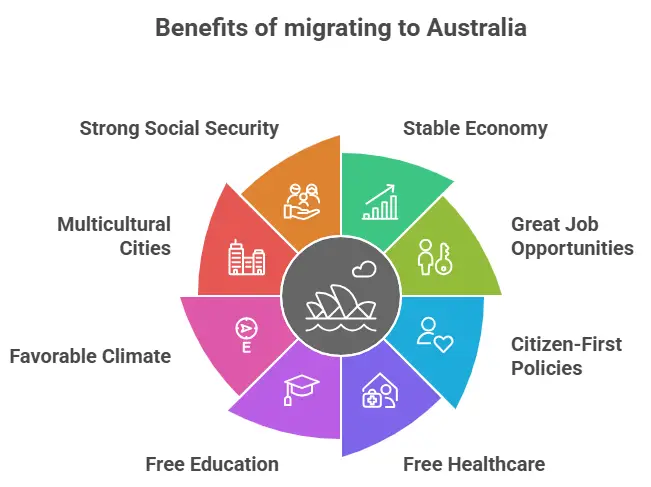
Many reasons make Australia a good place to migrate overseas with family:
- Stable economy
- Job opportunities across sectors like Engineering, IT, Education, and Healthcare
- Citizen-first policies
- Free healthcare
- Free education for children
- A favorable climate with plenty of sunshine
- Multicultural cities with a high standard of living
- Strong social security and family support benefits
List of Australia Visas for Indians
- Australia Visit Visa: For tourism, short business trips, or visiting family and friends.
- Australia Student Visa: For international students who want to study in Australian institutions.
- Australia Training Visa: For individuals attending workplace-based training or skill development programs.
- Australia Work Visa: For professionals who want to work in Australia on a temporary or permanent basis.
- Australia Family visas: For spouses, partners, children, or parents of Australian citizens or PR holders.
- Skilled Migration Visas: Points-based visas for skilled workers to live and work permanently in Australia.
- Business & Investment Visas: For entrepreneurs and investors who plan to start or invest in a business in Australia.
- Australia Permanent Residency (PR) Visas: Allow migrants to live, work, and settle in Australia permanently.
Australia Permanent Residence
If you get an Australian permanent visa, you can live in Australia permanently as a permanent resident. The most popular permanent visas are Skilled Work visas under the General Skilled Migration (GSM) program. Family visas are also commonly used by people who want to settle in Australia with their families.
- Work and Study Rights: As an Australian permanent resident, you can live, work, and study anywhere in Australia. You can also enroll in Medicare, Australia’s public healthcare system. Permanent residents are allowed to sponsor eligible family members for permanent residence, subject to visa rules.
- Travel to New Zealand: Australian permanent residents can travel to New Zealand and may be eligible to live and work there, depending on New Zealand immigration rules and approvals. It is not automatic and is subject to conditions.
- PR vs Citizenship: Permanent residency is different from citizenship. As a permanent resident, you will continue to hold the passport of your home country and will not receive an Australian passport.
- Travel In and Out of Australia: Australian permanent residence allows you to travel in and out of Australia freely. When your PR visa is granted, you receive a 5-year travel facility, which lets you leave and re-enter Australia multiple times while the visa is valid. After this period, you may need a Resident Return Visa (RRV) unless you become a citizen.
- Faster Application Processing: Australia has a well-organized immigration system designed to reduce processing delays. Submitting a Decision Ready Application helps speed up the process.
- Expert Support from Y-Axis: With a dedicated Australia migration team, Y-Axis has the experience to guide you through every step. Our RMA-certified professionals at our Australian partner office review your application carefully to help improve your chances of approval and ensure you apply with confidence.
* Need guidance to migrate to Australia on a PR visa? Get expert advice with Y-Axis counsellors.
Australia Skilled Migration
Australia’s Skilled Migration Program allows highly skilled professionals from around the world to live and work in Australia. The program supports the country’s strong economy and helps fill skill shortages in key industries.
Why Skilled Migration Is Important Now?
Australia continues to face skill shortages in sectors such as IT, healthcare, engineering, construction, and trades. The government regularly conducts invitation rounds, and several states have already issued a large number of skilled migration invitations in 2026.
Skilled Migration Visas
The General Skilled Migration (GSM) program includes the following visas that lead to permanent residency:
- Skilled Independent Visa (Subclass 189): A points-based permanent visa that does not require employer or state sponsorship. Invitations are based on points score and occupation demand.
- Skilled Nominated Visa (Subclass 190): A permanent visa for skilled workers nominated by an Australian state or territory. Each state has its own eligibility rules and occupation list.
- Skilled Work Regional Visa (Subclass 491): A 5-year regional visa that can lead to permanent residency after meeting work and residence requirements.
All skilled migration visas are processed through SkillSelect, where applicants must score at least 65 points to be eligible for an invitation.
How the Skilled Migration Process Works
- Check your occupation on the skilled list
- Submit an Expression of Interest (EOI) in SkillSelect
- Score a minimum of 65 points
- Receive an invitation and apply for the visa
State Sponsorship
Australian states and territories can nominate skilled workers for Subclass 190 and Subclass 491 visas. Selection is based on local skill demand, work experience, and other state-specific criteria.
New Skills in Demand Updates
Australia has introduced a Skills in Demand visa, replacing the earlier TSS visa, to better match skilled workers with job shortages and provide clearer pathways to permanent residence.
Also Read....
What are the key differences between Subclass 189 and Subclass 491 Visas in 2026?
Skilled Occupation List (SOL)
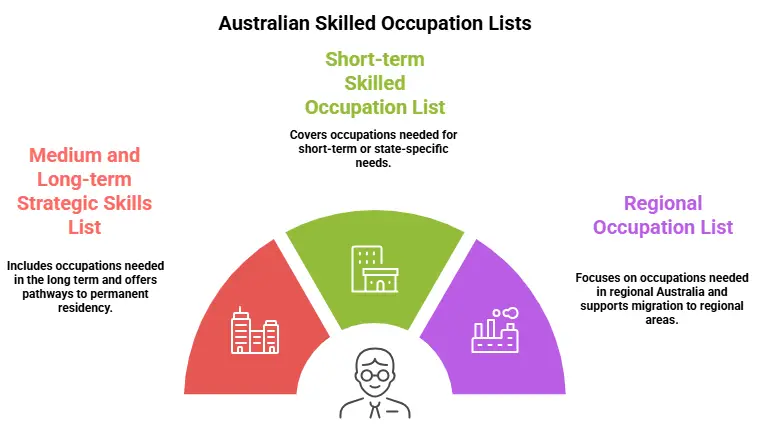
The Skilled Occupation List (SOL) is a list of jobs that are currently in demand in Australia. If your occupation is on this list, you may be eligible to apply for Australia’s Skilled Migration visas such as Subclass 189, 190, and 491.
Purpose of the Skilled Occupation List
- Identifies occupations Australia needs to fill skill shortages
- Helps decide eligibility for skilled migration visas
- Updated regularly based on labour market needs
Types of Skilled Occupation Lists
Australia uses different occupation lists depending on the visa type and location:
Medium and Long-term Strategic Skills List (MLTSSL)
- Includes occupations needed in the long term
- Used for Subclass 189, 190, and 491 visas
- Offers strong pathways to permanent residency
Short-term Skilled Occupation List (STSOL)
- Covers occupations needed for short-term or state-specific needs
- Used mainly for Subclass 190 and 491 visas
- Requirements vary by state or territory
Regional Occupation List (ROL)
- Focuses on occupations needed in regional Australia
- Used for the Subclass 491 regional visa
- Supports migration to regional areas
Apply for Jobs in Australia
There are more than 8 lakh jobs in Australia in more than 15 sectors. The top-in-demand occupations in Australia and the average annual salaries paid are given below:
| Occupation | Annual salary in AUD |
|---|---|
| IT | $81,000 – $149,023 |
| Marketing & Sales | $70,879 – $165,000 |
| Engineering | $87,392 – $180,000 |
| Hospitality | $58,500 – $114,356 |
| Healthcare | $73,219 – $160,000 |
| Accounting & Finance | $89,295 – $162,651 |
| Human Resources | $82,559 – $130,925 |
| Teaching | $75,284 – $160,000 |
| STEM | $90,569 – $108,544 |
*Searching for jobs in Australia? Avail Y-Axis resume marketing services to find the right one.
Australia Immigration Intake
The Australian Government sets an annual Immigration Intake under the Permanent Migration Program, with a total of 185,000 permanent visa places. This intake defines how many migrants Australia accepts each year across skilled, family, and special visa categories.
State and territory-wise allocations are announced separately. In recent intakes, the quota for Skilled Independent visas (Subclass 189) has been comparatively lower, leading to higher intake through State Nominated (Subclass 190) and Regional visas (Subclass 491).
Skill Stream Visas
The Skill Stream focuses on filling labour shortages and supporting Australia’s economic growth. It forms the largest share of the migration intake.
| Visa Category | Immigration Intake |
|---|---|
| Employer-Sponsored | 44,000 |
| Skilled Independent | 16,900 |
| State/Territory Nominated | 33,000 |
| Regional | 33,000 |
| Business Innovation & Investment | 1,000 |
| Global Talent / Talent & Innovation | 4,300 |
| Distinguished Talent | 300 |
| Skill Stream Total | 1,32,200 |
Family Stream Visas
The Family Stream supports family reunification for Australian citizens and permanent residents.
| Visa Category | Immigration Intake |
|---|---|
| Partner | 40,500 |
| Parent | 8,500 |
| Child | 3,000 |
| Other Family | 500 |
| Family Stream Total | 52,500 |
Special Category Visas
| Visa Category | Immigration Intake |
|---|---|
| Special Eligibility | 300 |
Australia Skills Assessment
Australia is one of the most urbanized countries in the world and welcomes skilled migrants from many countries. There are job opportunities in industries such as Engineering, Healthcare, IT, Construction, Mining, Manufacturing, Tourism, and Accounting & Finance.
Australia follows a points-based immigration system, where your eligibility is calculated using the following factors:
- Age: Younger applicants usually get higher points
- Education: Higher qualifications earn more points
- Work Experience: Skilled work experience in your field adds points
- English Language Skills: Higher English test scores improve your points
- Adaptability: Extra points for spouse skills, Australian education, or Australian work experience
To apply for Australian skilled migration, applicants must score a minimum of 65 points under the points-based system. However, candidates with 80–85 points or more usually have better chances of receiving an invitation, especially for permanent residence (PR) visas.
| Category | Maximum Points |
|---|---|
| Age (25-32 years) | 30 points |
| English proficiency (8 bands) | 20 points |
| Work Experience outside Australia (8-10 years) | 15 points |
| Work Experience in Australia (8-10 years) | 20 points |
| Education (outside Australia) – Doctorate degree | 20 points |
| Niche skills such as Doctorate or master’s degree by research in Australia | 10 points |
| Study in a regional area | 5 points |
| Accredited in community language | 5 points |
| Professional year in a skilled program in Australia | 5 points |
| State sponsorship (190 visa) | 5 points |
| Skilled spouse or de facto partner (Age, Skills & English language requirements to be met) | 10 points |
| Spouse or de facto partner with ‘competent English’ (No need to meet Skills requirement or age factor) | 5 points |
| Applicants without a spouse or de facto partner or where a spouse is an Australia citizen or PR holder | 10 points |
| Relative or regional sponsorship (491 visa) | 15 points |
*Get evaluated instantly with the Y-Axis Australia immigration points calculator for free. Check your eligibility right away for your Australia work visa.
Eligibility requirements for Australia Immigration
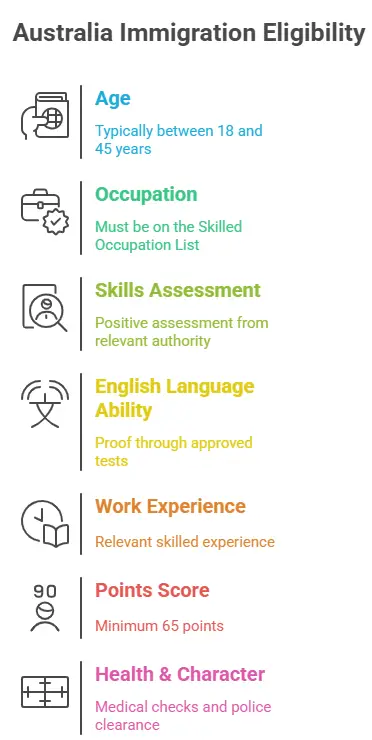
To qualify for Australia immigration, you generally need to meet the following:
- Age: Usually between 18 and 45 years
- Occupation: Your job must be listed on Australia’s Skilled Occupation List
- Skills Assessment: A positive skills assessment from the relevant authority
- English Language Ability: Proof of English through approved tests
- Work Experience: Relevant skilled work experience in your occupation
- Points Score: Minimum 65 points under the points test
- Health & Character: Medical checks and police clearance are required
Comparison of Australia Visa Subclasses
Australia offers different visa subclasses based on your skills, sponsorship, and location of work. Some visas provide direct permanent residency, while others are temporary visas with a pathway to PR. The table below compares the most common Australia migration visas, to help you understand their validity, sponsorship requirements, PR options, and key benefits.
| Criteria | Subclass 189 | Subclass 190 | Subclass 491 | Subclass 482 |
|---|---|---|---|---|
| Visa Type | Permanent Resident (PR) | Permanent Resident (PR) | Temporary Regional Visa | Temporary Work Visa |
| Visa Validity | Permanent stay with 5-year travel facility | Permanent stay with 5-year travel facility | 5 years | Up to 2–4 years (stream-based) |
| Occupation Must Be Listed | Yes | Yes | Yes | Yes |
| Family Can Be Included | Yes | Yes | Yes | Yes |
| Education, Work & English Required | Yes | Yes | Yes | Yes |
| Sponsorship Required | No | State/Territory Government | State/Territory or Eligible Relative (Regional) | Australian Employer |
| PR Status | Direct PR | PR (commitment to live in sponsoring state, usually 2 years) | PR pathway after 3 years of regional work and meeting income threshold | PR possible only if employer sponsors under a PR visa |
| Temporary Visa | No | No | Yes | Yes |
| Medicare Access | Yes | Yes | Yes | No (unless reciprocal healthcare applies) |
| Location Restriction | Anywhere in Australia | Sponsoring state | Regional Australia only | Employer location |
How to get Australian PR from India?
Step 1: Check Your Eligibility
- Check if you meet the basic eligibility requirements.
- Confirm that your occupation is on Australia’s Skilled Occupation List.
- Calculate your points score and ensure you score at least 65 points.
Step 2: Take an English Language Test
- Take an approved English proficiency test such as IELTS or PTE.
- Make sure you achieve the required score for your visa category.
Step 3: Get Your Skills Assessed
- Apply for a skills assessment through the relevant Australian authority.
- Your education and work experience will be assessed against Australian standards.
Step 4: Submit an Expression of Interest (EOI)
- Create and submit an Expression of Interest (EOI) through the SkillSelect system.
- Choose the visa type you want to apply for
- Provide accurate and complete information in your EOI.
Step 5: Receive an Invitation to Apply (ITA)
- If your profile meets the requirements and your points are competitive, you will receive an Invitation to Apply (ITA).
Step 6: Submit Your PR Application
- Submit your visa application within 60 days of receiving the ITA.
- Upload all required documents, including personal, educational, and work-related records.
Step 7: Get Your Australia PR Visa
- Once your application is approved, you will receive your Australian Permanent Resident visa.
Australia Visa Processing Time
The processing time of different types of Australian visas includes:
| Type of Australia Visa | Processing time |
|---|---|
| Visit visa | 20 to 30 days |
| Student visa | 1 to 3 months |
| Training visa | 3 to 4 months |
| Work visa | 2 to 8 months |
| Family and partner visas | 23 to 30 months |
| Skilled visas | 6.5 to 8 months |
| PR visa | 8 months to 10 months |
Australia Visa Fees
These are the visa application fees you need to pay to the Australian Government when you submit a PR application under the Skilled Independent, Skilled Nominated, or Skilled Regional visa categories.
| Visa Category | Primary Applicant (AUD) | Additional Adult (18+ years) | Dependent Child (<18 years) |
|---|---|---|---|
| Subclass 189 | AUD 4,910 | AUD 2,455 | AUD 1,230 |
| Subclass 190 | AUD 4,910 | AUD 2,455 | AUD 1,230 |
| Subclass 491 | AUD 4,910 | AUD 2,455 | AUD 1,230 |
How Y-Axis Can Help You?
Y-Axis, the world’s top overseas immigration consultancy, provides unbiased immigration services for every client based on their interests and requirements. Our impeccable services at Y-Axis include the following:
- Free eligibility check through the Australia Immigration Points Calculator
- Expert guidance/counseling for Australia Immigration
- Coaching services: Expert PTE coaching, IELTS proficiency Coaching
- Free career counseling, book your slot today
- Complete guidance for Australia PR visa
- Resume marketing services to find related jobs in Australia
{
"@context": "https://schema.org/",
"@type": "BreadcrumbList",
"itemListElement": [{
"@type": "ListItem",
"position": 1,
"name": "Home",
"item": "https://www.y-axis.com/"
},{
"@type": "ListItem",
"position": 2,
"name": "migrate",
"item": "https://www.y-axis.com/migrate/"
},{
"@type": "ListItem",
"position": 3,
"name": "migrate australia",
"item": "https://www.y-axis.com/migrate/australia/"
}]
},
{
"@context": "https://schema.org",
"@type": "FAQPage",
"mainEntity": [{
"@type": "Question",
"name": "How do I qualify to immigrate to Australia?",
"acceptedAnswer": {
"@type": "Answer",
"text": "You can easily get qualified to immigrate to Australia if you meet the following requirements:
Points: A minimum score of 65 in the Points Grid.
Age: Below 45 years.
English proficiency: PTE Score or IELTS test results.
Skills Assessment: Skill assessment by certified authorities in Australia.
Occupation: Occupation should be listed in Australia’s Skilled Occupation List or Priority Migration Skilled Occupation List (PMSOL)."
}
},{
"@type": "Question",
"name": "How long does it take to immigrate to Australia?",
"acceptedAnswer": {
"@type": "Answer",
"text": "Immigration to Australia through PR Visa takes on an average of 5 months and can take 12 months as well. This is dependent on individual circumstances. It will take roughly 3 months if you have all the required skills and points score."
}
},{
"@type": "Question",
"name": "How can I migrate/immigrate to Australia from India?",
"acceptedAnswer": {
"@type": "Answer",
"text": "Below is the stepwise immigration process for Australia:
Obtain the IELTS certification with the required score
Obtain Skill Assessment from the appropriate authority for assessment
Select an occupation from the Skilled Occupation Lists
If applicable, obtain Nomination/Sponsorship from a Territory or State in Australia
Submit an Expression of Interest – EOI on Skill-Select
You will receive an Invitation to Apply for the Visa if your profile is selected
You will have sixty days for submitting the Australia Visa application"
}
},{
"@type": "Question",
"name": "How much does it cost to immigrate to Australia from India?",
"acceptedAnswer": {
"@type": "Answer",
"text": "Below is the list of costs pertaining to an Australian visa application for immigration from India:
Subclass 189
Main Applicant -- AUD 4765
Applicant above 18 yrs -- AUD 2385
Applicant below 18 yrs -- AUD 1195
Subclass 190
Main Applicant -- AUD 4770
Applicant above 18 yrs -- AUD 2385
Applicant below 18 yrs -- AUD 1190
Subclass 491
Main Applicant -- AUD 4770
Applicant above 18 yrs -- AUD 2385
Applicant below 18 yrs -- AUD 1190"
}
},{
"@type": "Question",
"name": "How many points do you need to immigrate to Australia?",
"acceptedAnswer": {
"@type": "Answer",
"text": "The points score for Australia General Skilled Immigration has been increased from 1 July 2018. Minimum 65 points are now required by applicants of Australia Skilled Visa."
}
},{
"@type": "Question",
"name": "Is it easy to immigrate to Australia?",
"acceptedAnswer": {
"@type": "Answer",
"text": "The Australian immigration process can be complex and often challenging. However, it can be relatively easy to immigrate to Australia if you fulfill the visa requirements, including language proficiency, relevant skills and qualifications, scoring the minimum points through the points-based system, etc. You can migrate to Australia through different immigration pathways, such as skilled migration, business migration, family migration, etc., based on your purpose for moving to Australia."
}
},{
"@type": "Question",
"name": "How many points do you need to immigrate to Australia?",
"acceptedAnswer": {
"@type": "Answer",
"text": "The points score for Australia General Skilled Immigration has been increased from 1 July 2018. Minimum 65 points are now required by applicants of Australia Skilled Visa."
}
},{
"@type": "Question",
"name": "What are the eligibility requirements to apply for PR visa to Australia?",
"acceptedAnswer": {
"@type": "Answer",
"text": "Eligibility criteria for PR visa:
Points required: Minimum 65 points in the Points Grid
Age: Below 45 years
English proficiency: A competent level of proficiency in English
Health and character: Good health and character
Skills: Skill assessment by certifying authorities in Australia
Occupation: Occupation must be nominated in Australia’s Skilled Occupation List"
}
},{
"@type": "Question",
"name": "Is Australia accepting immigration applications?",
"acceptedAnswer": {
"@type": "Answer",
"text": "Yes, the Australian Immigration Department is open and is accepting application from immigration candidates. In fact, it issued invitations on 13 March 2020 under the
Skilled Independent visa (subclass 189)- 1,750 invitations.
Skilled Work Regional (Provisional) visa (subclass 491) – Family Sponsored-300 invitations."
}
},{
"@type": "Question",
"name": "Can I move to Australia without being a skilled worker?",
"acceptedAnswer": {
"@type": "Answer",
"text": "Australia offers different immigration pathways for highly educated and skilled individuals and can contribute well to the Australian economy. Australia has a huge requirement for skilled workers who can contribute to the country’s development. But without a job offer as a skilled worker also, you can migrate to Australia.
Skill Select Program: An individual can move to Australia without a job offer. You just need a few necessary skills and qualifications to work in Australia. The Australian government will make your profile available to employers so that they can nominate you.
Skilled Independent Visa (Subclass 189): Applicant must give an Express of Interest through skill selection before submitting the application.
Skilled Nomination Visa (Subclass 190): This has similar privileges as Subclass 189. The applicant must choose an occupation from Consolidated Sponsored Occupation List (CSOL) and submit their profiles.
Family Sponsorship: if you have a family member in Australia who has Permanent residence or citizenship in Australia. Under this sponsorship, the applicant need not have any job offer.
Business Innovation and investment program: Using this program, the applicant can own or manage a business in Australia or conduct a business or invest in any entrepreneurial activity in Australia.
Global Talent Scheme: This Scheme is to get highly skilled global talent to the country and encourage innovation. This Golden Talent scheme helps international talent invest in startups in Australia to give access to workers in Australia to provide advanced skills."
}
}]
}
]