
Skilled Immigration
State Territory
Employer Based Immigration
Some countries offer permanent residency anyone who has a parent,brother,sister,uncle,aunt or first cousin overseas
Investment Migration



Explore Malta’s job market with top hiring sectors, high-demand skills, salaries, and opportunities for skilled professionals seeking work abroad.
Malta Job Market in 2026–30
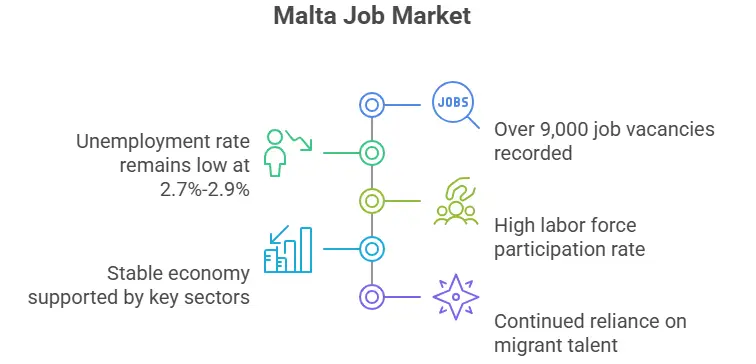
- Over 9,000 job vacancies were recorded, highlighting strong hiring demand across multiple industries.
- Malta’s unemployment rate remains one of the lowest in the EU at around 2.7%–2.9%, reflecting a tight labour market and ongoing need for foreign workers.
- The labour force participation rate continues to rise, with Malta maintaining one of the highest employment participation levels in the EU.
- The country’s economy remains stable, supported by key sectors such as tourism, financial services, iGaming, hospitality, healthcare, and manufacturing.
- Malta continues to rely on migrant talent to fill labour shortages, with steady demand for non-EU workers across essential and fast-growing sectors.
Job Outlook in Malta
Understanding the current job outlook in Malta is crucial for both employers and job seekers exploring opportunities in Malta. The country continues to experience strong hiring demand across key industries, supported by economic stability, low unemployment, and an increasing reliance on foreign workers to fill skills shortages. Malta recorded over 9,000 job vacancies, highlighting ongoing workforce gaps across multiple sectors.
There are abundant work opportunities in Malta across sectors such as hospitality, tourism, healthcare, construction, manufacturing, financial services, and the fast-growing iGaming industry. Demand for skilled and semi-skilled workers remains high, particularly in regions with concentrated economic activity.
Malta’s labour market is one of the strongest in the EU, with an unemployment rate of around 2.7%–2.9%, significantly lower than the EU average. This tight labour market has increased Malta’s need for foreign professionals and non-EU workers, creating more opportunities for international talent — including applicants from India.
With its stable economy, attractive Mediterranean lifestyle, and a strong focus on work-life balance, Malta has become a popular destination for career growth, work abroad opportunities, and long-term employment prospects. The country’s growing job market and business-friendly environment make it an appealing choice for those aiming to build a professional future in Europe.
*Want to work in Malta? Let Y-Axis guide you with the process.
General Employment Trends for the year
Employment trends in Malta continue to be shaped by the country’s strong economy, expanding industries, and consistent demand for skilled foreign workers. As a fast-growing EU nation, Malta’s labour market often experiences workforce shortages, creating opportunities for both skilled and semi-skilled professionals. Staying updated on in-demand skills, sector growth, and employer requirements is essential for anyone planning to work in Malta.
Malta’s economic stability, coupled with its low unemployment rate — among the lowest in Europe, means employers frequently rely on foreign talent to fill labour gaps. Changing demographics, including an ageing workforce and rising labour participation, also influence job demand. Additionally, sectors such as tourism, hospitality, healthcare, iGaming, construction, and financial services continue to expand, supported by government initiatives and ongoing investment in the economy.
Factors Influencing Job Creation or Reduction in Malta
Several key factors influence how jobs are created or reduced in Malta’s labour market:
- Economic performance: Malta’s steady economic growth drives job creation in tourism, transport, finance, and digital industries.
- Skill shortages: Limited availability of local skilled labour continues to increase demand for international workers, especially in healthcare, construction, hospitality, and IT.
- Technological advancements: Digital transformation has increased the need for professionals in iGaming, Fintech, software development, and cybersecurity.
- Government policies and labour regulations: Employment rules, residency regulations, and sector-specific policies shape hiring trends and employer demand.
- Demographic changes: An ageing population and high labour participation rate influence workforce needs, creating continuous demand in healthcare and social care.
- Global market dynamics: Tourism flows, EU labour mobility, and international economic conditions directly impact job availability in Malta.
Employers across Malta actively seek qualified talent from abroad to fill workforce gaps and support the country’s fast-growing industries. With competitive salaries, an international work environment, and growing sectors, Malta offers strong employment opportunities for foreign professionals looking to build a career in Europe.
In-Demand Industries and Occupations in Malta
Some of the most in demand occupations in Malta along with their salaries are given in the table below:
|
Occupations |
Average Annual Salary (€/year) |
|
Engineering |
€ 65,000 |
|
Information Technology (IT) |
€ 70,000 |
|
Healthcare |
€ 68,000 |
|
Marketing & Sales |
€ 50,000 |
|
Banking & Finance |
€ 55,000 |
|
Nursing |
€ 52,000 |
|
Teachers |
€ 50,000 |
|
Hospitality |
€ 45,000 |
|
Skilled Trades |
€ 40,000 |
Read more…
Highest Paying Jobs in Malta for Indians
Workforce Demands across Different Regions in Malta
Malta continues to experience steady workforce demands across multiple regions, driven by economic growth, labour shortages, and industry expansion. Although Malta is a small country, its regions show varying levels of hiring activity, especially in sectors such as hospitality, tourism, healthcare, construction, financial services, iGaming, and manufacturing.
Examination of Job Market Differences across Malta Regions
Malta’s job market is one of the most dynamic in the EU, driven by low unemployment and strong demand for both skilled and semi-skilled workers. Workforce needs vary across regions, with areas such as the Northern Harbour, Southern Harbour, Gozo, and the Northern Region showing particularly high hiring activity. These differences are shaped by the concentration of industries such as tourism, hospitality, iGaming, healthcare, construction, and administrative services. As a result, Malta continues to attract foreign professionals, including many from India, who are drawn by the country’s stable work environment, competitive salaries, and diverse employment opportunities.
Areas with Notable Job Opportunities in Malta
The table below highlights Malta’s key regions with notable employment opportunities, along with typical average annual salary levels based on dominant industries in each area.
|
Region |
Key Industries Hiring |
Typical Salary Levels (€/year) |
|
Northern Harbour (Sliema, St. Julian’s, Gżira) |
iGaming, IT, Hospitality, Sales, Finance |
€20,000 – €48,000 |
|
Southern Harbour (Valletta, Paola, Marsa) |
Public Administration, Logistics, Tourism, Retail |
€18,000 – €40,000 |
|
Northern Region (Mosta, Naxxar, Mellieħa) |
Construction, Healthcare, Education, Retail |
€20,000 – €42,000 |
|
Western Region (Rabat, Mdina, Żebbuġ) |
Education, Agriculture, Heritage Tourism |
€18,000 – €32,000 |
|
Gozo |
Hospitality, Construction, Healthcare, Tourism |
€18,000 – €35,000 |
Also, read…
What are the most in-demand jobs in Malta for the next 10 years?
Impact of Technology and Automation in Malta
Malta’s job market has been significantly influenced by rapid advancements in technology and automation, creating both new opportunities and evolving skill requirements. As Malta continues to expand its digital economy, the demand for tech-savvy professionals, skilled workers, and digitally capable talent is steadily rising across multiple sectors.
Technological Advancements and Automation Shaping the Job Market
In recent years, Malta has undergone substantial technological transformation driven by growth in iGaming, Fintech, ICT services, financial services, and digital tourism. Automation and digital tools are increasingly integrated into business operations, improving efficiency and creating new job roles that require advanced technical expertise.
These developments are reshaping the professional landscape and highlighting the importance of continuous skill development. The country is experiencing strong demand for professionals in areas such as:
- Information technology (IT)
- Software development
- Cybersecurity
- Data analytics
- Digital marketing
- Financial compliance and Fintech
- Engineering and technical support
As Malta continues to implement its Digital Malta Strategy and invests in technological infrastructure, the job market will increasingly favour workers who possess digital and technical skills.
Potential Opportunities and Challenges for Workers in the Evolving Landscape
Malta’s rapidly changing labour market presents both opportunities and challenges for professionals. The rise of automation and digital solutions has created strong demand for skilled talent in STEM fields, ICT, finance, iGaming, healthcare, management, and customer support. Industries such as hospitality, retail, logistics, and manufacturing are also adopting digital tools, creating a need for workforce adaptability.
However, the evolving economy also requires workers to continually reskill and upskill to remain competitive. Digital literacy, problem-solving abilities, and specialised technical skills are increasingly becoming essential for career advancement in Malta.
For foreign professionals, including those from India, this shift presents valuable opportunities to build careers in high-growth sectors that rely on global talent to fill critical skill shortages.
*Want to apply for jobs abroad? Avail Y-Axis Resume Marketing services to find the right one.
Skills in-demand in Malta
Employers in Malta increasingly seek candidates equipped with the right skills to support the country’s growing sectors, including iGaming, ICT, finance, hospitality, healthcare, construction, and professional services. As Malta’s digital transformation accelerates and businesses continue to expand, the demand for skilled professionals remains strong across various industries.
Key Skills Sought by Employers in Malta
Malta’s workforce trends show rising demand for individuals with both technical expertise and strong soft skills. Some of the most sought-after skills include:
Technical & Industry-Specific Skills
- Information Technology (IT) skills
- STEM skills (science, technology, engineering, mathematics)
- Software development and programming
- Cybersecurity and data protection
- Digital marketing and content management
- Financial analysis and compliance skills
- Accounting and bookkeeping
- Customer support and service skills
- Project management
- Skilled trades
Soft Skills and Workplace Competencies
- Communication and interpersonal skills
- Problem-solving and critical thinking
- Creativity and innovation
- Teamwork and collaboration
- Adaptability and flexibility
- Leadership skills
- Time management
- Emotional intelligence
- Multilingual proficiency (English is essential; Maltese is beneficial; other EU languages are a plus)
These skills are highly valued across Malta’s growing industries, especially in iGaming companies, Fintech firms, hospitality groups, healthcare institutions, education providers, construction companies, and customer service centres.
Importance of Upskilling or Reskilling for Job Seekers in Malta
As Malta’s job market continues to evolve, upskilling and reskilling have become essential for anyone seeking long-term career success. With rapid technological adoption and shifting workforce needs, job seekers must continuously build new competencies to stay competitive.
- Upskilling helps professionals adjust to new industry demands, enhance performance, and take on higher responsibilities.
- Reskilling allows workers to shift into new roles or industries experiencing strong growth, such as ICT, finance, healthcare, and digital services.
- Continuous learning fosters innovation, adaptability, and job relevance, making employees more resilient in a fast-changing labour market.
By investing in professional development, workers in Malta ensure they remain valuable in their roles and position themselves for future opportunities in the country’s expanding economy.
Remote Work and Flexible Arrangements in Malta
Remote and flexible work arrangements in Malta have become increasingly common as companies modernize their operations and adopt digital solutions. Many employers now offer hybrid schedules, remote work options, and flexible hours to help employees maintain a healthy work-life balance while supporting business productivity.
Malta Nomad Residence Permit (Digital Nomad Program)
- Malta offers an official digital nomad program known as the Nomad Residence Permit (NRP).
- This permit allows non-EU remote workers, including professionals from India, to live in Malta while working remotely for an employer or clients based outside Malta.
Key Features of the Malta Nomad Residence Permit
- Allows remote workers to live in Malta for 1 year, with the option to renew.
- Applicants must work for a foreign employer, be self-employed abroad, or run a company registered outside Malta.
- Applicants must earn a minimum monthly income of €2,700.
- Must have valid health insurance, a clean background, and proof of remote work capability.
- Holders may travel freely within the Schengen Zone, subject to standard entry rules.
This program makes Malta an attractive destination for digital nomads seeking a Mediterranean lifestyle while continuing their remote employment.
*Want to apply for a Malta Digital Nomad Visa? Let Y-Axis guide you with the process.
Exploring the Continuing Trend of Remote Work in Malta
Remote work in Malta has become a strong and growing trend, driven by advancements in digital infrastructure, business transformation, and increasing demand for flexible employment models.
Why Remote Work Is Expanding in Malta
- Many companies now adopt hybrid models, allowing employees to split time between home and office.
- Remote work supports productivity, creativity, and employee wellbeing, leading more employers to integrate flexible options into their long-term policies.
- Businesses benefit from a global talent pool, enabling Maltese firms—especially in iGaming, tech, finance, consulting, and customer support—to hire skilled professionals worldwide.
- Employees enjoy improved work-life balance, reduced commuting time, and the option to work from more affordable or comfortable environments.
- As digital transformation continues, more roles across sectors such as ICT, finance, iGaming, customer support, marketing, and administration are becoming fully or partially remote—making flexible work arrangements a sustainable feature of Malta’s evolving workforce.
Implications for Both Employers and Employees in Malta
The rise of remote and hybrid work models in Malta has created meaningful benefits for both employers and employees. As more Maltese companies adopt digital tools and flexible work policies, the workplace landscape continues to evolve in ways that enhance productivity, job satisfaction, and access to talent.
For employers in Malta, remote work expands the ability to attract and retain top talent, including skilled professionals located outside the country. This is particularly valuable in sectors experiencing talent shortages, such as ICT, iGaming, finance, and customer support. By embracing flexible work arrangements, employers can also promote employee well-being, diversity, and inclusion, while reducing operational costs and improving business continuity.
For employees, remote work offers greater control over daily schedules, helping them maintain a healthier work-life balance. Many workers report improved focus, comfort, and flexibility, enabling them to be more creative and productive. Remote work also opens access to broader career opportunities, including roles with international companies or businesses based in Malta that do not require daily commuting. Overall, remote work reduces stress, enhances job satisfaction, and provides a more adaptable work environment that aligns with modern lifestyle needs.
Government Policies and Initiatives in Malta
The Government of Malta continues to strengthen its labour market by implementing policies designed to address workforce shortages, support economic growth, and attract skilled foreign talent. As Malta’s economy expands and demographic changes increase demand for workers, foreign professionals play an increasingly important role in supporting key industries.
Overview of Government Programs and Policies Influencing Employment
Malta actively recruits skilled and semi-skilled foreign workers to bridge labour shortages across essential sectors such as healthcare, construction, hospitality, financial services, ICT, and iGaming. Government bodies such as Jobsplus and Residency Malta administer programs that facilitate the recruitment of international talent and ensure smooth integration into the labour market.
Key policy initiatives supporting employment include:
- Streamlined work permit processes for non-EU nationals through the Single Permit system.
- The Nomad Residence Permit (NRP) for remote workers and digital professionals employed outside Malta.
- Skills development programs and collaborations with industry to address shortages in technical and digital roles.
- Investment in digital transformation, encouraging growth in ICT, Fintech, and iGaming sectors, which contributes to job creation.
- Economic Vision 2030, which focuses on building a future-ready workforce, improving productivity, and supporting innovation-driven industries.
- Malta’s small population and consistently low unemployment rate—one of the lowest in the EU—mean that foreign workers are essential to sustaining economic activity. Thousands of non-EU nationals are hired each year to meet local workforce demands across expanding sectors.
As Malta continues to modernize its labour market, government initiatives remain focused on improving talent attraction, enhancing work conditions, and supporting the integration of international workers to strengthen the country’s long-term growth.
Challenges and Opportunities for Job Seekers in Malta
Job seekers in Malta experience both opportunities and challenges as they navigate the country’s growing labour market. While Malta offers strong employment prospects across multiple industries, individuals must be prepared to meet employer expectations and adapt to the competitive landscape.
Challenges Faced by Job Seekers in Malta
- Job seekers in Malta may encounter several challenges when trying to secure employment, particularly in fast-growing or specialised industries. Common challenges include:
- High competition for roles in popular sectors such as iGaming, finance, hospitality, and administration.
- Skill gaps for applicants who lack technical or digital skills required by employers.
- Limited local experience, particularly for foreign nationals entering Malta’s job market for the first time.
- Communication or language barriers, especially in roles requiring Maltese or multiple languages.
- Difficulty in building professional networks, which can be essential for finding job opportunities.
- Industry-specific requirements such as compliance training, certifications, or specialised qualifications.
Despite these challenges, Malta’s strong economy and ongoing labour shortages create meaningful opportunities for job seekers, especially those with the right skills and qualifications.
Tips and Strategies for Navigating the Malta Job Market Successfully
To succeed in Malta’s evolving job market, job seekers can use the following strategies:
- Upgrade skills by enrolling in courses, certifications, or workshops related to ICT, finance, hospitality, customer service, or compliance.
- Build a strong professional network through LinkedIn, industry events, and local business communities.
- Customize CVs and cover letters to match Maltese employer expectations and highlight relevant experience.
- Use online job platforms such as Jobsplus Malta, MaltaPark, LinkedIn, and employer websites for active job searching.
- Gain practical experience through part-time roles, internships, or voluntary work, especially for new graduates or newcomers.
- Attend industry conferences, job fairs, and training sessions to stay updated on trends and employer needs.
- Leverage career services provided by community organizations, recruitment firms, and training centers in Malta.
- Optimize your LinkedIn profile to showcase skills, achievements, and professional strengths.
- Connect with industry professionals for informational interviews and insights into hiring trends.
Summary of Malta Job Outlook
Malta’s job outlook remains strong, with growing opportunities in key sectors such as ICT, iGaming, finance, tourism, hospitality, healthcare, construction, skilled trades, and customer support. The country’s low unemployment rate and continued economic expansion drive demand for both skilled and semi-skilled workers.
Industries like technology, fintech, cybersecurity, engineering, nursing, hospitality, and accounting continue to attract foreign professionals due to ongoing skill shortages. With a stable economy, diverse job opportunities, and increasing reliance on international talent, Malta remains a promising destination for career growth and long-term employment prospects in the EU.
*Want to apply for jobs abroad? Get in touch with experts at Y-Axis to guide you with the process.