Highlights: IRCC Introduces Clear Guidelines for Temporary Resident Documents
- Canada has announced new guidelines that make the process of managing and reviewing temporary visas and permits more transparent and consistent.
- The new framework, effective November 4, 2025, gives immigration officers clear legal guidance under the revised Immigration and Refugee Protection Regulations (IRPR).
- It applies to all temporary resident documents, including visitor visas, study permits, work permits, and electronic travel authorizations (eTAs).
- The update outlines specific situations where permits can be reviewed or cancelled, such as loss of eligibility or administrative errors.
- Automatic cancellation applies in cases like becoming a permanent resident, losing a passport, or in the event of the holder’s death.
*Want to apply for a Canada visa? Let Y-Axis help you with the process.
Canada Sets Clear Boundaries on Visa and Permit Cancellations
Until now, Canada’s immigration officers exercised broad discretion when cancelling temporary visas and permits, often leading to confusion and inconsistent decisions.
To bring greater transparency and consistency, Immigration, Refugees and Citizenship Canada (IRCC) has rolled out a new legal framework, effective November 4, 2025, under the Immigration and Refugee Protection Regulations (IRPR).
This framework introduces clearly defined rules outlining when and how temporary resident documents—such as visitor visas, study permits, work permits, and eTAs—can be reviewed or cancelled.
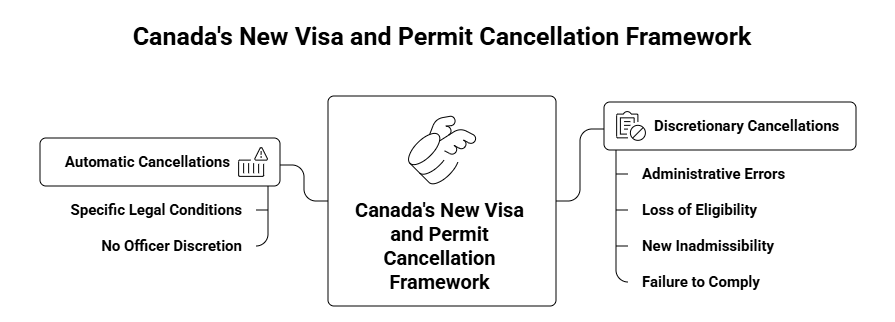
The updated regulations establish two distinct categories: discretionary cancellations, where officers have authority to review and act based on compliance or eligibility, and automatic cancellations, which occur under specific legal conditions.
Officers can now take action in cases such as:
- Administrative or processing errors during document issuance.
- Loss of eligibility, for instance when a school or employer becomes non-compliant.
- New inadmissibility, such as a criminal conviction or expired passport.
- Failure to comply with visa or permit conditions, including overstaying the authorized period.
According to IRCC, these changes aim to streamline decision-making, enhance fairness, and ensure greater consistency across immigration cases. The move also brings Canada’s immigration practices in line with countries like the United States and Australia, which already have codified visa revocation procedures.
*Want to apply for Canada PR? Sign up with Y-Axis for end-to-end support with the process.
Which Temporary Resident Documents Are Affected by Canada’s New Rules
The revised IRCC framework applies to all categories of temporary resident documents, providing clear rules on when and how these may be reviewed or cancelled. The goal is to ensure greater accountability, consistency, and fairness in decision-making across visa categories.
Here’s how each document type is affected under the new rules:
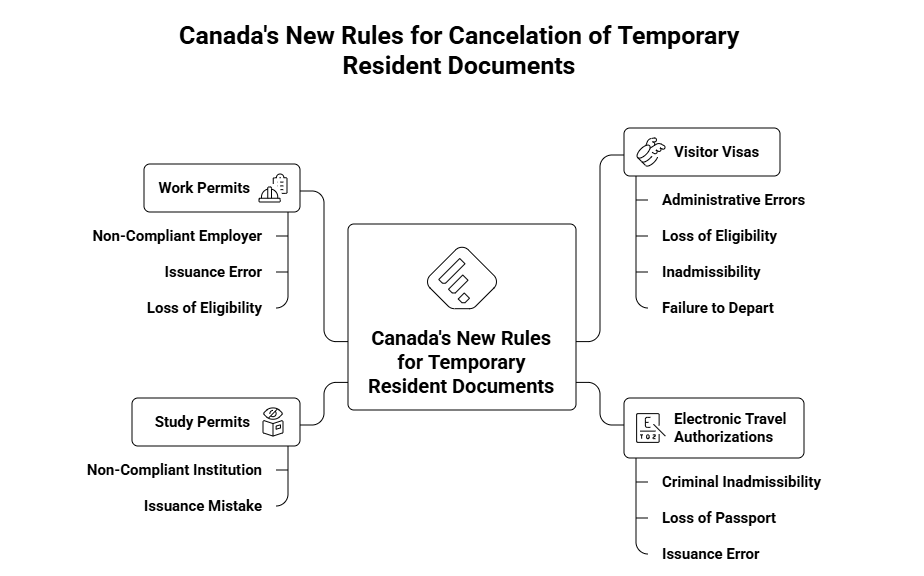
Visitor Visas (Sections 180.1–180.2 of IRPR)
- Visitor visas can now be cancelled in specific circumstances, including administrative errors, loss of eligibility, inadmissibility, or failure to depart Canada as required.
- A visa also becomes automatically void if the holder:
- Becomes a permanent resident.
- Loses the passport associated with the visa.
- Passes away.
These updates eliminate ambiguity and provide officers with structured legal authority to act when a visitor no longer meets eligibility or compliance conditions.
*Want to apply for a Canada visitor visa? Get in touch with experts at Y-Axis to help you with the process.
Electronic Travel Authorizations (eTAs) (Sections 12.07–12.08)
- IRCC officers can now cancel an eTA if a traveler becomes criminally inadmissible, loses a valid passport, or if the eTA was issued in error.
- These changes help strengthen Canada’s entry screening process and ensure that only eligible travelers maintain valid authorization.
Study Permits (Sections 222.7–222.8)
- Study permits may be revoked if the issuing institution is later found to be non-compliant with IRCC’s Designated Learning Institution (DLI) requirements, or if the permit was granted by mistake.
- Automatic cancellation applies if the student becomes a permanent resident or passes away.
- This provision helps IRCC maintain oversight of post-secondary institutions and safeguard the integrity of the international student system.
*Want to apply for a Canada student visa? Talk to experts at Y-Axis to help you with the process.
Work Permits (Sections 209.01–209.02)
- Work permits may be cancelled if the employer is non-compliant, the permit was issued in error, or if the worker loses eligibility to work in Canada.
- These measures ensure that foreign workers are tied to legitimate employers and that employment conditions remain compliant with Canadian labour and immigration laws.
*Want to apply for a Canada work visa? Let Y-Axis guide you with the process.
Canada’s New Framework Focuses on Fairness, Compliance, and Clarity
Canada currently issues over 2 million temporary resident documents each year, including more than 800,000 work permits and 700,000 study permits, according to IRCC’s 2024 data.
With such high volumes, administrative errors and compliance issues can lead to legal disputes and policy inconsistencies.
These new rules aim to:
- Prevent misuse of temporary permits.
- Enhance system integrity through clearly defined cancellation triggers.
- Improve fairness by ensuring that only valid and compliant permit holders remain in status.
- Streamline immigration operations by reducing officer discretion and introducing structured guidelines.
The IRCC also clarified that the changes do not automatically increase the frequency of cancellations, but rather make the process more predictable and defensible.
A “waiver safeguard clause” ensures that permits issued under temporary public policy waivers (for humanitarian, emergency, or special circumstances) cannot be cancelled based on the same waived requirement later.
Also, read…
Breaking News! Canada targets 2 million TRs and PRs under 2026–2028 Immigration Levels Plan!
What Does This Mean for Indian Applicants and Temporary Residents?
For thousands of Indian nationals studying, visiting, or working in Canada, the new rules mean greater transparency, but also a stronger need to maintain compliance.
Indian students account for over 40% of Canada’s total international student population, and Indian professionals are among the largest recipients of Canadian work permits and PR pathways.
Under the new framework:
- Students must ensure their DLI institutions remain compliant.
- Workers must verify that their employers meet LMIA and compliance obligations.
- Visitors should avoid overstays and keep travel documents valid.
Failure to meet these conditions could lead to permit cancellation, not as an arbitrary act, but under clearly defined legal grounds.
*Are you looking for step-by-step assistance with Canadian immigration? Contact Y-Axis, the world’s No. 1 overseas immigration consultancy!
For recent immigration updates, check out Y-Axis Canada immigration News!
Frequently Asked Questions
What are the new conditions Canada has set for cancelling visitor, study, and work permits?
In November 2025, Immigration, Refugees and Citizenship Canada (IRCC) introduced clear operational guidelines on when temporary resident documents—such as visitor visas, study permits, work permits, and eTAs—can be cancelled. The conditions include ineligibility or inadmissibility, failure to comply with conditions, and changes that affect eligibility. Permits may also be cancelled for administrative errors or when the person is deemed unlikely to leave Canada as required. These updates aim to strengthen compliance and ensure fair enforcement within Canada’s immigration system.
Why did Canada introduce new rules for cancelling temporary resident permits in 2025?
The new rules were introduced to enhance the integrity and transparency of Canada’s immigration system. Authorities noted issues such as non-compliance, overstays, and misuse of programs. The framework gives IRCC officials clearer authority to cancel permits when individuals no longer meet requirements or violate conditions, emphasizing ongoing post-issuance checks. The goal is to safeguard the system and maintain public confidence.
Who will be affected by Canada’s updated permit cancellation conditions?
The updated cancellation rules apply to all holders of temporary resident documents, including visitor visas, study permits, work permits, and eTAs. International students, temporary foreign workers, and tourists could all be affected if they stop meeting eligibility requirements, provide false information, or otherwise breach conditions.
Can a Canadian visitor visa be cancelled under the new rules?
Yes. IRCC may revoke a Temporary Resident Visa if the holder becomes inadmissible, no longer meets eligibility requirements, or is believed unlikely to leave Canada when required. Visas issued by administrative error may also be withdrawn. The updated framework supports continual assessment, not just at application time.
How will the new cancellation policy impact international students in Canada?
Students must maintain full-time studies (unless exempt), keep their DLI compliant, and respect permit conditions. Permits may be cancelled for non-compliance, misrepresentation, or other admissibility issues, underscoring the need for accurate documentation and updates to IRCC when changes occur.
What circumstances can lead to the cancellation of a Canada work permit?
Cancellation may occur if the worker becomes inadmissible, violates employment conditions, works for an unauthorized employer, or if the permit was issued in error. These rules strengthen compliance with the IRPR and Canadian labour standards.
Do the new rules apply to those already in Canada on valid permits?
Yes. The policy applies to both new and existing permit holders. Officers can review a person’s situation after arrival and cancel the document if violations or changes in eligibility are detected, ensuring compliance throughout the stay.
How does IRCC determine whether to cancel a study or work permit?
Decisions are based on defined criteria: admissibility, ongoing eligibility, and compliance with permit conditions. Reasons such as misrepresentation, criminality, failure to maintain status, or administrative error can justify cancellation. Procedural fairness applies, allowing individuals to respond before a final decision.
Can permit holders appeal a cancellation decision under the new rules?
Yes. Options may include requesting an administrative review, restoration of status (if eligible), or seeking judicial review at the Federal Court. Deadlines are strict, so timely professional advice is recommended.
When did the new cancellation conditions for Canada visas come into effect?
The new conditions took effect in early 2025 following IRPR amendments, with operational guidelines implemented across IRCC offices by November 2025. They now apply to both newly issued and existing temporary resident documents.