You can migrate to Japan as a Caregiver through the Specified Skilled Worker (SSW) program and the Technical Intern Training Program (TITP) pathway. Caregivers migrating to Japan through the SSW (Type 1) visa must meet specific requirements, including a Japanese language proficiency of JLPT N4 level or an equivalent approved test (such as the JFT-Basic) and pass the Nursing Care Skills Evaluation Test. With the SSW (Type 1) visa, you can live and work in Japan as a caregiver for up to 5 years, provided you meet the visa eligibility requirements.
*Want to work in Japan? Talk to experts at Y-Axis to guide you with the process.
Immigration Pathways in Japan for Caregivers
Japan offers different immigration pathways for caregivers, including the Specified Skilled Worker (SSW) visa, which is best for those with the required skills and Japanese language proficiency (JLPT N4 Level), along with other pathways such as the Technical Intern Training Program (TITP), which requires passing certain training exams and meeting the Japanese language skills. However, the TITP pathway will soon be replaced with a new system in the coming year. Some of the most in-demand jobs in Japan for the next 10 years includes job roles for nurses and caregivers, with high salaries and a stable career growth.
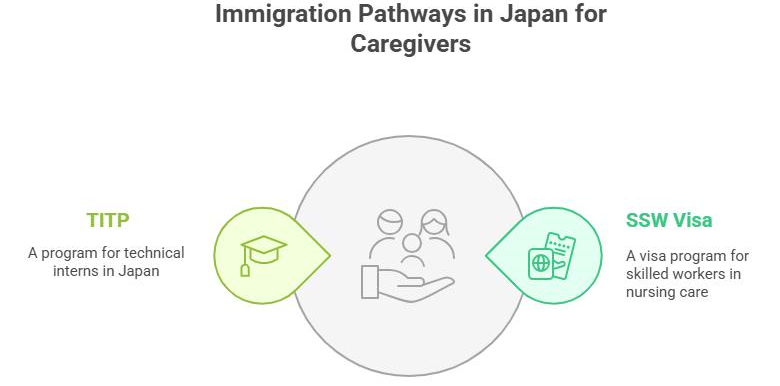
The following are the immigration pathways in Japan for caregivers from India:
Specified Skilled Worker (SSW) Visa – Nursing Care Category
The Specified Skilled Worker (SSW) Visa for nursing care is one of the main immigration pathways for caregivers to migrate to Japan. Through the SSW visa pathway, skilled foreign caregivers can live and work in Japan, primarily in the elderly care sector. The SSW pathway for caregivers was introduced to address the aging population and ongoing labor shortages in Japan, bringing in trained and experienced caregiving professionals to work in daily care facilities, such as nursing homes. You must meet specific skill requirements, as well as demonstrate Japanese language proficiency at the JLPT N4 level. The SSW visa for caregivers is a government-associated work permit under the (Type 1) status, which allows caregivers to live and work in Japan for up to 5 years.
How it works: Caregivers can apply for the SSW (Type 1) visa by obtaining a job offer from a verified Japanese employer and meeting the eligibility criteria, which include a basic Japanese language proficiency of JLPT N4 level and passing the Nursing Care Skills Evaluation Test. While having paramedical or nursing training is not mandatory to qualify for the SSW (Type 1) visa, it does increase your chances of getting employed.
Validity period: The SSW (Type 1) Visa for caregivers is issued for initial periods of up to 4 months, 6 months, or 12 months, which can be extended for a maximum of 5 years.
Pathway to PR in Japan: While the SSW (Type 1) visa does not directly lead to PR in Japan, it gives you the chance to transition to a different long-term visa status in Japan. Caregivers must get a National Certified Care Worker license, which allows them to convert to a Care Worker (Kaigo) Visa. The Kaigo visa can be renewed after a specified period, enabling long-term employment and settlement in Japan. To qualify for permanent residence, however, the caregivers are required to meet specific eligibility requirements based on their visa status.
*Want to apply for a Japan work visa? Sign up with Y-Axis for end-to-end support.
Technical Intern Training Program (TITP) in Japan
The Technical Intern Training Program (TITP) for caregivers enables young individuals from foreign countries to live and work in Japan for a specified period, gaining skills and on-site work experience in the elderly care sector. The primary purpose of Japan’s TITP program is to transfer knowledge and technology to participating countries and promote caregiving skills among them.
Note: Japan has announced plans to replace the current TITP program with a new system by 2027, which may subsequently alter the migration pathways.
How it works: Caregiving interns receive practical training in approved facilities across Japan, with hands-on experience in elderly care and nursing. Through the TITP program, young individuals aspiring to be caregivers can gain valuable workplace knowledge and develop professional skills.
Validity Period: The TITP program in Japan is valid for 1-3 years, depending on the internship program and course duration.
Pathway to Japan PR: Caregivers who complete the TITP program can transition to the SSW (Type 1) visa, provided they meet the requirements. While neither the TITP pathway nor the SSW visa pathway directly leads to PR in Japan, they can offer long-term residency options by transitioning to other visa options.
*Want to settle in Japan? Contact Y-Axis for end-to-end assistance with the process.
Eligibility Criteria for Caregivers to Migrate to Japan
To migrate to Japan as a caregiver, you must meet specific eligibility criteria, including being at least 18 years old, passing the Japanese language proficiency test (JLPT N4/JFT-Basic), and possessing relevant caregiving skills. The exact eligibility requirements for caregivers migrating to Japan vary depending on the chosen immigration pathway.
The general eligibility criteria for caregivers to migrate to Japan are as follows:
- Must be at least 18 years of age
- Proof of Japanese language proficiency (JFT-Basic/ JFT-Basic or an equivalent test).
- Pass the Nursing Care Skills Evaluation Test (exempted for those who completed the TITP program)
- Have relevant caregiving skills or training in nursing/paramedical qualifications (like ANM/GNM) (not compulsory but highly beneficial)
- Have at least 12 months of work experience as a caregiver (if required)
- A valid medical fitness certificate
- Criminal clearance certificate
Also, read…
Japan to issue 400,000 student visas and post-study work permits
How to migrate to Japan as a Caregiver?
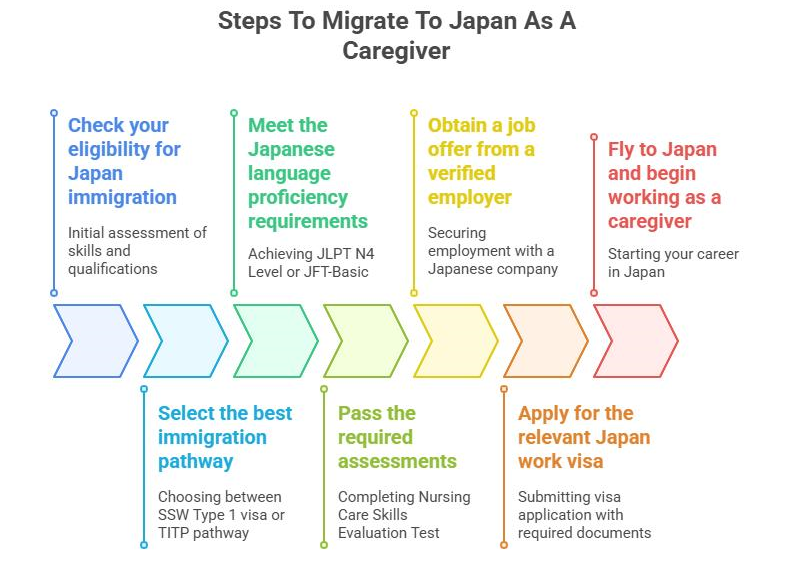
You can follow the steps below to migrate to Japan as a caregiver successfully:
Step 1: Check your eligibility for Japan immigration, based on your skills and qualifications as a caregiver.
Step 2: Select the best immigration pathway, depending on your profile and long-term employment plans in Japan (SSW Type 1 visa, or the TITP pathway)
Step 3: Meet the Japanese language proficiency requirements (JLPT N4 Level or JFT-Basic, or an equivalent)
Step 4: Pass the required assessments, such as the Nursing Care Skills Evaluation Test (mandatory) and any other care-related Japanese language assessments. (Caregivers who complete a TITP program in the same field may not take the tests, based on the program rules.)
Step 5: Obtain a job offer from a verified and authorized Japanese employer who will also support your documentation and application process.
Step 6: Apply for the relevant Japan work visa or status of residence, along with the required documents (passport, language certificate, educational certificates, PCC, etc.)
Step 7: Fly to Japan and begin working as a caregiver after obtaining your visa.
*Are you looking for step-by-step assistance with overseas immigration? Contact Y-Axis, the world’s No. 1 overseas immigration consultancy, for end-to-end assistance!
FAQs
Are caregivers in demand in Japan?
Caregivers are currently in high demand in Japan due to the country's rapidly aging population. This also creates a workforce shortage in Japan, prompting the government to promote overseas migration of caregivers to address the labour shortages in the upcoming decade. Japan's SSW (Specified Skilled Worker) Visa pathway allows skilled caregivers to migrate to Japan to work in sectors facing a skill shortage, such as care and nursing.
What documents are needed to migrate to Japan as a caregiver?
Caregivers migrating to Japan need to secure relevant educational qualifications and caregiving skills recognized in the country, along with proficiency in the Japanese language. The following documents are necessary for Japan immigration as a caregiver:
- Proof of minimum age threshold (at least 18 or above).
- Proof of clearing the Japanese language proficiency test (JFT-Basic/ JLPT N4 level).
- Nursing care skills evaluation test report.
- Caregiving training/experience (not required for TITP).
- Educational certificates.
- Certificate of Eligibility (COE).
- Medical test reports.
- Medical and travel insurance.
- Valid passport.
What are the language requirements for caregivers migrating to Japan?
Foreign caregivers migrating to Japan must pass the Japanese language proficiency test (JLPT N4 level or JFT-Basic A2 equivalent). It is also necessary to qualify for a caregiving test to apply for Japan immigration pathways as a caregiver.
What are the visa requirements to migrate to Japan as a caregiver?
To migrate to Japan as a caregiver, the Specified Skilled Worker (SSW) Visa is the most common immigration pathway. Caregivers can apply for an SSW Visa for Japan immigration, provided they have the required educational qualifications, work experience, and proof of Japanese language proficiency (JLPT N4+/J Basics). Clear the caregiving skill test to apply for the SSW pathway, which allows 5 years of legal work and stay in Japan for caregivers aged 18 and above with a clean criminal record.
How to apply for a Caregiver Visa in Japan from India?
You can apply for a caregiver visa in Japan after clearing the Japanese language (JLPT N4/JFT-Basic) and skill tests. Certified training proof, educational qualification, and a valid job offer are also mandatory for an SSW Visa from India (job offer not necessary for TITP training). The immigration pathway to Japan as a caregiver is employer-initiated for the SSW Visa, with the employer handling the documentation and registration processes for the visa application.
What is the salary offered to caregivers in Japan?
The salary of caregivers in Japan varies, with an average compensation of ¥3-4 million (₹ 19,00,000-₹ 24,00,000) annually for experienced caregiving professionals. Entry-level caregivers and trainees generally receive a salary ranging between ¥200,000 and ¥250,000 (₹ 1,00,000-1,50,000 INR) monthly, although there is potential for growth and bonuses.
Which caregiving certifications are recognized in Japan?
Japan recognizes foreign caregivers, provided they qualify for migration through the SSW pathway or the Technical Intern Training Program (TITP). Foreign caregivers should pass the Japanese language proficiency test (JLPT N4+/J Basics) along with the required skill assessment. To qualify for Certified Care Worker (Kaigo Fukushi-shi), a higher-level certification for caregivers in Japan, direct exams are held, offering long-term residence and career growth.
How to get a caregiver license in Japan?
Caregivers are granted a legal license to work in Japan after passing the national Certified Care Worker (Kaigo Fukushi) exam. High Japanese language proficiency is necessary (JLPT N2 equivalent for the exam, N4/JFT-Basic for entry) along with professional training in caregiving or relevant work experience to qualify for a caregiver's license in Japan.
What insurance options are available for caregivers migrating to Japan?
Caregivers migrating to Japan can secure insurance through two mandatory public insurance systems: the National Health Insurance (NHI), also known as employment-based Social Health Insurance (SHI), and the Long-Term Care Insurance (LTCI). Apart from the two standard insurance options for caregivers in Japan, the country also has private supplemental insurance options. After long-term visa approval and settling in Japan, it is necessary to enroll in the universal healthcare system in Japan for insurance.
Can caregivers apply for permanent residence in Japan?
Yes, caregivers can apply for permanent residence in Japan through the Certified Care Worker (Kaigo Fukushi-shi) pathway upon immigration. After legally living and working in Japan on a long-term visa, such as the SSW, it is possible to transition to "Caregiver (Kaigo)" status, which allows you to reside in the country for an indefinite period. A certified caregiver pathway leads to permanent residence in Japan after the necessary PR criteria are achieved.