Australia is expected to create more than 1 million new and replacement jobs over the next 10 years. This is because the country’s population is growing and the government is investing in key sectors like healthcare, infrastructure, education, technology, and clean energy. Australia is known for its strong economy, high salaries, and good quality of life. Many industries in Australia are facing skill shortages, so employers are actively hiring international professionals, including fresh graduates, experienced workers, and skilled specialists. The main advantage of the Australian job market is the rise of flexible and remote work options, which allow professionals to work from different cities and regional areas. Australia also has clear work visa and permanent residency (PR) pathways, making it easier for overseas professionals to settle long-term. Because of these benefits, Australia remains one of the top career destinations for global talent.
Why Apply for Jobs in Australia?
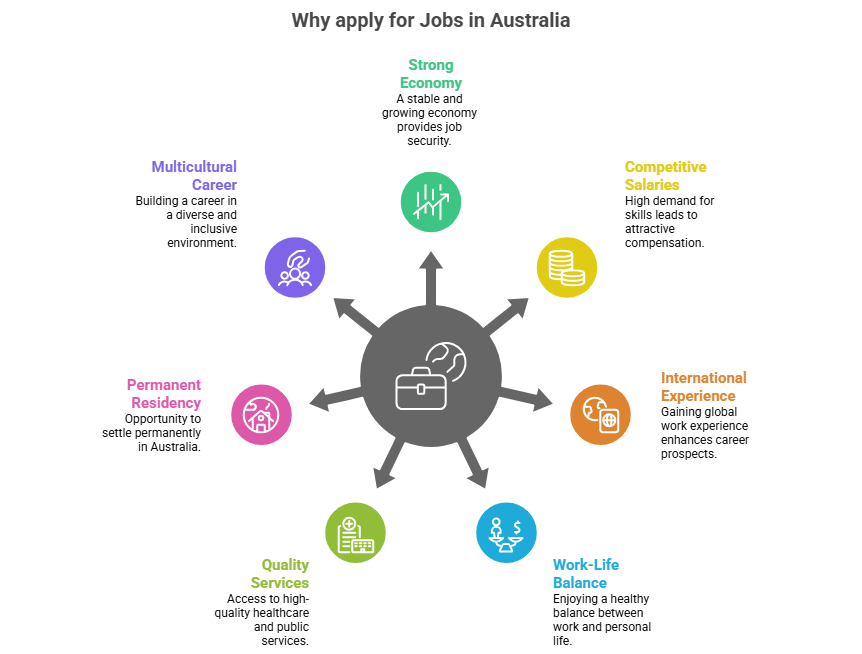
- Work in a strong and stable economy
- Earn competitive salaries in high-demand occupations
- Gain international work experience
- Enjoy a good work-life balance and employee benefits
- Access high-quality healthcare and public services
- Opportunity to apply for permanent residency (PR)
- Build a long-term career in a multicultural country
*Want to work in Australia? Let Y-Axis help you with the process.
Job Outlook in Australia for the Next 10 Years
Australia’s job outlook for the next 10 years looks positive and stable. The government is planning long-term growth, and many industries are facing worker shortages. Because of this, Australia needs more skilled workers, including professionals from other countries.
The Australian government is investing heavily in healthcare, clean energy, infrastructure, education, and technology. These investments are creating new jobs across the country. At the same time, many older workers are retiring, which is opening up more job opportunities for new and experienced workers.
Australia also supports business growth, startups, and skilled migration, which helps companies hire international professionals and create more jobs.
Key Employment Trends in Australia
- Growing healthcare demand:
Australia’s ageing population has increased the need for nurses, doctors, aged care workers, and medical support staff. Government funding in healthcare is creating many new jobs.
- Technology and digital jobs:
More businesses and government services are going digital. This has increased demand for IT professionals such as software developers, data analysts, cybersecurity experts, and AI specialists.
- Infrastructure and construction growth:
New housing projects, roads, railways, and transport systems are creating jobs for engineers, construction workers, and skilled tradespeople.
- Clean energy and green jobs:
Australia is focusing on renewable energy like solar and wind power. This is creating jobs in clean energy, engineering, and environmental roles.
- Education and public sector hiring:
Schools, childcare centres, universities, and public services are hiring more staff due to ongoing shortages.
- Skilled migration and business growth:
Many Australian companies are hiring overseas workers through sponsored visas to fill skill gaps, which increases job opportunities for international professionals.
Job Opportunities by 2035
- Australia is expected to create over 1 million jobs in the next decade
- Employers will continue to sponsor overseas professionals due to skill shortages
- Government migration programs support long-term workforce demand
- Sponsored jobs offer work visas and PR pathways for skilled professionals
Who Can Apply for Job Opportunities in Australia?
Australia welcomes professionals at all experience levels, including freshers, experienced workers, and senior professionals.
Freshers & Graduates
- Fresh graduates can apply for entry-level roles in various industries
- Popular sectors include IT, engineering, hospitality, healthcare, and business services
- Australia offers graduate programs and internships for skill development
- Some employers sponsor visas for eligible fresh graduates
Experienced Professionals
- Professionals with work experience can apply for mid-level roles
- Many Australian employers offer sponsored work visas
- High demand in healthcare, IT, engineering, construction, and finance
- These roles provide better salaries and career growth
Skilled & Senior Professionals
- Senior professionals can apply for leadership and specialist roles
- These jobs offer higher salaries and long-term stability
- Many senior roles are eligible for skilled migration visas
- Such roles often lead to permanent residency (PR)
*Want to apply for jobs in Australia? Avail Y-Axis Resume Marketing services to find the right one.
Most In-Demand Jobs in Australia for Indians
The table below highlights the most in-demand jobs in Australia, along with the estimated number of job vacancies over the next 10 years and the average annual salaries. These roles also offer strong work visa and permanent residency (PR) opportunities, making Australia an attractive destination for long-term career growth.
|
Occupation |
Estimated Job Vacancies (Next 10 Years) |
Annual Salary in AUD |
|
IT |
250,000+ |
$81,000 – $149,023 |
|
Marketing & Sales |
180,000+ |
$70,879 – $165,000 |
|
Engineering |
200,000+ |
$87,392 – $180,000 |
|
Hospitality |
220,000+ |
$58,500 – $114,356 |
|
Healthcare |
300,000+ |
$73,219 – $160,000 |
|
Accounting & Finance |
150,000+ |
$89,295 – $162,651 |
|
Human Resources |
120,000+ |
$82,559 – $130,925 |
|
Teaching |
160,000+ |
$75,284 – $160,000 |
|
Professional & Scientific Services |
140,000+ |
$90,569 – $108,544 |
In-demand Job roles in Australia
The table below shows the most in-demand job roles in Australia across different industries. These roles provide good job opportunities, attractive salaries, and are commonly eligible for Australian work visas and permanent residency (PR), making them ideal for long-term career development:
|
Industry |
Job Roles |
|
Healthcare |
Doctors, Nurses, Aged Care Workers, Physiotherapists, Medical Technicians |
|
IT & Technology |
Software Developers, Data Analysts, Cybersecurity Experts, Cloud Engineers |
|
Engineering |
Civil Engineers, Mechanical Engineers, Electrical Engineers, Project Engineers |
|
Education |
Teachers, Lecturers, Academic Researchers, Education Coordinators |
|
Finance |
Accountants, Financial Analysts, Auditors, Tax Consultants |
Read more...
What are the most in-demand jobs in Australia for the next 10 years?
Australia Work Visa Options
Australia offers a wide range of work visa options for international professionals who want to live and work in the country. These visas are designed to support Australia’s growing economy and help employers fill skill shortages across industries such as healthcare, IT, engineering, education, construction, and finance.
Depending on your skills, qualifications, work experience, and career goals, you can choose a temporary work visa or a permanent residency pathway. Some visas require employer sponsorship, while others allow skilled professionals to apply independently.
Below are the major Australian work visa options for overseas professionals:
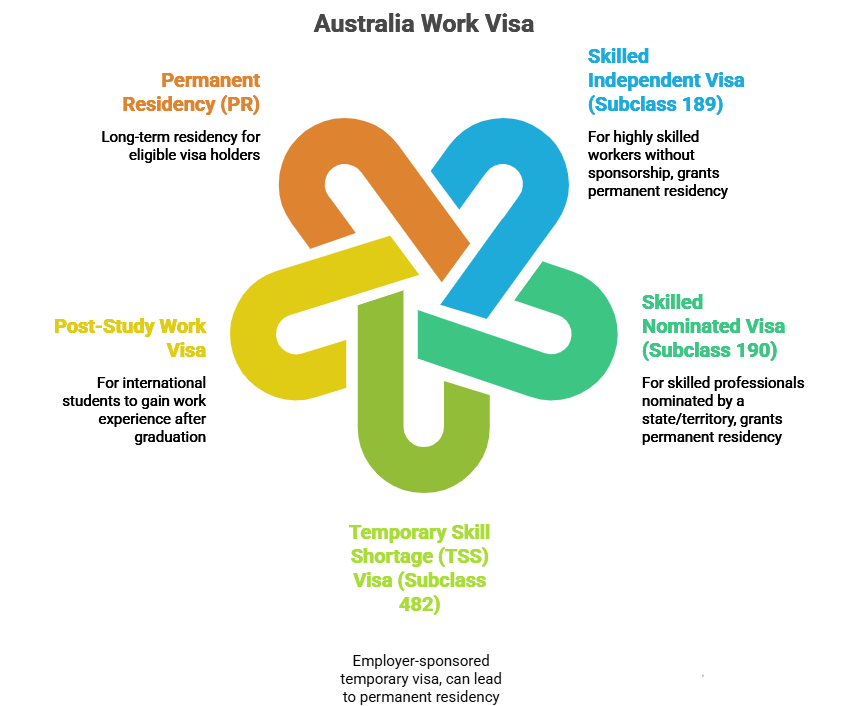
Australia Skilled Independent Visa (Subclass 189)
This visa is for highly skilled workers who do not need employer or state sponsorship. Applicants are selected through a points-based system. The Subclass 189 visa grants permanent residency, allowing you to live and work anywhere in Australia.
Skilled Nominated Visa (Subclass 190)
The Subclass 190 visa is for skilled professionals who are nominated by an Australian state or territory. It also follows a points-based system and leads to permanent residency. Visa holders must usually live and work in the nominating state for a specific period.
Temporary Skill Shortage (TSS) Visa (Subclass 482)
This is an employer-sponsored visa that allows skilled professionals to work in Australia for a temporary period. It is commonly used when employers cannot find suitable local workers. In some cases, this visa can lead to permanent residency if eligibility conditions are met.
Post-Study Work Visa
This visa allows international students who complete their studies in Australia to stay back and work. It helps graduates gain Australian work experience and improve their chances of securing employer-sponsored jobs or applying for skilled migration visas.
Australia Permanent Residency (PR)
After working in Australia on an eligible visa and meeting the required criteria, professionals can apply for Australian Permanent Residency (PR). PR holders can live and work permanently in Australia and enjoy long-term benefits such as healthcare access and settlement options.
*Want to know more about Australia work visas? Get expert guidance from Y-Axis.
Cost of Living in Australia
The cost of living in Australia depends on the city and lifestyle. Cities like Sydney and Melbourne are more expensive, while smaller cities are more affordable. On average, a single person needs around AUD 2,000 to AUD 2,500 per month to cover rent, food, transport, and basic expenses. Salaries in Australia support a comfortable lifestyle, and public healthcare helps reduce medical costs.
How to Apply for an Australian Work Visa from India?
Step 1: Identify the right Australian work visa based on your skills and experience.
Step 2: Check if your occupation is listed on Australia’s skilled occupation list.
Step 3: Apply for jobs with Australian employers or apply through skilled migration.
Step 4: Prepare required documents such as a passport, skills assessment, and qualifications.
Step 5: Submit your visa application online and pay the required fees.
Step 6: Complete medical tests and biometric requirements if applicable.
Step 7: Wait for visa approval and travel to Australia.
When Is the Best Time to Apply for Jobs in Australia?
The best time to apply for jobs in Australia is now, as many industries are facing skill shortages and employers are actively hiring overseas professionals. Sponsored work visas and permanent residency (PR) pathways are widely available, and applying early increases your chances of securing a job and long-term settlement opportunities. Applying now also allows candidates to take advantage of ongoing government skill-migration programs and employer demand before competition increases. Many Australian companies plan hiring in advance, so early applicants have better access to job openings, visa sponsorships, and smoother relocation planning.
*Are you looking for step-by-step assistance with Australian immigration? Contact Y-Axis, the world’s No. 1 overseas immigration consultancy, for end-to-end assistance!
FAQs
Can Indian professionals apply for jobs in Australia without prior Australian experience?
Yes, Indian professionals can apply for jobs in Australia even without prior Australian work experience. Many employers focus on skills, qualifications, and international experience rather than local exposure. Skilled professionals in IT, healthcare, engineering, education, and finance are especially in demand. Having relevant experience, English language skills, and proper documentation can improve job prospects. Some employers also provide visa sponsorship, making it easier for overseas candidates to work legally in Australia.
Are fresh graduates eligible to work in Australia?
Fresh graduates can apply for jobs in Australia, especially in sectors such as IT, engineering, hospitality, healthcare support, and business services. Australia also offers graduate programs, internships, and post-study work options for international students. While visa sponsorship for freshers is less common than for experienced professionals, some employers do sponsor eligible graduates. Gaining skills, certifications, and relevant internships can improve job opportunities for fresh graduates.
Which industries in Australia are hiring the most international professionals?
Australia is hiring international workers mainly in healthcare, IT, engineering, construction, education, hospitality, finance, and aged care. These sectors face long-term skill shortages due to population growth and retirements. Healthcare and aged care are among the biggest employers because of Australia’s ageing population. IT and engineering roles are growing due to digital transformation and infrastructure projects. Many of these industries offer sponsored work visas and PR pathways.
Do jobs in Australia offer permanent residency opportunities?
Yes, many jobs in Australia offer clear pathways to permanent residency (PR). Skilled roles listed on Australia’s skilled occupation lists are often eligible for PR through points-based or employer-sponsored visas. After working in Australia for a required period and meeting eligibility conditions, professionals can apply for PR. PR allows long-term settlement, access to healthcare, and the ability to live and work anywhere in Australia.
Is remote or flexible work common in Australia?
Yes, remote and flexible work has become more common in Australia, especially in IT, technology, marketing, consulting, and professional services. Many companies now allow hybrid or remote work models, which gives professionals more flexibility in choosing where they live. This trend has also increased job opportunities in regional areas, not just major cities like Sydney and Melbourne, making Australia more attractive for work-life balance.
What salary range can professionals expect when working in Australia?
Salaries in Australia vary by occupation, experience, and location, but they are generally competitive. Professionals in IT, engineering, healthcare, and finance can earn higher-than-average salaries. Entry-level roles offer reasonable pay, while experienced and senior professionals can earn significantly more. Australian salaries are designed to support a good standard of living, and strong labour laws ensure fair wages and employee benefits.
Can professionals change jobs after moving to Australia on a work visa?
Yes, professionals may change jobs in Australia, but the rules depend on the type of visa. Employer-sponsored visa holders usually need a new sponsor if they change employers. Skilled migration visa holders with PR or independent visas have more flexibility to change jobs. It is important to follow visa conditions and inform authorities if required to avoid legal issues during employment changes.
How many job vacancies are expected in Australia over the next 10 years?
Australia is expected to create more than 1 million job vacancies over the next decade. These include both new jobs and replacement jobs caused by retiring workers. The demand will be high across healthcare, IT, engineering, education, construction, and professional services. Population growth, government investment, and long-term workforce planning are key reasons behind this increase. Because local workers alone cannot meet demand, Australian employers will continue to hire skilled professionals from overseas.
How do ageing workers affect job vacancies in Australia?
Australia has a large number of workers reaching retirement age, which is creating many replacement job vacancies. As experienced professionals retire, employers need new workers to fill these roles. This is one of the biggest reasons behind long-term job demand in Australia. Industries like healthcare, education, construction, and public services are most affected by this trend.
Which industries will have the highest job vacancies in Australia over the next 10 years?
Over the next 10 years, the highest job vacancies in Australia are expected in healthcare, aged care, IT, engineering, construction, education, hospitality, and professional services. Healthcare and aged care will see the strongest demand because Australia’s population is ageing, which increases the need for nurses, care workers, and medical professionals. Technology jobs will continue to grow as businesses adopt digital systems, cybersecurity, and AI. Large infrastructure, housing, and clean energy projects will create long-term demand for engineers and skilled workers. Due to ongoing skill shortages, these industries will actively hire international professionals to meet workforce needs.